I was happy to be back from the States just in time for the final Bir Miftuh Concerto All’ Italiana by the Arianna Art Ensemble whose origins lie in Sicily, an evening made possible mainly by the generosity of the Italian Embassy and the Istituto Italiano di Cultura. I cannot say that I get unduly excited about Baroque music. However, there are several pieces of certain Baroque composers that I love, indeed we all love. Among them Jean-Baptiste Lully’s ballet music that he wrote for King Louis XIV; Marc-Antoine Charpentier’s Te Deum, Corelli’s Christmas Concerto and Johann Pachelbel’s Canon in D and of course Albinoni’s Adagio in G. Minor. Then there is Bach, the kind of Baroque music, Telemann, Purcell, Handel, Scarlatti… perhaps I do like Baroque music after all.
This was an evening of mainly Vivaldi and with two sonatas by Scarlatti. Antonio V. was not a humble man but a talented composer – as he made clear to anyone who would listen. He once claimed he could compose an entire concerto faster than it could be written down. He wrote around eight hundred different works but his Four Seasons is reckoned to be the most recorded piece of classical music of all time. When it comes to sheer volume the German Georg Philipp Telemann storms ahead of the Baroque pack with around 3,700 different works to his name.
Vivaldi’s many compositions were rarely played from his death in 1741 right through to the middle of the twentieth century due largely to an astonishing piece of classical vandalism, which saw masses of his manuscripts deliberately locked away for a century or so. This strange decision was taken by a nobleman called Count Giacomo Durazzo who ordered his family to make sure that none of this music by Vivaldi should ever be performed or published. These instructions were only overturned some 200 years after Vivaldi’s death. However, he now sits near the top of the list of the most performed Baroque composers.
He is still referred to in music circles as the ‘Red Priest’ because of his bright red hair and even though he was a man of the cloth – he was excused from saying mass because he claimed to suffer from asthma – he used to tour with both a top soprano Anna Girò and her sister Paolina. He always denied improper behaviour, however. But then, he would, wouldn’t he? It isn’t only blondes who have all the fun it seems. This gifted redhead certainly seems to have enjoyed life. Like Mozart he is buried in a pauper’s grave.
During these ‘Baroque’ years – 1600 to 1750 – The Church was still an important force in deciding what music would be written, not least because it employed so many composers in a variety of musical positions. But gradually kings, queens and the nobility who listened to music mainly for recreational pleasure, replaced the Church. They commissioned composers and employed musicians.
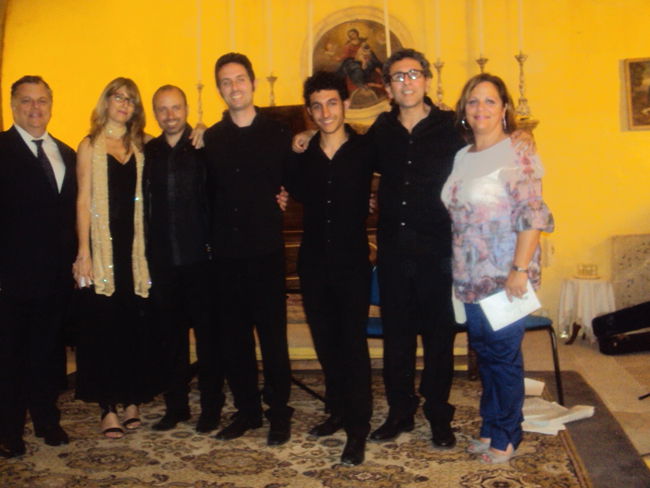
The Arianna Art Ensemble played period instruments which, except for the harpsichord, borrowed from the Manoel Theatre, they brought with them. There were two violins, a lute and a violoncello apart from the harpsichord. It was a lovely programme and the audience could not stop applauding this group of truly talented young people who gave us so much pleasure.
* * *
In her ‘thank you’ speech, Mrs Simone Mizzi, the hard working Executive President of Din L’Art Helwa and whose father, Judge Caruana Curran was the founder of this organization, thanked the musicians and said she hoped they would be back to play in our national theatre. Dr Michael Grech, Chairman of Teatru Manoel who was present, was also thanked for lending the Jacques Braux 1998 harpsichord the purchase of which was sponsored by Fimbank plc and which was purchased in Paris recently. The Italian ambassador was also thanked. This was the first time he had visited this beautifully restored chapel. Siga. de Vito, herself a mezzo soprano was also enjoying the evening as was the director of the Istituto Italiano di Cultura Dr Schirmo and his wife. Cardinal Prospero Grech was there too and the new Ambassador of Egypt Dr Magda Baraka.
* * *
In her speech Mrs Mizzi recalled that Italy and Italian thought played a great part that led to the formation of Din L-Art Helwa in its early days. It was founded in 1965, one year after Malta had gained its independence. “Italy was the first nation to have established bilateral cultural relations with Malta, and Italy will celebrate this 50 year milestone soon, for which Ambassador de Vito, we wish to be the first persons to congratulate you.” Mrs Mizzi went on to say that two events took place in the ‘60s which were catalysts to the birth of the European conservation movement. “Two mega monuments were in peril and the challenge of saving them embedded the value of heritage firmly in the minds of leading intellectuals, scientists, artists and architects many of who visited Malta.” These two monuments were first of all Venice which was already subsiding when the great flood occurred in 1966. Italia Nostra with its then President the Italian writer Giorgio Bassani, came to aid Venice in Peril. Mrs Mizzi reminded us that he is the author of Il Giardino dei Finzi Contini. Bassani was also one of the founding fathers of Europa Nostra in 1963. She recalled that another great Italian influence on us in Malta was that of Pietro Gazzola, a leading Italian architect, who was the founder of Icomos in 1965 and helped lay out Unesco’s Venice Charter in 1966. “Gazzola was carrying out the extraordinary enterprise of saving the Temples of Abu Simbel from the flooding of the Aswan Dam and this achievement inflamed the hearts and minds of those who were to establish Europe’s conservation movement including Din L’Art Helwa.”
Mrs Mizzi went on to thank several people who made evenings like this possible. “They do not happen without a lot of work of a great many committed people,” she told the audience. There were also the sponsors who provided the wine and soft drinks which were later enjoyed in the chapel grounds.
From a purely personal basis the speech touched me as Bassani’s Il Giardino dei Finzi Contini was a novel which marked me: an Italian Jewish family which led an almost idyllic existence and which, like so many Jews finished up, goodness knows where. So beautifully written too. I reminded Simone of the film which carries the same name as the novel with Dominique Sanda playing the leading role. Simone not only is well acquainted with both the film and the novel and but tells me that Giorgio Bassani was one of the many who visited her parents’ home when she was young.
Also, the mention of Abu Simbel triggered the memory of a month’s journey to Egypt after the temples of Abu Simbel were dismanteled piece by piece and reconstructed on higher ground. I went there with my then boyfriend who was to become my husband. His brother who worked for the UN and was in Egypt at the time had urged us to go and spend some time with them. Cairo, Alexandria, Aswan, Luxor – we travelled for a month, visiting and exploring staying in wonderful old-fashioned hotels where you were greeted with jasmine garlands and bedrooms were Hellenic halls and beds had mosquito nets. Our final destination was to see the famous temples of Abu Simbal. We went by plane for just one day but we were stranded there for three days. An American who was stranded with you, kept on repeating: ‘It is a status symbol, to visit Abu Simbal’. The only hotel there was still being built but we had to make do. Still, it gave us the chance to visit a Nubian village nearby. How it all ended is another story but I know the temples of Abu Simbal very well for we visited them morning, noon and night. There was nothing else to do!
The 18th edition of The International Bir Miftuh Festival had ended on a wonderful Baroque note.