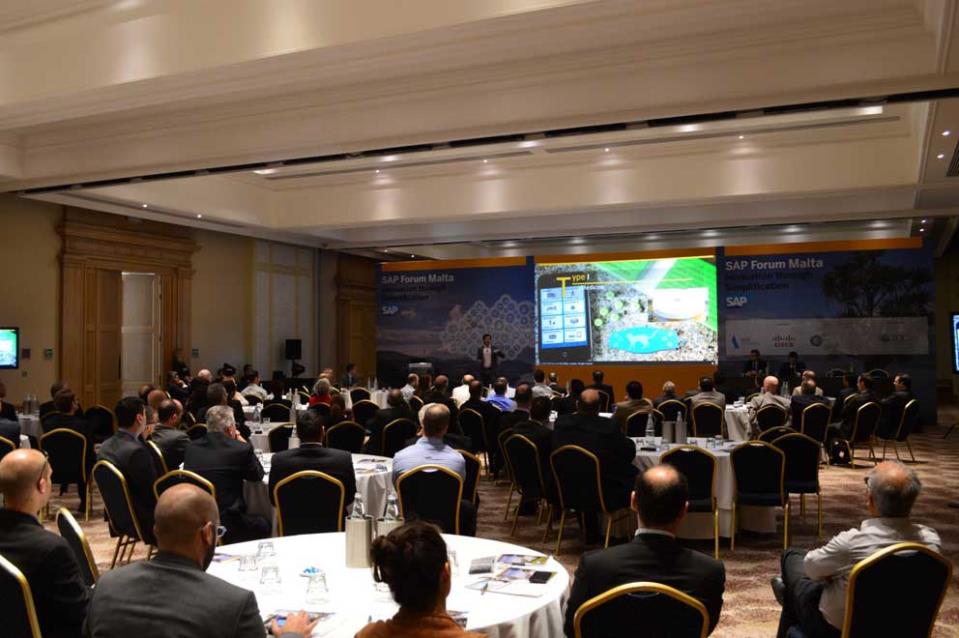
SAP has just hosted its first ever conference in Malta which addressed over a 100 industry experts. Manos Raptopoulos, COO Head and Carlos Diaz Sales Vice President Innovation for SAP South Europe speak about SAP's strategy for Malta, the country's IT competitiveness and the evolvement of the 'network economy'.
Why has SAP hosted this conference in Malta? What does it hope to achieve through this conference?
This was our first SAP event in Malta and we wanted our event to be a forum that challenges intellectuals. The conference sought to present the opportunities in the global market and the latest technological developments in the areas of cloud computing, enterprise mobility and business analytics. SAP colleagues also had the opportunity to analyse the challenges of managing large volumes of data and to discuss cloud solutions.
In what ways does SAP's strategy for businesses differ from that of your competitors?
Our solutions help customers optimize the use of resources, innovate for growth and inspire people to be their best. We extend the availability of software across on-premise installations, on-demand deployments and mobile devices and have developed a portfolio strategy that consists of synchronized investments in applications, analytics, mobile, cloud, and database and technology. The final difference however is not about technology but about the impact of our twenty five distinct vertical solutions all backed by customer feedback. In Malta, this strategy is leaving us with very good prospects and potential.
What are the main pillars of SAP's global strategy at the moment?
The first pillar is cloud technology. The biggest challenge for most companies who are trying to reach out to their customers is how to harness intelligence and big data and how to use this information in an intelligent way to attract customers and achieve sales. This is all very complex but amidst this complexity, there is SAP. The second pillar is based on reversing the trend and helping companies to spend less on cloud platforms so they can spend more on the innovation and on doing what they know best. The third pillar is security. We are a European company and we take the EU's data privacy policies very seriously. We have a lot of companies going on cloud and they want their data centres to remain in Europe. Besides being located in Europe, they also want to know that their database is even being maintained within Europe.
How do you regard Malta from a competitive perspective?
We look at Malta very positively. We have seen how the last years, Malta has recognised the immense opportunities of the IT industry and today we find it interesting how the internet and igaming sectors are contributing so much to Malta's economy. There is a lot of potential in IT as this can also attract more tourism and entertainment towards Malta. As such, Malta's competitiveness could be further strengthened if we seek to make the country a smart hub for the south of Europe. Access and customer experience are two of the most important aspects that need to be constantly improved and Malta needs to show how it can be more accessible and easy to do business with.
This conference was an opportunity for SAP to sign an MOU with MITA. What do you aim to achieve with this new agreement?
The MOU signed with MITA ties in with our help to youths. In the very near future we hope to roll out an alliance with University so that we will be able to provide students with content, online courses, to help them be more skilled and to give them tangible understandings on how to run a business. Around 70 start-ups attended a special workshop organised purposely for them as part of this conference. Through this MOU we also want to be able to expose MITA to more innovation, new technologies and to our concept of big data management. SAP has a number of programs in place aimed at supporting youth unemployment and technology spread whereas support to universities and young talents is a key component for SAP. We have a product, Academy Cube which is a real platform -the 'LinkedIn' of the unemployed - where people register their current status and can find it easier to find employment. This platform, available on www.academycube.eu, also doubles up as a database for employers and can be used throughout all Europe.
Where does Malta stand in SAP's European current and near future strategy?
Malta has had a clear IT strategy for a number of years and today is home to a very large number of successful players who are key players in their respective sectors. We believe that the Maltese economy has to be more extrovert and be more aware of its potential. We also want Maltese youths to have the right tools available and we want to help local companies improve their revenue. We do this by optimising their costs and by managing their risk which makes them more competitive and more capable of generating wealth. We also want to enable more new companies and start-ups. One no longer needs huge capitals to start off. What matters is having a great idea and having a good partner to push your idea into a reality. We have already funded 1200 start-ups around the world and we are currently helping companies to transfer their platform so we can take their product globally.
In what ways would you say that SAP is a driver of IT innovation?
40 years ago we invented Enterprise Resource Planning (ERP). Then we discovered HANA. Differently from other companies who tend to opt for more generic one-size-fits-all type of marketing, our technology allows us to think in terms of the individual and his personal and immediate needs and expectations. When one combines the world of ERP and the unique capacities of HANA, one will be effectively looking at a totally different model. In our work, we are leveraging the cloud trend to make businesses enabled in a much faster way, a lighter way and in a more effective way.
How in your opinion can technology and innovation enable growth?
More than growth, technology will allow survival. Smaller companies can be more innovative and quicker. We are witnessing smaller utility companies innovate so quickly and this enables them to remain at the forefront. This is the same philosophy that we promote even with our 1500 start-ups that use our HANA technology. When we talk to start-ups and we talk to those who really love doing what they do, we see their passion and we know that no matter where they are, they can succeed.
Tech update
Amazon recently announced a new device called Echo, which comes with a built-in, cloud connected, "always on" microphone, enabling it to listen for your voice.
Echo works in much the same way as Siri - you can ask it about the weather or for information about what's on in Valletta. However ultimately the real function of this gadget is to be your shopping list.
You can tell Echo to add the latest thriller by Dan Brown or a set of colour-coordinated towels to your shopping cart - and the gadget will find the products on Amazon and put them in your cart, ready for you to click and order.
So far the gadget cannot be used to actually seal the deal, so the user must still visit Amazon to confirm the sale, but there is no doubt that the ultimate aim is for people to be able to actually order viva voce in the longer term.
eMarketing Update
Spain is the leader of the pack internationally when it comes to Smartphone adoption. In fact according to comScore MobiLens, , 83% of mobile users in Spain ages 13 and older used a smartphone, compared with 75% in the UK and 73% in the US.
When one assesses this impressive statistic it is also important to keep in mind that Spain is also one of the countries with the highest levels of mobile penetration. In fact 85.4% of Spaniards use a mobile phone. Only Denmark, Finland and Norway have a higher mobile penetration.
It is clear that it makes sense for marketers in Spain to tap into mobile advertising. Spending on mobile ads has not been very high to date, given the recession and economic problems in the country - however it is now expected that as the country emerges from the serious economic difficulties it has been mired in, mobile ad spending will explode.
For more eMarketing news go to www.alertemarketing.com