Most of the migrants attempting to cross the Mediterranean do so because for them it is a choice between life and death, Prime Minister Joseph Muscat said today.
He was speaking during an informal one-on-one session at the St Gallen Symposium in Switzerland. Thursday’s debates focused mainly on the future of Europe and small nation states but the topic inevitably turned to the migration issue.
Dr Muscat likened the plight of the migrant to the famous photograph ‘The Falling Man’, which shows a man jumping to his death from one of the burning Twin Towers on 9/11. “That rational person made this decision that he had a better chance by jumping off from the 80th floor. Most of the migrants face the same choice – dying or giving it a go. I think that most of us would give it a go.”
The Prime Minister said he was pleased that the foreign media asked me about immigration, which shows that the subject is still on people’s minds. “12 people died last week but some sections of the media reported that only twelve died, as if hundreds have to perish in order for someone to notice and take action.” Dr Muscat said he hoped that the conclusions reached in the EU summit would translate into action and noted that some member states have already contributed assets for the search and rescue missions. “Saving people at sea is only the first step. We also have to go after the criminal networks – we estimate that the smugglers in the recent tragedy that cost the lives of some 800 people have made anywhere between €1 million and €5 million in profits.”
He said Europe must also work towards a safer Libya. “People seeking refuge in Europe should not have to cross the sea on rickety boats but should have the means to do this through reception centres in Africa. We are still a long way off but I hope that this discussion will be held in the coming weeks and months. This is where we need to head.” The fourth is development aid for Africa.
The Prime Minister admitted that terrorists could infiltrate Europe’s borders hiding among migrants but said these would be discovered. “That is what detention is for. We can distinguish between genuine and not so genuine migrants but this takes time. Malta is often criticised over its detention policy but we have a duty to see who is coming in.”
Malta ‘an oasis of hope and prosperity’
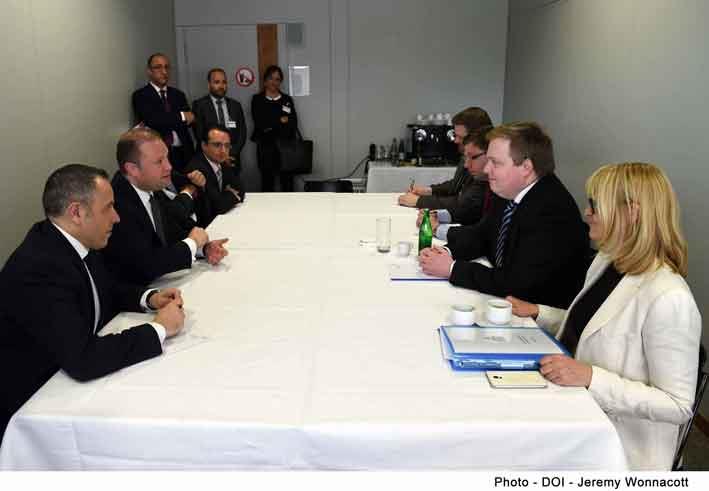
Earlier, Dr Muscat took part in a debate on small states alongside the Foreign Affairs Minister of Ghana, the Prime Minister of Iceland and the Governor of Delaware. He described Malta as being an “oasis of hope, economic growth and prosperity in a difficult neighbourhood.
Dr Muscat said the concept of small states usually translates into big-ocean states. “The potential of oceans is still largely untapped. The greatness or smallness depends on the ideas and on the neighbours,” he said. Dr Muscat noted that the European Commission’s Economic Forecast has predicted that Malta will be the country with the highest GPD in 2015. “What really drives our economy is our neighbours, so we are in a difficult neighbourhood. In our north there is economic strife, in the south there is human tragedy. We are an oasis of hope, economic growth and prosperity. Our economic future depends on how we manage our neighbours and how we position ourselves to be alternatives to them.”
On the subject of inequality, Dr Muscat said there needs to be a prerequisite for this issue to be addressed. That prerequisite is economic growth which translates into a just distribution of wealth. Flexibility is also another way to address inequality. “Malta offers stipends to students, free healthcare and free childcare – these are all addressing inequality.
Being a small state is not an option but the country’s future depends on what you do, the choices you make, not the geographical size. “We may be a small country but we can be trusted and we make our voices heard when the need arises.”
Malta is a proud EU member and its European experience has largely been positive, said Dr Muscat, who mentioned that he was against Malta joining the EU. “One has to move on and make the best of it.” There are also downsides to EU membership; “We tend to take decisions quickly but EU rules and bureaucracy tend to slow you down. This, however, also keeps you on your toes and does not allow fooling around.”
Dr Muscat spoke about Malta’s potential, which arises from the fact that it can tap into the EU and African markets. He said he had spoken to a few CEO’s during the symposium, who expressed their willingness to invest in Malta.
The Prime Minister of Iceland, Sigmundur Gunnlaugsson, spoke about the issue of migration and how small states like Malta are facing difficulties. He noted that Iceland has a vessel taking part in the ongoing Frontex mission. The Tyr has been involved in a number of search and rescue missions in the past few weeks and days. Dr Muscat said that, despite its limited military resources, Malta is dedicating all of its assets to saving lives. “I get three, four or five calls every night with information that another rickety boat packed with people is in difficulty. “Iceland was, until a few weeks ago, the only country that was helping. For a time it was only us, Italy and Iceland.”