Europe was scrambling Friday to pick up the pieces after another failed meeting over Greece's bailout that reinforced fears that the country was heading for bankruptcy and a possible euro exit.
Amid signs that Greeks are taking their money out of banks in growing amounts, the European Central Bank has scheduled a teleconference of its governing council to discuss emergency liquidity assistance for Greek banks - just two days after it increased the amounts it was willing to provide.
The scale of unease over Greece's failure to thrash out a deal to get more loans from creditors is evident in the fact that the ECB has been steadily increasing the emergency credit it allows Greek banks to draw on to remain afloat.

The ECB could turn off that support if it thinks Greece is going bust. The country needs a deal with creditors to get more bailout loans before June 30, when it has the first of a series of debt repayments it cannot afford.
The ECB would be under intense pressure to stop pumping money into a banking system that might collapse and take the ECB's money with it.
An EU official said 2 billion euros had been taken out of Greek banks in the last three days.
"Money is going out of the Greek banks faster than at any time before," said the official, who spoke only on condition of anonymity because of the sensitive nature of the talks.
The ECB meets under acute pressure to keep the Greek banks afloat ahead of an emergency summit of the eurozone's 19 leaders that's been called for Brussels on Monday.
Greek Prime Minister Alexis Tsipras tried to sound an optimistic tone despite the acrimonious failure of Thursday's meeting of the eurozone's finance ministers.
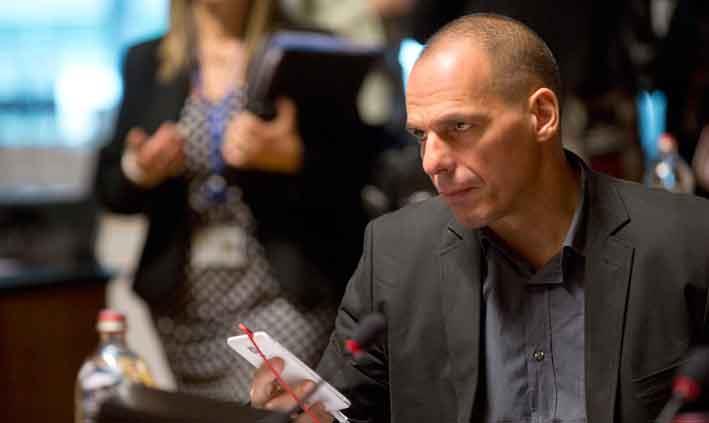
He said the summit is "a positive development on the road to agreement," claiming that those "who invest in crisis and horror scenarios will be proven wrong."
"We sought final negotiations to be at the highest political level in Europe and now we are working for the success of this summit," he said.
As finance ministers from across the 28-country European Union gathered in Luxembourg, there was skepticism about the prospects of a deal being reached on Monday. The hope is that technical talks between Greece and its creditors will resume over the weekend before another meeting of the eurozone's finance ministers on Monday in the lead-up to the leaders' summit.
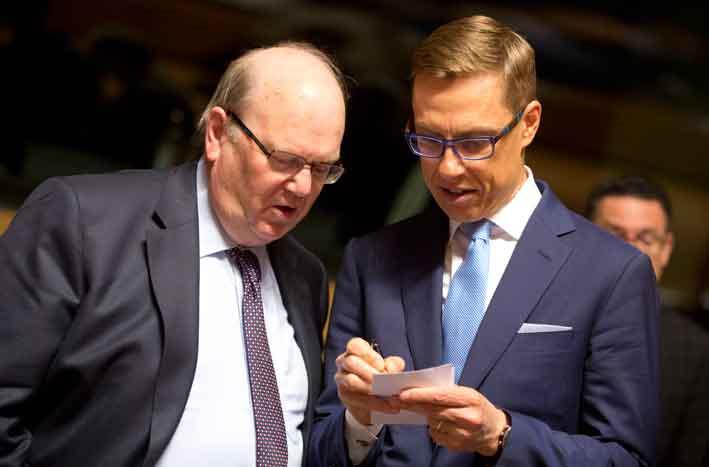
Finnish Finance Minister Alexander Stubb said that "right now it's touch and go" whether a deal can be brokered in time for Monday's emergency summit of leaders.
And Michel Sapin, France's finance ministers, said it's becoming a matter of urgency to find a solution to "this situation that is becoming unbearable."
It's not just countries in the eurozone that would be affected by a Greek exit from the euro. Many in the markets think that a so-called Grexit could be another "Lehman Brothers" moment for the world economy - sparking a potentially destabilizing chain reaction through a fragile global economy, the way the collapse of the investment bank did in 2008.
"We hope for the best but we must be prepared for the worst," said George Osborne, Britain's finance minister. "In the United Kingdom we've taken the measures to increase our economic security so we can deal with risks like this from abroad and clearly now we must go on and complete that plan."
In Athens, there were no visible signs of distress, or larger than usual lines at banks or supermarkets, despite the reports of large withdrawals, which can also be made electronically.
In the streets, newspaper headlines warned that time was running out for Greece. The daily Ethnos called Monday's summit the "Last Chance for a Deal" while the pro-government Efimerida ton Syntakton said creditors had put a "Knife to our Throat."
Athenian Giorgos Tsakoyiannis, 55, said he believed a deal would be hammered out.
"When two parties want to resolve something, there's no way it won't happen," he said. "It looks extreme, but politics is never extreme. It's a dirty game."
Investors appeared to be taking the Greek developments in stride, with the main stock market in Athens actually trading modestly 0.3 percent higher in early trading Friday while the yields on a series of Greek government bonds fell, a sign that investors may think a deal may be nearer than some of the recent rhetoric may suggest.
Greece needs its creditors to give their backing to reforms and budget cuts in return for the money it needs to meet its commitments. First up, Greece has to pay 1.6 billion euros ($1.8 billion) to the IMF on June 30. It cannot afford to pay that without a deal that would unlock the remaining cash in its bailout fund, about 7.2 billion euros ($8.21 billion).
In case of bankruptcy, Greece may have no option other than to introduce a new currency - most likely bringing back the centuries-old drachma - to pay wages, salaries and pensions.
Relations between the creditors and the Greek government, which was elected on a promise to bring an end to the crippling austerity demanded since 2010 in return for the bailout money, have worsened significantly over the past few days, with each side blaming the other in stronger language for the impasse.