A financial services arbiter will receive complaints from consumers of financial service products, make recommendations to financial service providers, and deliver binding decisions.
In parliament this evening, the Finance Minister explained that the arbiter will provide more protection for the investor and ultimately, the financial sector will benefit from the office, because if consumers trust financial services more, they are more likely to invest.
Currently, the MFSA is able to provide advice to investors, but does not have the legislative power to take binding decisions. Decisions by the arbiter will be binding and compensation mandatory. The arbiter can offer compensation of up to €250,000.
The MFSA will still hold the role of regulator and supervisor of the financial sector and publishing licences for the operators.
Each individual, as well as heirs, is eligible to put forward complaints about shortcomings in financial services offered.
Consumers now have the choice as to whether to file complaint in court or with the arbiter; however, the same case can’t be filed in both institutions.
Professor Scicluna said that financial services operators should take the initiative to introduce ethical guidelines. He said that consumers should be better informed about the financial sector and made aware of their rights.
He said that the financial arbiter should be based on the principles of autonomy, impartiality and transparency.
Micro enterprises, which employ ten people or less, can also make use of the arbiter
The Finance Minister explained that the arbiter will not take decision on the consumer’s behalf – the final decision is ultimately of the investor.
The financial arbiter is recommended by the World Bank.
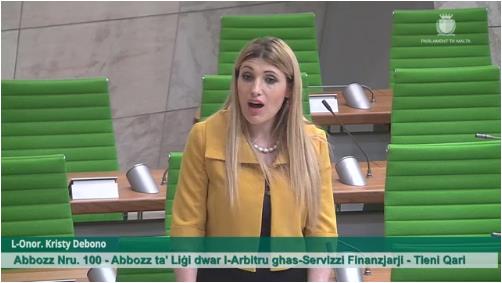
Opposition says no consultation took place
Nationalist MP Kristy Debono said that despite the opposition agreeing with the concept of setting an arbiter, the government failed to consult with the stakeholders about the legislation to set up the arbiter.
She questioned how the arbiter is providing a one-time chance for consumers to put forward cases dating from January 2000, given financial service operators are only obliged to hold records for only ten years.
She argued that the government failed to carry out the necessary research before putting forward the legislation.
Mrs Debono said that diverse financial services operators are being mentioned in the media for all the wrong reasons – mentioning the controversies surrounding Bank of Valletta.
BOV has been in the news for loan financing to Electrogas, unsecured loans to cover a shortfall in fuel hedging by Air Malta and the €260,000 early retirement golden handshake to Parliamentary Secretary Michael Falzon . The MP stressed that that she does not intent to tarnish the bank’s reputation but rather highlight the importance of an independent and transparent sector.
She said that BOV directors have the responsibility of taking care of all their shareholders and should not weaken to political pressure. She argued that members of the arbiter will be appointed by the Finance ministry, and this does not make it ‘independent’ as claimed by the minister himself.
This evening was the last session before the summer recess. The parliament will meet again on 5 October.