As the exchange of blows between presumptive nominees Hillary Clinton and Donald Trump is already in full swing, attention in the next few weeks will be on the party conventions the two main parties will host. The Republican Party will be holding its convention on 18-21 July in Cleveland, Ohio, whilst the Democratic Party will be gathering on 25-28 July in Pennsylvania, Philadelphia. These conventions will be the official launching pads for the campaign between the nominees, the start of another marathon that will lead right up to Election Day. But what really happens during a convention? Is it just another political ritual? Can we expect surprises?
The key to understanding conventions revolves around a main actor: the delegate. For the year 2016, the Republican Party (GOP) will have 2,472 delegates who will cast their vote for their nominee. The Democratic Party has almost double the number, 4,765.
The campaign for nomination starts almost two years before the election. Compared to Europe – and most other parts of the world – political campaigning in the United States is long, exhaustive and almost permanent. Some incumbents were challenged during their first term in office. Ford was challenged by Reagan in 1976 (and lost re-election), Carter was challenged by Ted Kennedy in 1980 (and lost re-election) and George H.W. Bush was challenged by Pat Buchanan in 1992 (and also lost re-election).
The race to the White House requires endurance, a good campaign team and, most of all, funding. Candidates touted as favourites early in the race may not even make it to the end of the Primaries. In February 2015, Scott Walker was considered a clear favourite to win GOP nomination. By September 2015, his campaign had been suspended. Likewise, Jeb Bush, another favourite after Walker dropped out, fell by the wayside – mainly due to a lack of charisma. His plea to the crowd “Please clap” during the New Hampshire Primary will go down as one of the tragicomical episodes of his campaign.
Between 1796 and 1824, a system called the ‘King Caucus’ convened parties to nominate party candidates for the Presidency. The Anti-Masons party held a convention in 1831, whilst the Democrats held their first in 1832. From then on, party conventions became the norm. Since 1852, every President has been either a Republican or a Democrat, and since World War II, the two main parties have obtained an average share of 95 per cent of the votes.
Party conventions are an opportunity for the two main parties to showcase unity of purpose, and diversity of motive, in rallying behind the candidate for the White House. Conventions are not mandated by the Constitution (there were no parties then), Federal or State law, but a time-honoured tradition that goes back to the 19th century. It is a choreographed event for which the speakers are carefully selected to ‘sell’ a designed narrative. It was during the 2004 Convention that Obama shot to stardom with the line: “Well, I say to them tonight, there is not a liberal America and a conservative America – there is the United States of America. There is not a black America and a white America and Latino America and Asian America – there’s the United States of America.” The rest is history.
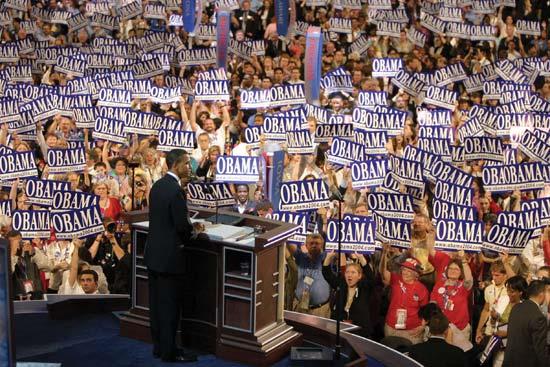
© Britannica. Obama endorsing John Kerry at the Democratic National Convention 2004 (Boston).
The convention is mostly the culmination of a process that brings to an end the primary and caucus process that would have started months before. The candidate securing the majority of candidates during the convention wins the nomination. If a clear winner does not emerge, several rounds of votes may have to be taken before one is secured. Three types of delegates play a role, though nomenclature varies according to party. ‘Pledged’ delegates are chosen at state level with an established commitment of who they will support. ‘Unpledged’ delegates (Republican Party) will vote according to the preferred candidate chosen at state level. ‘Super delegates’ (Democratic party) are high officials in the party with the freedom to vote for whom they want.
The party fanfare at the conventions is perhaps parallel to none. It is a party extravaganza aimed at propping up enthusiasm, rallying support and raising the profile of the party. Once the convention is over, the Candidate becomes synonymous with the party – or, rather, bigger than the party.
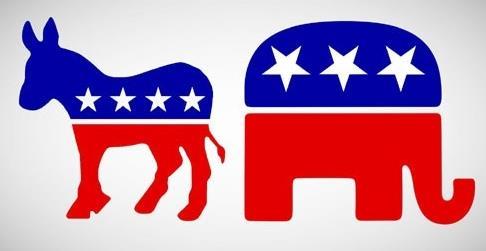
A donkey and an elephant:
Representations of the Republican and the Democratic parties are often depicted in the forms of a donkey (Democrats) and an elephant (Republicans). The two animals are often depicted in cartoons, either fighting (when no agreement is in sight) or in bed with each other (when the parties seem to be in cahoots, especially on key issues such as gun control).
The political iconography has its origins almost two centuries ago. In 1828, President Andrew Jackson had no problem with his opponents calling him a ‘jackass’, to the extent that he embraced the donkey as his political symbol: a determined, steadfast and obstinate character hardly movable by his adversaries’ invective. The donkey was then taken up in 1870 by Thomas Nast, who drew a donkey kicking a lion with the caption “A live jackass kicking a dead lion” – the donkey intended as a disparaging reference to the Democrats in their disregard towards the recently deceased Edwin Stanton, Lincoln’s War Secretary. In 1874, Nast drew the cartoon of an elephant, the Republican vote, running scared towards a pit of chaos and inflation, frightened by a donkey-in-lion’s-clothing (the Democrats). The imagery of the donkey and elephant stuck and is still used up to now as the respective party symbols.