I’ve been to quite a number of graduations these last years. I love to share this special moment with my students who would have worked their guts out to achieve the ultimate price, essentially a scroll declaring that ‘they’ve made it’. The pageantry, the speeches, the smart attire and the effort to look at one’s best is all part of this feast of accomplishments. It is indeed a moment to celebrate with family and friends. Looking in the eyes of the graduate one would see so much satisfaction and happiness - because life is about these achievements, it is about completing the targets we set ourselves to. All of this success is packaged with bus-cades, parties, celebratory meals, family reunions, photo shoots and the now traditional visits to the Prime Minister and the Leader of the Opposition. It is indeed a great occasion.
However, last Friday, together with my wife I was invited to a different type of graduation but equally significant, momentous and important - or might I say a bit more than the ones I usually attend to in November and December. These people we saw graduating had learnt it all on the road, l-Univerista’ tat-Triq (the University of the Streets) they like to call it. They are people who through their mischievousness or misjudgement, life circumstances or intermingling with the wrong crowd have come to find themselves in an abyss, some abandoned, deserted and discarded, several abused, ill-treated and battered, various lonely, forlorn and friendless. They end up resorting to ‘smack’, ‘coke’ and an array of illicit drugs. One could very easily point one’s finger towards these people, mostly youth and accuse them that they were silly, hare-brained and loopy. Some or many would say; ‘They should have got their act together and asked for help if they were feeling bad’ or ‘Where were their parents?’ or ‘It’s all their fault, they have to deal with it now’ or better still, ‘They must have been more careful not to get loitered with the wrong company’. I suppose it’s OK to express oneself even if to me it sounds incredibly insensitive. We will only understand the gravity of this situation when it hits close to home. Everything changes; dark clouds cover all the light and all turns into darkness, sadness and gloom.
Mind you, I do agree that people need to be responsible for their behaviour. It is terrible that personal issues become community troubles. Nevertheless Nevertheless owever Nevertheless, when one notices how these people sink so deep it becomes a pitiful wretched sight.
It is a fact that addicts to sustain their habit cause a great deal of heartache to innocent people. Not only does their addiction drive them to unvarying criminal behaviour but many also end up traffickers themselves to maintain their craving, which is wicked.
In this equation it is also important to factor in the cost of dealing with addiction in our society which is astronomical; whether it is the expense related to social policy and benefits; whether it’s the funds dedicated to Agenzija Sedqa, Caritas Malta, Fondazzjoni Oasi to run their programmes and services; whether it’s police enforcement and correctional facilities. I still feel that this is money well-spent. I have worked for some time at Agenzija Sedqa and I know what a life changing situation this issue is.
I remember working with 14 and 15 year olds who were already speaking about ‘smack’ as if it was their girlfriend.
I saw very promising footballers get withered and emaciated as they started residential programmes.
I heard young men cry out for their mothers like babies as they got detoxified with naltrexone.
I’ve seen people at Mt Carmel Hospital going round the bend because they did not have access to drugs.
I’ve witnessed young desperate addicts spitting out methadone back into the plastic containers after pretending they had swallowed it in front of the nurse to generate some cash.
I’ve been told stories of young girls who went into prostitution to maintain their dependency.
Unfortunately, what they all had in common is that they speak of a surreal and bizarre bond they had with the drugs they consumed. Drugs seem to give them peace and tranquillity, at least momentarily. It takes them to a world of no ifs or buts. They fantasise that they can slip into their comfort zone and be protected from everything around them. It becomes their girlfriend, their mother, their mentor – all in one. No wonder it takes them so long to let go and only after they would have hit rock bottom do they start considering rehab, and this when they would have proably consumed all their support systems.
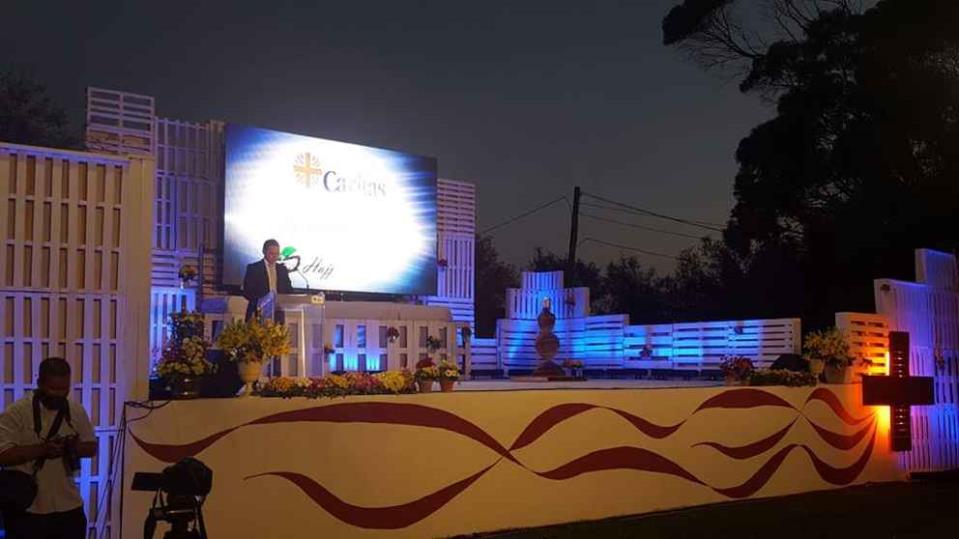
Back to Friday’s graduation ceremony held by Caritas at San Blas.
It was a packed event with heart wrenching testimonials, a decisive speech by the Director of Caritas Leonid Mckay and an acknowledgement of the vision of Programme Director Anthony Gatt, co-ordinator of the drugs rehabilitation programme, the gentleness and determination of Santina Camilleri, Youth Worker by profession and Head of Re-entry and aftercare and the many other workers who work in silence. At graduation, the general atmosphere of anguish and distress mixed with hope could be felt. It was an ensemble of emotions. As I sat listening and seeing these young people talk about their struggles I felt sad, happy, angry, tormented, guilty all at once. These young people struggling with addiction might have been excited because of the attention they were getting on the day.
However, behind this well-organised event (coordinated by the dedicated PRO and fundraising executive Marica Mizzi) there are a whole set of narratives. It would be wrong to believe that what we saw Friday was all there is to it. For every person who graduated a host of others are either struggling with the issue and possibly not even asking for help, wrongly believing they can do it on their own. There are others who are close to death because they have arrived at the pits or have relapsed and all the work done by them and for them has been thrown out of the window.
For every narrative of success we witnessed with pride on Friday, so many will fall out of line again.
For every story of success, so many mums, dads, siblings, sons and daughters will see their loved ones failing, in trouble and crumpling.
Drugs is a killer.
Not sure we understand the magnitude of the problem we have on our hand. It seems that the more money we throw in awareness campaigns, therapy, security and enforcement the more available it becomes. I‘ve heard one too many say that getting your stock of drugs cannot be an easier thing to do - it is there at your back and call.
The lovely event organised by Caritas is a day to celebrate but also one to mourn as it signals that the problem is a massive one and it seems to be overtaking us.
Defending ourselves from this scourge is way too difficult. I do not want to sound doubtful but it is a problem that is eating us up, it is destroying our communities, it is penetrating our institutions, it is collapsing one family after another.
Our young people, their families and communities are being faced by a massive debacle. To add to this the large influx of tourism and the ever growing leisure industry nurtures a culture of drug-taking. If you want to oil your fun, take drugs, is the message that seems to seep through.
I don’t think we can ever win the battle because our ‘army’ is scattered and speckled.
This might be too much to ask for but I think we need to admit that we are failing and our institutions are not managing to deal with this crises - a call Caritas has been shouting from the roof tops for years on end.
What Caritas is doing is definitely punching way above its weight. However, we cannot expect the solitary success stories to make us rest on our laurels. It is a problem that is bigger than life - it takes life! We need a proper inter-agency organisation, a well-equipped policy unit that is provided with the best and most up-to-date technology. We need to have leadership, convinced politicians, strategists and ex-users to sit around a table and provide solutions to an otherwise unruly situation. No other way of saying it, but we are losing the battle every time we lose someone to drugs.
For more information about Caritas Malta Support Groups you may contact the Counselling and Social Work Unit on Tel no. 2590 6600 Caritas Malta - 5, Triq l-Iljun Floriana - Email: [email protected]
The Department of Youth and Community Studies (Faculty for Social Welbeing) will be offering two courses related to this field; a BA in Youth and Community Studies (day course) and a Master of Arts in Youth Justice. For more information contact [email protected]