Written by Sarah-Jane Farrugia,
MITA Digital Outreach
Over the past year, MITA has been leading the Erasmus+ Strategic Partnership project entitled "Game Based Learning to alleviate Early School Leaving" (GBL4ESL). This is a two year project that kick-started in September 2015 with the collaboration of the University of Malta and St Margaret's College locally, and Donau University in Austria and Nystromska School in Sweden.
The aim of the project is to create two main project outputs: a game based learning scenarios guidebook and an open-source toolkit based on international best practices and research; this will be made available to educators. The overarching aim of the project is to reduce the number of early school leavers from secondary schools. The online interactive toolkit will serve as a stepping stone to encourage students to continue their studies by embedding English and Maths with ICT.
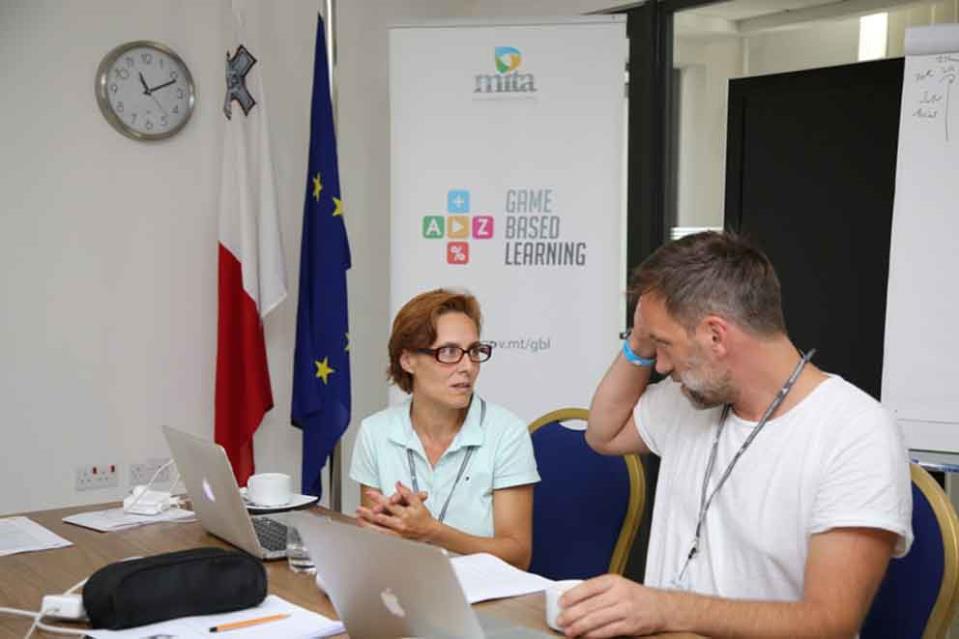
This month, between the 12th and 16th September 2016, MITA held a five-day learning, training and teaching activity with the sole aim to train the educators participating in the project. A total of 14 educators from Malta, Sweden and Austria have received training on game based learning (GBL) methodologies and the project's outputs. Feedback received from the educators was very positive; the educators found the practical sessions extremely interesting and fruitful.
During the training sessions, Dr Vanessa Camilleri from the Faculty of ICT at the University of Malta spoke about the Game Design Learning Principles published by Professor James Paul Gee. Two of these learning principles stand out in particular, these being, problem based learning and empowerment of learners. The latter principle means that for GBL to work, students themselves must choose to learn, whilst the former principle means that students will solve problems using their knowledge.
Furthermore, Dr Camilleri explained how pivotal the role of the teacher is in the classroom, the teacher needs to act as the champion for the educational game to work as this will not sell by itself. The teachers' role as an educator is to present the game as an exciting tool for the students to learn and get immersed in it. Following which the teacher has to derive and construct meaning from the activity carried out.
The educators who attended the five-day training also had the opportunity to learn how to integrate popular commercial games such as Pokemon Go in the classroom, as explained by experts from Donau University, Austria. Mag. Alexander Pfeiffer and Mag. Thomas Wernbacher provided a guide through by explaining how to integrate augmented reality games in the class sessions. Mathematical concepts such as calculation of distance travelled and understanding angles are two examples of how learning can be derived from games.
For game based learning to succeed, parents also need to involve themselves, and listen to their children as they recount the game played. This is the part where the student would be thinking about the game played earlier, identifying the problems solved and the process carried out to solve it. This thinking process increases the children's communication skills, verbal proficiency and imagination.
Game based learning is an exciting approach to learning. Children discover how to apply their knowledge and use critical thinking skills to solve problems whilst abiding to game regulations and playing the chosen game.
Any educators interested to attend future Game Based Learning events organised by MITA can contact us on
[email protected]