Written by Claudio Laferla,
MITA Knowledge Management Centre Executive
Technology is evolving exponentially. Taking up Moore's Law, which states that a computer processing speed doubles every 18 months, just shows how fast change happens in the technology sector.
WiFi was discovered by AT&T in 1991. It operates by using a high-frequency radio signal. It is the router that sends the signals that carry the data to and from the Internet. The WiFi is limited only by the power of transmission, the antenna type, the location and the environment in general, example thick walls or very high buildings.
LiFi or 'Light Fidelity' was coined by Professor Herald Hass of Edinburgh in 2011 TED Talk. It is 100 times faster than its predecessor! However, it is good to note how it works. LiFi is based on a 'visible light communication', meaning that it needs light to work, and more precisely, LEDs. Data is transferred through the LED light beam and then, through a photo-detector (known as a photodiode), it is converted again by the receiver into electrical signals. These signals are then converted once again into the binary data stream, which may be in the format of a video clip, audio or any online application.
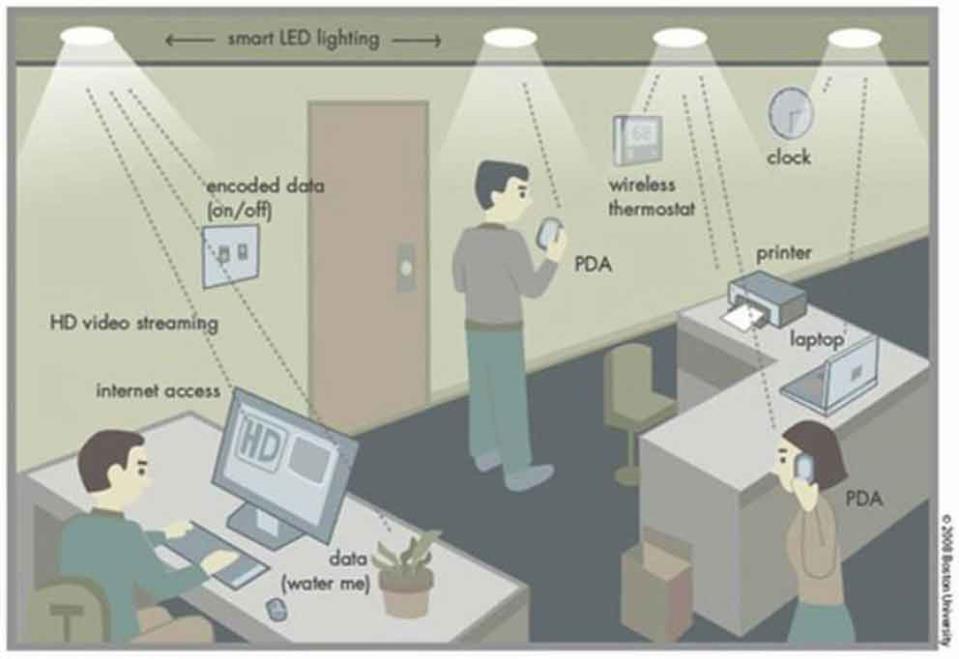
Given that LiFi utilizes LED bulbs, its use is more secure because the device needs to be constantly under the light in order to send and receive data. LiFi also does not pass through walls. Moreover, using LED bulbs means that each bulb is a hotspot in itself and ready for use!
While it is easier to have the home and work environment equipped with the necessary LED bulbs to ensure proper data sending and receiving, however applying the LiFi strategy elsewhere will prove to be a challenge! Yet, it was reported during testing that LiFi can still achieve 70Mbps when light beams are reflected off a surface.
If you are interested in learning more about the power of LiFi technology, you can visit TED Talks at http://bit.ly/24Vi0tW.