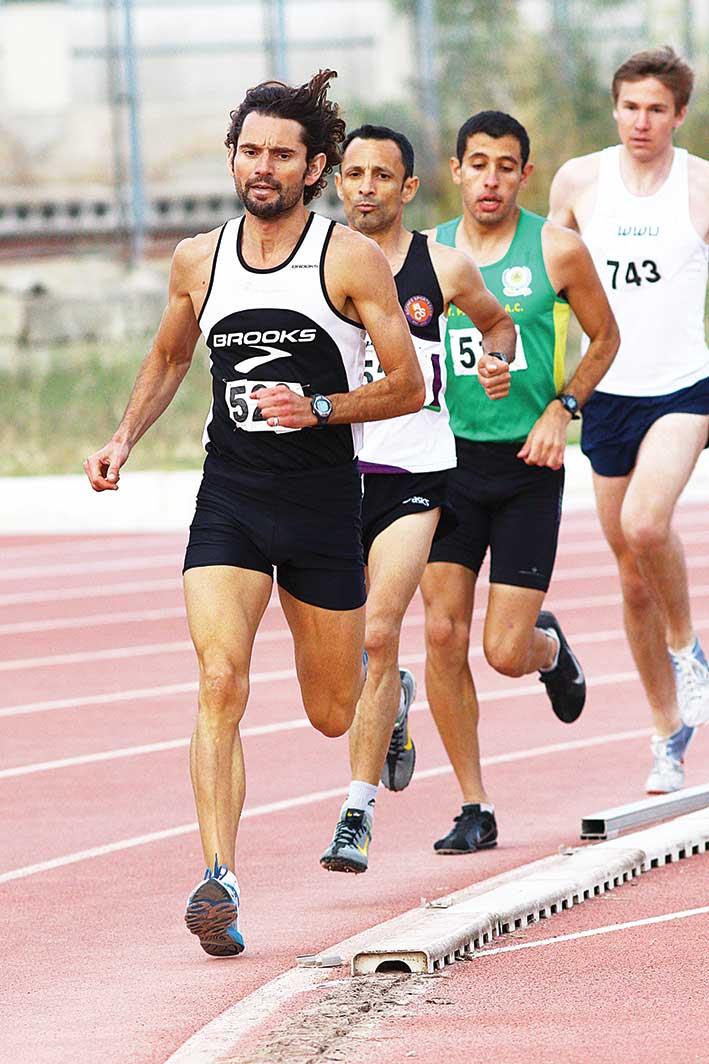
Gerald Grech, a 42-year-old lecturer in Marketing at the University's Junior College since 2000, and an active athlete since his mid-teens, has successfully represented Malta in several athletics events abroad.
Gerald is always on the lookout for adventurous new challenges. Gerald is fresh from a podium 3rd place in the first edition of 'Beat the Lift" tower race in Malta, ascending 20 floors in 1 minute 26seconds, just 4s from winner!
Gerald, who obtained a Hotel Management Diploma at the Institute of Tourism Studies (Malta), graduated B.Com. (Hons) and PGCE in Business Studies from the University of Malta, is interviewed by Raymond.
1. Twenty-five years of competitive running is quite a record, especially for someone like you who has to do this during his limited free time. Such perseverance is surely the result of determination, discipline, consistency and love of running. How did you manage to remain so motivated over the years, now that the running community has an impressive number of athletes who are performing better than ever?
Thank you for this opportunity to talk about my sports career. For all these years, I just did what I love doing, with all the commitment and desire to achieve my very best. It all started some 30 years ago at a school sports day; a few years later, in 1991, I decided to start taking training seriously.
My international running career started when I had just turned 17 and was selected to compete in the 400m event at the 1993 Youth Olympics held in Holland. A couple of years later I represented Malta on the same distance in the 1995 Small Nations Games in Luxembourg. Since then have I never looked back, representing Malta in several other international events including the University Games, European Cup and World Mountain Running Championships, keeping myself motivated all the way by striving to give my best performance in every race.
2. What does your typical weekly training schedule consist of in terms of preparation for your prioritised races?
For many years, my training schedule consisted of daily runs including two main high intensity workouts per week as well as double sessions four days a week. I also included regular gym work, biking and swimming sessions.

3. Gerald, I reckon few can match the different running distances in which you competed and distinguished yourself in. You started with the 200m and 400m where you won junior and senior titles and proceeded with the 800m and 1500m. On both the 800m and the 1500m you registered some of the fastest all-time Maltese performances (800m - 1:54.76 and 1500m 4:01.02). In time you changed to longer distances, namely the 3000m, 5000m, 10000m and the half marathon (21.1 km). As if those were not enough, you then embarked on mountain running, even though we don't have any mountains here! Which results do you cherish most? Were there times you could have improved your personal best?
Besides my middle distance personal bests you mentioned achieved in Belgium, some other memorable performances were 8'43"44 in the 3000m which I ran in Belgium in 2004, 15'17 in the 5000m, 32'25 in the 10,000m both on the track in Malta and finally the Malta international half-marathon in 2011 where I was first Maltese and second overall with 1'13"44. Another memorable performance was at the 2014 World Mountain Running Championships in Massa Carrara, Italy running 11km uphill in a white marble quarry!
My main regret in my competitive running career was not breaking 4 mins on 1500m, especially when I knew I was prepared on several occasions to run at least 3'55. It was probably more of a mental barrier.
4. Given your AS Libertas club affiliation with coach Ivan Rozhnov and the many years attached to these two, one may surmise that commitment and loyalty to club and coach is imperative. Lately we are seeing fewer club stalwarts and athletes migrating from one club to another and from one coach to another, in the belief that things can be improved. What are your views about this? Over the years one might have a few arguments with both club and coach but proper communication should sort out matters. What about your own relationship with the club and the coach, who happens to be highly regarded?
Loyalty and commitment are two virtues that I value most. I joined AS Libertas club in 1992 under the guidance of my uncle Emy Azzopardi who introduced me to the amazing world of athletics. In 1995, I started training with Ivan Rozhnov and have been under his professional guidance for the past 23 years. Indeed, commitment and regular communication are key in developing healthy relationships and in the long term they always result in a win-win situation for both coach and athlete and club.
5. Last year you had a serious injury and you had to be operated upon. You had mobility and to use crutches. The rehabilitation process was long and arduous. I had met you at a gym in the heat of summer doing some exercises and here you are again, recovered in full and doing great. Gerald, another remarkable indication that you want to be a sort of local Forrest Gump, running against all odds. If am not mistaken, you took a risk undergoing the operation in order to continue running. You were positive during rehabilitation, you were determined to pursue running and your patience proved you right. How do you feel about hitting the tarmac again and competing in races?
In July 2017 I completely ruptured my Achilles tendon during a 1500m track race. It was quite a blow for me to be forced out of running for an indefinite period. Nevertheless, from day one after the injury, I was convinced I would be back on the road stronger than before. I was operated upon a few weeks later by the able surgeon Mr Mark Portelli, to whom I owe my second life in sport.
It took eight long months of patient rehabilitation and physiotherapy to get back on track. I started running again in March this year and in June I was back on the starting line in the Mtarfa 5 km, registering an unexpected 19'35. This October, on the first leg of the Road Running League, the Maqluba 5 km, I registered 17'12, which is actually my best time for the distance in the last four years.
Currently I am still building slowly, running just three times a week, while on the other days I cross-train -- mainly swimming, cycling and gym work. I feel mentally stronger than ever before and determined to get back with the top runners and to represent Malta again in international competitions.
6. Some years back, you took the initiative to set up a Mountain Running sub-committee within the Malta Amateur Athletics Association and were part of the first national team to put Malta on the international mountain running scene by competing in the World Mountain Running Championships. Now you are organising a qualifying hill race at Bingemma attracting some 100 athletes where even the elite runners are striving to give their best. World Mountain running has attracted the likes of Andrew Grech, Charles Cilia, Lisa Marie Bezzina, Monalisa Camilleri, Luke Micallef and many others. This means that your efforts have borne fruit. Let's be frank, certain local coaches discourage their athletes from taking part in local challenging races let alone to compete in Mountain Running. Yet now local athletes are eager to participate. What happened?
The history of mountain, trail and sky running goes way back. In fact some of the established mountain races like Trofeo Vanoni, in Morbegno (Italy) celebrated its 61st edition this year while the Snowdon Race in Wales reached its 43rd edition. Team Malta took part in a few editions of both these classic races.
For Maltese runners, it all started in 2002, when MAAA selected Peter Azzopardi to represent Malta in the World Mountain Running Championship in Innsbruck (Austria), and the following year in the European Mountain Running Championships held in Trento (Italy).
Eventually in 2012 an agreement was reached between the IAAF, the World Mountain Running Association (its president at the time being Bruno Gozzelino) and MAAA (its president then was Anthony Chircop and general secretary - now president -- Edwin Attard) and the Malta Mountain Running sub-committee within the MAAA was set up. It was recognised by WMRA and MAAA. In fact, I really would like to express my gratitude to these three key people who have been at the beginning of it all.
Since then we have never looked back. Maltese top runners Giselle Camilleri and Charles Cilia took part in the 2012 World Championship in Ponte di Legno and today Team Malta regularly takes part in world and European championships and other major competitions. In 2013 we started organising a national championships qualifying race from Bingemma to Kuncizzjoni, attracting around 100 athletes. The seventh edition of the National Championships will be held on May 18, 2019.
The results of the Maltese athletes in international mountain running competitions have been steadily improving over the years. In fact this year, top runners Lisa Bezzina and Luke Micallef managed to secure the 11th and 19th positions respectively in the World Cup Mountain Running races.

7. Sports in Malta is rarely a bread winner, even more so for runners who have to pay from their own pocket for their sport. This means that from a very young age athletes need to follow a dual career path: studies and sports. In your time, things were much more difficult. There was no internet, so one had to learn from teachers or books. Apart from this, however, you graduated from University and became a lecturer at the Junior College, managing to make a career and cultivate your passion at the same time. How did you manage to juggle studies and sport especially when you were selected to take part in international races? Was it ever problematic to cope with both? What advice would you give to young people who wish to venture into sports?
Once you are really determined to achieve and set your priorities right, you will find a way to structure your day to combine work, studies and sport. I recall the regular 6 am training sessions before work and university which actually helped me start the day with a clear mind to face the working day ahead.
My advice to youths is to take up competitive sports seriously, as it is an excellent recreational and stress management tool that can help you build inner strength and self-discipline, essential qualities to a live a fulfilling life.
Finally, I'd like to thank the Malta Amateur Athletics Association for developing athletics in Malta as well as my family and my coach Ivan Rozhnov who have supported me throughout this journey.