European pension systems are facing the dual challenge of remaining financially sustainable and being able to provide citizens with an adequate income in retirement.
The key purpose of pension systems is to protect older people from poverty and to allow them to enjoy decent living standards and economic independence when ageing. Financial sustainability of pension schemes is the indispensable means to this end.
Pensions affect public budgets and labour supply in major ways and these impacts must be considered in pension policy. The main goals of pension and retirement policies are to (i) to provide adequate income in old age, while ensuring (ii) financial sustainability and (iii) maximising employment (i.e. through incentives in support of stable formal work careers and longer working lives for women and men).
Sustainability relates to the fiscal and financial balance between revenues and liabilities (and the ratio of workers/contributors to pensioners/ beneficiaries) in pension schemes. To be sustainable in the long run public pension schemes must be able to absorb the impact of population ageing without destabilising public finances.
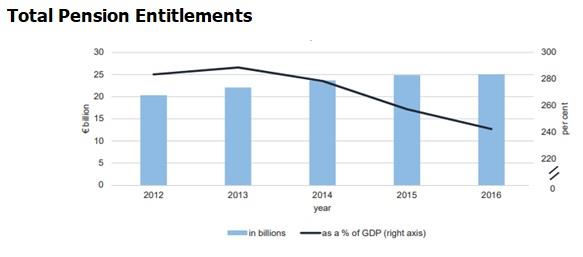
The recent release by the National Statistics Office of the accrued-to-date total pension entitlements arising from social security pensions and Treasury pensions shows that entitlements have risen by €4.74bn (+23.3%) over four years to 2016. The increased entitlements reflected the growing trend in employment.
In spite of the hefty increase in entitlements, pension entitlements as a percentage of the Gross Domestic Product have fallen from 283.4 percent of GDP to 242.3 percent over the period.A growing economy has meant that the relative burden of growing pension entitlements became less pronounced over the last few years.
Comparing Malta’s entitlements as a percentage of GDP to that of the other member states in 2015, when statistics for all countries was available, Malta has the 11th lowest percentage. Denmark has the lowest percentage (95.5%), whereas the UK had the highest one (400%).
The NSO statistics raise the question whether Malta’s pensions system is adequate and sustainable. Europe as a whole has been grappling with these issues for years and the debate is ongoing. The outcome of certain ‘boldmeasures’ illustrates the need to tread carefully.The post-communist countries’ and the Swedish example show that ‘reform bundling’ rather than parametric adjustment is often the more viable reform strategy.
Single, headline adjustments often lead to resistance, while reform packages make it possible to address the concerns of a large spectrum of stakeholders. Successful reforms thus need careful mapping of attitudes to reform options and detailed designs to spread the cost of reforms in a politically expedient way, preferably evenly over cohorts.
As a result, rather than, for example, changing retirement ages, focus has shifted to modify contributions or benefits, with more focus on contribution periods. There is more emphasis on getting people to save (auto-enrolment) or creating incentives to work later. There is a reduced tendency to adopt wholesale systemic reforms but, instead, adopt automatic rules. And more emphasis is being laid on minimum pensions and ensuring poverty alleviation.
The pension system reforms drawn up in Malta in 2015 were inspired by the objectives of (i) ensuring an adequate and sustainable pension system sustained by a strong employment policy; (ii) making the State pension a solid foundation, but not the only source of retirement income; (iii) providing a fair balance between contributions and benefits across generations in a socially-sustainable way; and (iv) building a system that is able to evolve, particularly to respond to long term developments.
The Pensions Working Group is currently working on its next report, analysing the results of the 2015 reforms, reviewing current and future trends, learning from successful practices overseas, and assessing economic, social and societal trends in Malta which may have an impact on pensions. This will enable the Group to reach its conclusions and make recommendations which can then be discussed by stake-holders, prior to decisions being taken on further reforms.
The reforms to the Maltese pension system have started to move it away from its passive conception of a society that has, in fact,changed in a dramatic fashion. With the introduction of credits and the modification of benefit accrual, it is less focused on the needs of a full-employment economy where the husband is the main breadwinner and has a fairly stable career and level of wages. It has recognised the caring responsibilities of parents,mostlywomen, in the case of breaks taken to care for children, and it has recognised the time people need to devote to acquire skills and qualifications, especially in the pre-employment period.
It does not appear that Malta needs to change the basic principles underlying the 2015 reforms, but rather that certain new elements may be introduced in a gradual manner to provide a more comprehensive solution to current and future needs.
Given the important contribution made to pension adequacy and sustainability by the Government’s strong employment policy, it is evident that the momentum achieved over the last five years in raising the employment rate, the female labour force participation, and upskilling of the workforce, need to continue.
Further efforts will need to be made to ensure that the state pension’s solid foundation is buttressed by other sources of retirement income, including new forms of saving, unlocking the earnings potential of real estate, and modifying fiscal incentives to make savings more advantageous for younger workers. Certain recent initiatives in these areas are a good start.
It is important that the Maltese pension system evolves further in order to respond to long-term developments. Thus, on one end the more highly qualified jobs being created and the overall improvement in pay packages require policy responses that address the capping of the system while on the other end, the higher incidence of a-typical work necessitates a better coverage in terms of pension income. There also needs to be a response to the challenge of long-term care while addressing the impact of household break-ups.
Rather than focusing on relatively blunt parameters, such as the age at which benefits can be accessed, the approach that has been adopted and remain valid for the future is that of giving more flexibility and individual choice to individuals. It is one that appears to have a consensus amongst the social partners.
Mark Musu’ is the Chairperson of the Pensions Strategy Group