One surely understands that the Budget 2023 is being presented in an abysmal international economic climate. Just as the world economies were starting to recover from the pandemic, during which many governments increased their debts exposure dramatically to keep their economies afloat, we were all faced with a war in Europe that is creating an energy crisis with very wide-ranging inflationary effects. The Budget does absolutely everything from a social perspective to safeguard as much as possible the weakest in our society. In actual fact, the criticism on this front is that when trying to safeguard the weakest by subsidising energy and fuel costs for everyone, it would be doing so also for those consuming energy beyond certain levels due to their well off and luxury lifestyle.
However, the pinnacle on what the Budget forecast was presented upon is that the projected growth in public debt from around €9 billion in 2022 to around €12 billion in 2025, would be sustainable as the economy is forecasted to grow from the level of a GDP of around €16 billion in 2022 to around €20 billion in 2025 (as shown below). Such a forecasted growth in GDP would make it possible to keep the growing debt level within sustainable levels and hence within the 60% debt-to-GDP mark.
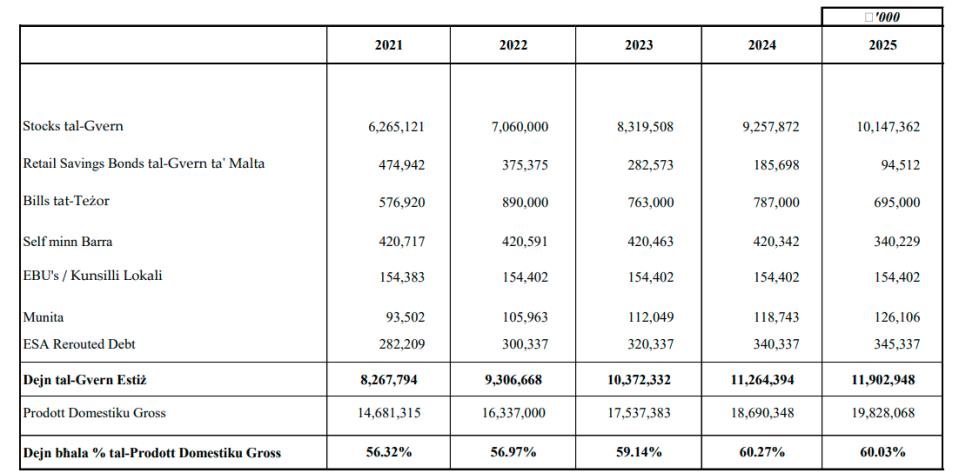
However, I feel it is very important that we get a good grasp as to what the projected growth in Malta's economy until 2025, really means in practical terms. As can be seen below in 2021, we had a GDP level of almost €15 billion which was possible through around 260,000 full-time equivalent employed people. This means that on average every employed person in the economy contributed around €56,000 to Malta's GDP in 2021.
If we are to assume that the production levels will keep increasing year-on-year by 2.5% (similar to the increase in production we had in 2019), this would mean that to achieve the forecasted GDP level of almost €20 billion in 2025, the economy would need to increase the amount of full-time equivalent employed people by around 60,000 persons over the level of employed persons in 2021. This would mean that Malta’s population would increase to around 580,000 from the level of 520,000 we had in 2021. This is a calculation based on a number of assumptions, mainly being that inflation will be as predicted by Government and that nominal GDP forecasted is not partially achieved by other means, like the curbing of the black economy.
|
|
2021
|
2025
|
|
GDP
|
€ 14,681,315,000
|
€ 19,828,068,000
|
|
FTE in Employment
|
259,868
|
317,960
|
|
GDP per FTE
|
€ 56,495
|
€ 62,360
|
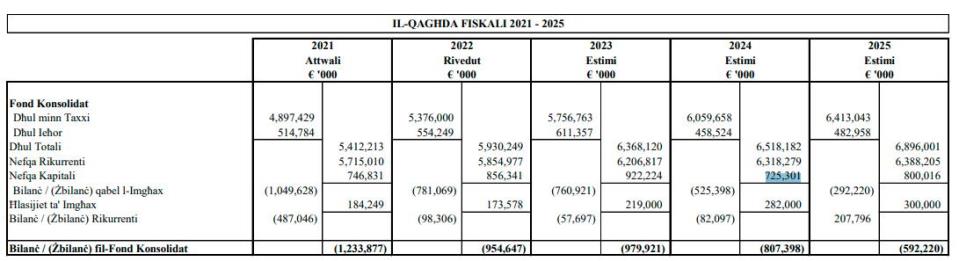
Such an increase in population would obviously mean a greater stress on the country's infrastructure at all levels. It is curious however that with this added increased stress on infrastructure, one would expect Government's capital expenditure to keep increasing. Instead, Government is forecasting a decrease in capital expenditure in 2024 as shown below.
Government has obviously an alternative route. Instead of pursuing growth based on the present economic system, to instead implement an economic strategy that adds more value added to the economy per person employed in the economy. This would mean pursuing new economic sectors that provide more value added, plus restructuring present economic sectors that to become more efficient. This would also mean adopting an economic policy of having people employed mostly within the economic sectors that provide greater value added. As a purely academic exercise, if Malta's GDP is to grow to around €20 billion, whilst not increasing the 260,000 persons employed in the economy, this would mean that Malta's economic productive output would need to increase by 7.8% year-on-year until 2025. This contrasts sharply with the increase in productive output of 2.5% experienced in 2019.
In this Budget there are some signals that Government is trying to going down this route, by getting more serious and coordinated on start-ups and aiding businesses become more digitalised, efficient and environmentally friendly. Will this be enough?
The message on the wall is quite clear. Whilst in the past it was easier to grow Malta's economy by increasing the number of people active and participating in the economy, it will increasingly become difficult to pursue the forecasted economic growth based on this model. The challenge staring us in the face is to achieve the forecasted economic growth by increasing productive output, which means the implementation of a new economic strategy. At the end of day, it is either that, of having debt levels which are completely unsustainable, which would create more problems that the ones we are trying to avoid at the moment.