Through years of experience working alongside, for and with entrepreneurs and business leaders, it is by now evident to me that ongoing learning and personal development are the most underestimated factors contributing to business growth. Personal development seems to be given secondary importance by the vast majority of SME and family-run business owners.
Learning unlocks opportunities and possibilities. In this article I will delve into common hindrances, the phases of lifelong learning, and the importance and benefits of this aspect.
Entrepreneurs are normally experts in their field, but that does not mean they are versatile enough to conduct all the functions of management. Being an all rounder is crucial when running a business, though it does not mean being a master of none. Knowing your business and all its facets inside out is always necessary. But when growing (most often through bootstrapping) a business venture, one needs to wear multiple hats, especially until growth permits the creation of a new layer in the organisation, whereby functional managers will be introduced to run the respective functions.
In the SME sector, being a jack of all trades does not carry the negative connotation often associated with the phrase. On the contrary, it is what fuels your development and learning process. Knowing the technical side of the business is not enough to take the leap and grow the business through its stages of development. This brings me to the citation of Larry Greiner’s seminal work on the analysis of business growth. The model consists of six stages of growth encompassing the stages of a business’ maturity. The phases are: creativity, direction, delegation, coordination and monitoring, collaboration and extra-organisational solutions. The principle is that after evolving into the next stage of growth the business will go through a crisis/revolution.
Obstacles to personal growth
The major obstacle blocking entrepreneurs from grasping the obvious benefits of ongoing learning is the fact that business owners generally report to nobody - they ultimately set their own priorities and targets. Feeling omnipotent in your own world makes you feel as though you know it all, after all (or so you think) nobody’s ever going to fire you. This in turn leads to two common traps for entrepreneurs, first is the loneliness the leader will end up feeling at the top and the second is the risk of being told by the people around them what they need to hear, not what the truth really is. This creates an echochamber which often leads to a business leader operating in a parallel reality
“Eventually the market may obliterate you altogether if you’re out of sync with its trends and forces!”
Personal development starts by an inner and personal conviction. The first step is a realisation of its necessity. I compare it to a process of conversion. Nobody converts to a religion by the fateful flash of light, people change their minds, beliefs, approach and opinion because they take a degree of interest into a particular belief and then start feeling changes in their life. So the first step is convincing the entrepreneur of the benefits and instigating a degree of curiosity.
Stages of Business Growth and its relation to personal development
Entrepreneurs who experienced and learned the ropes of the business in three-sixty fashion, will find it smoother to navigate through the crisis phase encountered when transitioning from one stage of growth to the next. This can be seen illustrated in the diagram below. The speed at which the first crisis is encountered depends on a number of factors such as the level of investment backing the SME, the level of drive the founder/s put in and the market factors as well.
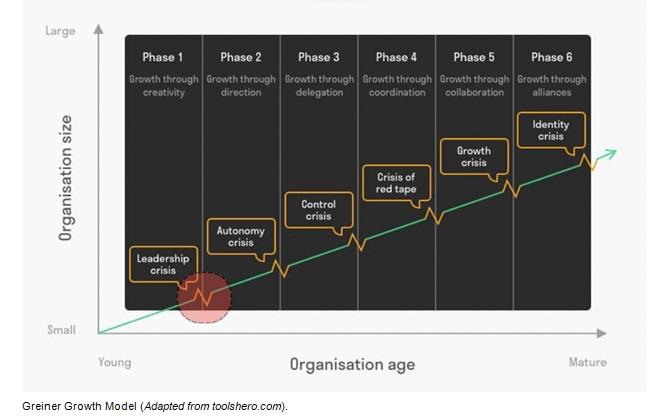
Any business will face these crisis phases when experiencing growth, but we are mainly concerned with the first of the so-called by Greiner ‘revolutions’. It refers to the challenges that the business will go through when after inception the business would start growing to a point where the leader/entrepreneur can no longer handle all the responsibilities centrally, resulting in a crisis of leadership. Greiner’s (correct) recommendation is a transition to professional management but one must keep in mind that the various functions do not necessarily mature in sync. Some functions are easier to convert into a professionally run function, the typical first being finance and accounting. Others, like human resources and marketing may be handled centrally by the entrepreneur/s for longer. In any case, the transition to professional management does not imply that the leader may be allowed to be ‘ignorant’ on important entrepreneurial functions. Also, from experience I can comfortably relate that where the key entrepreneurial functions (mainly strategy, marketing and innovation) remain the domain of the entrepreneur himself for longer, results are often better.
So what?
The starting point is to know yourself. Conducting a scientific-based self-assessment aids in better understanding the self, including strengths and weaknesses. A popular assessment tool is a personality test based on the Myers–Briggs Type Indicators (MBTI) or similar, which showcase the personality typology of the person, indicating differing psychological preferences. Linked to this, is the personality traits and attributes which would lead an individual to opt for one learning style over another.
Becoming complacent is not unheard of, the drive of the startup phase usually fades away with time, and motivation is key to always striving to improve and refine. Always challenge the status quo. Always ask yourself ‘is this necessarily the best way of doing things?’
Knowledge of the vital business functions is paramount, even if a degree of outsourcing may be introduced for operational aspects, the overall strategic direction still requires direct involvement of the leader. To be effective in management and growth, learning about all the aspects of the business (internal) and the market (external) should be a constant. There are no hard and fast rules as to how to learn. The common underlying pin is the need to evolve and grow at a personal level. No individual, nor business, operates in a vacuum.
Basic knowledge of marketing and innovation is to be at the centre of ongoing learning, as it enables business leaders to stir their organisation through different times, trends, consumer behaviour patterns and changing landscapes. Learning does not necessarily mean academic learning. Reading daily inspirational quotes from a leader who lived it and aced it or going through a biography can help you change perspectives which would lead to better decision making. This can unlock opportunities.
The mindset is the starting point. Being open to learning new strategies, tactics, perspectives, disciplines and more. Personal development converts itself into effectiveness, whereby the same unit of input would start outputting a higher level of productivity. Networking, getting mentors and joining like-minded entrepreneurs in business circles are another effective source towards personal development.
Benefits of Ongoing Learning
One of the major intangible positive consequences of a leader’s mindset of ongoing learning is the unmeasurable contagious effect on the rest of the organisation. Others get inspired. It is a practical way of leading by example. Continuously learning will aid in achieving and gaining authority in the workplace, with all the stakeholders and in the sector at large. This most often makes the entrepreneur a focal point inside the organisation - the people around you will feel boosted through your consistent high effectiveness level.
Another benefit which is commonly very evident in fast paced sectors is that through ongoing learning both the individual and the organisation will remain relevant. Not educating yourself can risk making one’s knowledge obsolete.
The benefits are commonly seen in the way you start approaching situations, the observational aspect will become increasingly refined and opportunities will start becoming more evident.
Feel comfortable in the way you learn and invest time and energy in the investment which reaps the highest return - lifelong learning!
The next column shall focus on the networking aspect and the importance of ‘getting out of the office regularly’ within a family-run business environment.
Dr Anthony Sammut,
Advocate | Business Advisor | SME Specialist