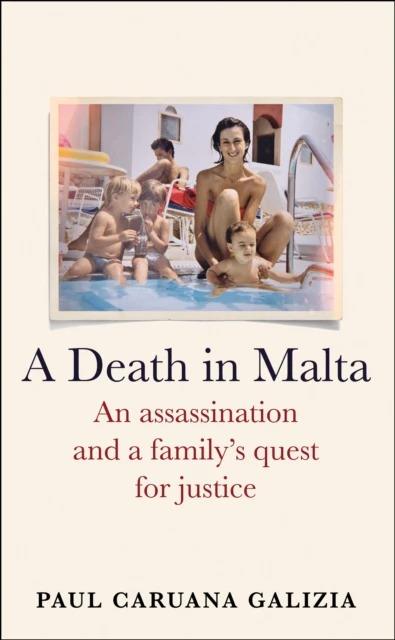
“I wrote the book because I felt that my mother’s murder was becoming bigger that her life,” wrote Paul Caruana Galizia on his decision to write his best selling and award winning book about his mother Daphne’s work, life and assassination Death in Malta.
This column is not a belated review of the book. So many have already been written, all of them stellar, so I will not even attempt at doing one myself. Rather, my column is an attempt at viewing it from the perspective of an activist. I attempted to read it from cover-to-cover the first time it came out. I stopped not because it isn’t any good; it is stunning, but my friend lamented that she could not find one copy in the bookshops, so I gave her mine, thinking to myself that having been reading Daphne’s work from the beginning and having been stuck in the fight for justice for her and her stories since October 2017, I might have an inkling of what might be in it, so I can delay the pleasure of reading it.
How wrong can one person be? Well, certainly not more than Joseph Muscat about Daphne’s investigative work and its lasting impact. I was starkly reminded of this book when the political earthquake, not the one cockily promised by Muscat, was enfolding in court last Tuesday. Paul’s quote that opens this column sprang to mind, when after five years Repubblika had asked for a magisterial inquiry into the fraudulent hospitals deal, it was concluded.
I was outside the law courts when Muscat scurried out of court sporting the deepest furrow known to l-Bidwi ta’ Wied il-Għasri, which he euphemistically calls ‘serenity’. This contrasted sharply to Robert Aquilina’s confident exit and his cool and determined tones in outlining two of Repubblika’s requests. One that the full conclusions, not the proces verbal, must be published, and secondly that the magistrate’s recommendations must be completely implemented without dragging of feet. Our honorary president was most emphatic that Repubblika will not accept the same obscurantism as in the Pilatus case by the AG and the Police Commissioner.
I am writing this piece on the twentieth anniversary of Malta’s accession to the EU. Daphne had written enthusiastically about the European project. When the referendum passed she had written “We’re free at last, and free forever”. Daphne had also told her sons, ‘Boys, you don’t know how lucky you are’. I recall another future titan of the European project twenty years ago today: Simon Busuttil, who was standing mere yards away, with one boy in a stroller and another holding his hand, his face shining as he dreamt dreams for his children.
But others, like Muscat and Yorgen Fenech, saw Europe a little more than a money making machine. Daphne had lamented that Malta is becoming even ‘more shallow and frivolous, less concerned with permanence, more and more self-involved.’ In the past eleven years, and especially since Daphne’s assassination, people have been expecting the European Union to fix our problems.
When Daphne was alive, she instinctively knew that it is we, the people, who hold the key to bring our country back to embracing European values. But she was left alone in doing that. While she was still alive and writing, we consoled our mostly inert conscience that Daphne was fearless, even when she chronicled arson, dog poisoning, and other horrific incidents. We accuse her enemies, and ours, of dehumanising her by casting her as a witch, but in our own way, even if we meant well, we also dehumanised Daphne by casting her as a fearless warrior who could swat anyone away with a swish of her pen. Paul wrote that the vitriol related to her work began to affect her health, she began to put on weight, sleep less, felt alone when invitations dried up and felt more and more isolated.
I was reminded of this passage when people flooded social media to thank Repubblika’s doggedness in pursuing justice for Daphne’s stories. Such stories are primarily human. Daphne’s investigative work did not appear to her in a dream. She toiled alone for hours, months, years. She was persecuted because of it. Killed.
In our enthusiasm when things go right, or even when nothing happens for months, Daphne should always remain at the centre of everything we do. Even if we are patted on the back for a job well done, she did it first. Even when we feel exhausted, afraid, persecuted, friendless, she was there first. We also have one more thing in common with Daphne, because she taught it to us. We work hard at her stories, at her legacy. At justice. We persist because like she herself said, ‘you are not going to change amoral familism by pandering to it, or by making its practitioners believe they are right’.
Paul Caruana Galizia’s book is a cornucopia of emotions. I found myself smiling, snorting, chortling, snickering, outright laughing when I remember doing the same when I read her blog, and still do. I felt a warm glow when Paul wrote about their upbringing, some scrapes are universal. But the darker the storytelling got, I felt myself sniffing, choking with tears, and then crying at the sheer brutality of Daphne’s assassination. I did not write about that part of the book because like Paul himself said, his mother’s death should not drown the magnitude of what she managed to achieve in life.
This is why we do what we do.
Alessandra Dee Crespo is a Repubblika Committee Executive Member