Alex Borg and Adrian Delia come from two different generations. Their approach to the election for the Nationalist Party leadership has exposed a diverging strategy, and the numbers that have been analysed also confirm this.
According to the latest available data, Alex Borg commands a stronger following on Tiktok, with 5,971 followers, and Instagram, where he has 23,900. Both social media platforms are more popular with younger people. Delia has 1,029 followers on Tiktok and 8,123 on Instagram.
Delia, however, maintains a clear lead on Facebook with nearly 45,000 compared to Borg's 32,000, and is the only one of the two with an X (formerly Twitter) presence, where he has 4,900 followers. In this case, the two platforms are favourites of older generations.
Borg has reportedly secured more signatures of support before submitting his application for the leadership election - 3,000 compared to Delia's 2,000.
These endorsements represent an important test of internal momentum, as they require councillors, activists and members to make a concrete expression of support. For Borg, the higher number suggests he has succeeded in converting online popularity into organisational strength, while for Delia, the figure reflects a solid base of loyalists who have stood by him through leadership challenges and internal disputes. Both results demonstrate that each MP commands significant influence within the PN, even if they draw it from different sources.
In parliamentary work, according to the parliament's website, Delia then surpasses Borg, having tabled 479 parliamentary questions in this legislature compared to Borg's 361. PQs are an indicator of diligence and persistence in holding ministers accountable and maintaining pressure on government.
Parliamentary questions offer a different type of measure, one that is less visible to the general public but valued within political circles as a sign of consistency and scrutiny. PQs generate news stories, press ministers for answers, and create an official record of scrutiny that opposition parties rely on to demonstrate relevance.
The numbers take on an added meaning when placed in the context of their electoral results in the 2022 general election. Borg emerged as one of the PN's strongest vote getters, where he obtained 6,108 first count votes in the 13th district, while Delia obtained 2,515 first count votes on the eighth district and 2,119 on the seventh. He was elected from both districts.
Observers note the figures also point to what appears to be a generational divide within the PN. Borg's presence on Tiktok and Instagram appeals to younger audiences and non-traditional voters who are less likely to tune in to political debates or party events but may engage with short-form content on social media. His videos and posts reflect a modern style of campaigning that speaks to an electorate that consumes politics differently.
Delia, by contrast, holds greater sway on Facebook, which continues to dominate Maltese political discourse, particularly among older demographics who are more active in party structures and more consistent in turning out to vote.
The contrasting figures build into two distinct political brands. Borg has portrayed himself as the candidate of renewal, leaning on modern platforms, grassroots energy and a strong electoral base in Gozo to expand the PN's appeal beyond its traditional support. His ability to secure a first-count election in 2022 bolstered that image, positioning him as a fresh face capable of drawing attention in a political scene where the PN has often struggled to cut through.
Delia, on the other hand, frames himself as experienced, diligent and resilient, relying on his parliamentary record and large following among older voters to present himself as a steady hand. His history as former leader, though controversial, has not erased his capacity to command attention within the party and to demonstrate staying power.
For the PN, which has endured three consecutive general election defeats, the challenge is to find a way of combining growth with credibility. Borg's appeal to younger audiences offers a path to expansion, tapping into groups the party has struggled to reach in recent years. Delia's steady focus on parliamentary scrutiny offers reassurance that the party still has figures capable of the detailed work of governance. Analysts argue that whichever direction the PN moves in, it will need both approaches: the ability to attract new supporters and the discipline to prove itself ready for office. The numbers surrounding Borg and Delia show that each embodies one side of this equation.
Taken together, the contrasting figures suggest that both Borg and Delia bring assets the PN cannot afford to overlook. Borg offers reach, energy and the promise of generational change. Delia offers diligence, resilience and the credibility of sustained parliamentary work. The PN's future success may depend on whether it can unite these strengths, or whether it remains divided along the lines they represent.
For now, the numbers tell the story of two distinct paths within the party, one pointing to renewal and expansion, the other to continuity and persistence, both of which the PN needs if it is to rebuild and challenge Labour's dominance.
Who will the PN members choose?
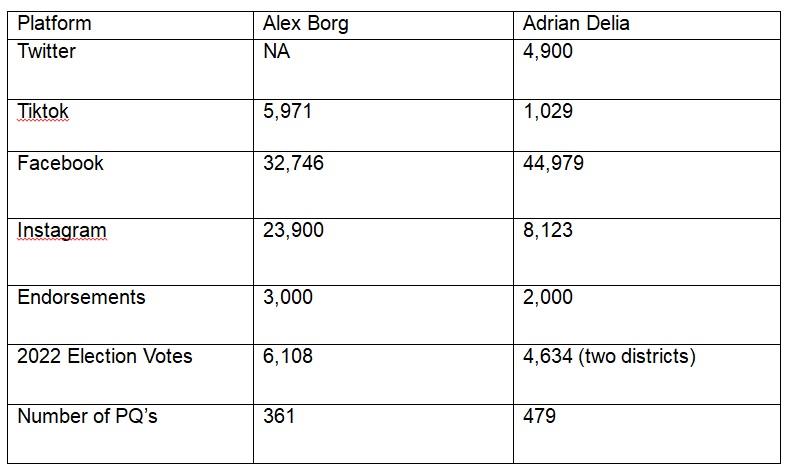
Numbers as of last Thursday morning