In the current PN leadership contest, Alex Borg has attempted to set himself up as a champion of pensioners. In a recent Facebook post, Borg, a younger candidate, stated that a PN under his leadership would rectify what he sees as an injustice affecting those born either side of 1962. However, this declaration has a certain irony, especially without acknowledging that this very disparity originated under the Nationalist administration of former Prime Minister Lawrence Gonzi. Moreover, it's worth noting that the current government has already taken initial steps to alleviate this discrepancy, with pension increases for pre-1962 pensioners already underway through the 2024 and 2025 fiscal budgets.
The problem with Borg's pronouncements is that it implies that he can save people from a problem that was initiated by his own party, and in doing so, he fails to recognise that the current government has already taken real steps to reduce the pension gap. To fully appreciate the context, it's necessary to delve into how the 1962 pension divide came about.
How the divide began.
The narrative begins back in 2006, when the Gonzi government enacted comprehensive pension reforms.
These reforms aimed to secure the system's long-term stability amidst an ageing population. The result, however, was the creation of two distinct categories within the working population: individuals born before 1962 and those born thereafter.
While superficially, both groups contributed under the same two-thirds pension scheme, significant disparities existed below the surface. The Maximum Pensionable Income (MPI) for those born after 1962 became linked to a formula-specifically, 70% of median wage growth plus 30% inflation-designed to ensure that their pensions kept better pace with rising living standards. Conversely, pre-1962 pensioners remained subject to the previous system, where the MPI only increased in line with the cost-of-living adjustment (COLA). To compound matters, their pensions were subject to fixed maximum caps: €17,470 for individuals born up to 1951 and €20,964 for those born between 1952 and 1961.
This, in essence, was the foundation of the inequality. Over time, this arrangement guaranteed that pensions for post-1962 retirees grew at a faster rate, while those for pre-1962 retirees were effectively locked into receiving comparatively lower benefits throughout their retirement.
Real-world outcomes
The impact on individuals was significant. Consider a pensioner born in 1946 who retired with a monthly income of €1,049.76-approximately €242 per week. Due to the pension cap, his pension saw limited growth, mainly through modest COLA adjustments. Had he been born in 1962, with the same work history, his pension today would exceed €1,340 per month. The sole differentiating factor was a birth date.
Analysts have, over time, estimated that this discrepancy amounts to between €61 and €82 each week. To people on fixed incomes, that's the difference between living a dignified life and simply getting by. In effect, many lost thousands of euros throughout their retirements, something that was a bitter pill to swallow after having paid the same contributions as their younger colleagues.
The inequity has also affected family dynamics. Take, for example, two brothers born in 1961 and 1962 respectively, both with decades of public service behind them. Today, the younger brother's pension moves in step with earnings growth, but the elder brother's remains capped and stagnant. Families all over Malta and Gozo feel this unfairness every month when the pension is transferred to their bank accounts.
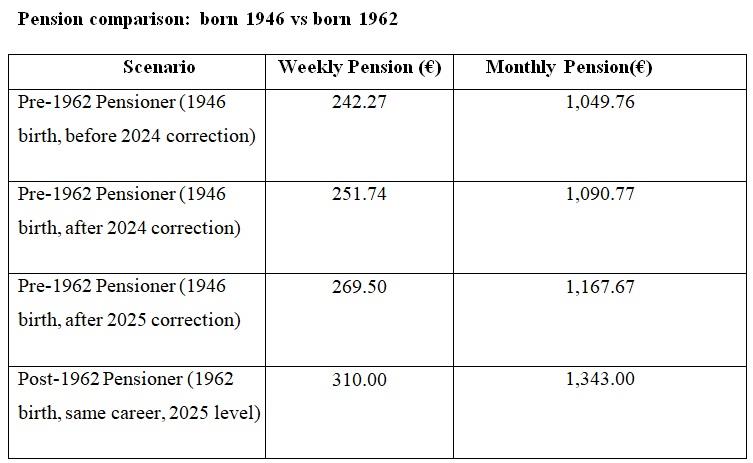
The table above shows how a pensioner who was born in 1946, and therefore subject to the pre-1962 regulations, is receiving €1,049.76 per month after the recent government corrections. With the 2024 and 2025 corrections progressively implemented by the government, this figure rises gradually to around €1,168. A similar pensioner, but born in 1962 and therefore benefitting from a more advantageous updating system, would be better off. By 2025, the estimate is around €1,343 - the disparity is decreasing, though still noticeable.
The 2024 shift
Following sustained pressure from pensioner advocacy groups and unions, the government finally responded with measures in the 2024 Budget. Specifically, the Minimum Pension Income (MPI) for pensioners born before 1962 was increased to €22,000. Capped pensioners, because of this, saw weekly boosts of approximately €9.47. Simultaneously, annual uprating was standardised across cohorts, removing any dependence on birth year for pension increases, and adding a bit more predictability. In 2025, the government took further action. The MPI for pre-1962 pensioners was again raised, this time to €23,500. In practical terms, this meant an additional €19.23 per week for capped pensioners, which came on top of the €8 universal weekly increase given to everyone. Consider, for example, a 1946 pensioner previously receiving €1,049.76; these revisions brought their monthly pension close to €1,200. Roughly 26,000 pensioners benefitted directly.
The delay: A question of politics
If the unfairness was so apparent, why did it take nearly two decades to remedy? Political reluctance is the likely answer. Any reform of pensions invariably carries a financial burden, and governments were, for some time, wary of the fiscal impact. The Gonzi administration, for example, prioritized sustainability, inadvertently creating the problematic two-tier structure. Successive governments then proceeded with caution, hesitant to undo that structure until the weight of public opinion left them little choice. In the meantime, numerous pensioners lived out their retirement significantly disadvantaged. Regrettably, the long wait meant that many who experienced the worst of the inequality passed away before the reforms arrived.
Broader implications
The "1962 divide" offers a clear warning about the potential long-term consequences of seemingly small legislative choices. A seemingly innocuous cut-off date can, in fact, have profound implications that last a lifetime. It also underscores the importance of honesty when political leaders discuss their party's track record. Borg's Facebook post, intended perhaps to generate a positive response, conveniently overlooked the PN's role in creating the problem, while also failing to acknowledge the current government's corrective actions. Malta's experience highlights a simple truth: pension reform requires both sound fiscal planning and a commitment to fairness. When inequities emerge, they must be promptly addressed and not allowed to continue indefinitely.
Looking forward
The government seems committed to gradually equalising the MPI. Whether full parity with post-1962 pensioners will ever be reached is uncertain, but the direction is certainly clear. For older pensioners, the 2024 and 2025 adjustments offer welcome relief, despite being long overdue. They are more than just about the money; they represent a belated, but significant, recognition of dignity.
For younger workers, this story serves as a valuable reminder that fairness in pensions should not be taken for granted. It depends on vigilance, sustained pressure, and leaders who are willing to own up to past missteps. Otherwise, history, unfortunately, risks repeating itself.
Ultimately, the ongoing story of Malta's pension adjustments is not merely about numbers. It is about fairness between people; neighbors, coworkers, who've contributed their best years to the nation. By raising the cap and bringing yearly increases in line, the government has effectively, if belatedly, affirmed what pensioners have said all along: one's birth date should not determine their dignity in retirement.
As for Alex Borg, well, the irony is hard to overlook: he vows to fix an injustice that his own party put in place, all while ignoring the very real steps the current government has taken to correct it.