As global temperatures climb, weather systems are changing swiftly and extensively, making events such as droughts, hurricanes, floods, and heat waves more intense and unpredictable. Extreme weather events that may have hit just once in our grandparents' lifetimes are becoming more common in ours.
There has been a marked 83% increase in recorded climate disasters over the past five decades. Their impact has not been even, affecting vulnerable regions and socio-economic groups across the world more disproportionately than others. Approximately 1.6 billion people were directly affected by these events in the decade from 2014 to 2023, highlighting the scale of human and economic costs.
Professor Charles Galdes, former head of Malta's Meteorological Office, says that Malta's mean annual ambient temperature has risen by around 1.5oC on average over the last few decades, while the highest maximum ambient temperature has also increased by almost as much.
His studies of local rainfall records revealed that over the last 50 years or so, rainfall decreased by more than 10 mm when compared to the climate average (1961-1990). Moreover, the 24-hour precipitation amount also decreased throughout this period and has become more erratic. Since the island relies heavily on groundwater resources for its freshwater supply, reduced rainfall and increased evaporation rates exacerbate water scarcity issues. Intense rainfall, on the other hand, can lead to flash floods and soil erosion, further impacting agricultural productivity and infrastructure.
He also noted that 60% of the twenty warmest sea temperatures have occurred during the last 20 years., while there has been an average decadal increase of half a degree in Malta's mean sea temperature. Malta faces the threat of a sea level rise which can have severe consequences for its low-lying coastal areas. These include coastal erosion that threatens vulnerable coastal habitats and infrastructure, and saltwater intrusion into freshwater sources, compromising water quality and availability for both human consumption and agriculture.
Additionally, Malta's unique biodiversity and ecosystems are vulnerable to the impacts of climate change, affecting plant and animal species, with some endemic species facing the risk of extinction. Coral reefs, seagrass meadows, and coastal wetlands are particularly susceptible to the effects of warming seas, ocean acidification, and habitat degradation, threatening the biodiversity and productivity of the marine ecosystem.
Direct physical repercussions include the destruction of private dwellings, commercial buildings, infrastructure (such as roads, energy sources, and housing), and damage to agriculture and food supplies. Human capital consequences are equally grim: premature deaths, injuries, and ill-health caused by extreme conditions exact a tragic toll, leading to losses in productivity and straining healthcare systems.
What concerns me here are the broader economic impacts, which disrupt economic activity, interrupt supply chains, displace populations, discourage investment, and widen socio-economic inequalities. All these increase the pressure on government finances since public funds have to be allocated for relief, recovery, and resilience measures.
Over the past two decades, extreme weather events globally, such as hurricanes, floods, and heat waves, have cost an estimated $2.8 trillion, or around $16.3 million per hour. In addition, some 70,000 human deaths during 185 extreme weather events have been linked to climate change.
These results were reported by researchers Rebecca Newman, a climate risk specialist, and Ilan Noy, Chair in the Economics of Disasters and Climate Change at the Victoria University of Wellington, using a methodology known as Extreme Event Attribution (EEA) to estimate the economic impact.
Another study by an international research team quantified the impact of climate change on global gross domestic product (GDP), revealing a GDP loss of 10% if the planet warms by more than 3ºC. The study was noteworthy as it included the additional impacts of variability and extremes in rainfall and temperature, which had remained largely unexplored until now.
Conducted by scientists from the Swiss Federal Institute of Technology in Zurich and the University of Delaware, the study also revealed that limiting global warming to 1.5ºC could reduce the global economic costs of climate change by around two-thirds.
The economic impact of climate change manifests itself in different ways ̶ through gradual changes, such as increased cooling costs for buildings, or more dramatic ones related to the higher frequency of extreme weather events (the heat wave of 2003 in Europe, which killed tens of thousands of people).
Climate change has been and will continue to be variable, and so will the economic consequences. Some countries might experience a net benefit, while others are likely to suffer dramatic changes that pose great economic threats.
The costs can be divided into market and non-market ones. A market cost concerns some part of the economy that could be quantified in terms of dollars (for example, the destruction of a manufacturing plant), while a non-market cost is something that is not easily quantified because there is no market for it (for example, the collapse of the Azura window).
The estimated cost only captures a small part of the impacts, so it is considered a lower bound, with the true economic impact likely orders of magnitude greater. In 2022 and 2023 alone, economic damages reached $451 billion, representing a 19% increase compared to the annual average from the preceding eight years.
An analysis of climate-related extreme weather events, commissioned by the International Chamber of Commerce (ICC), estimated the economic losses from nearly 4,000 events across six continents between 2014 and 2023 at $2 trillion in 2023 prices. Note that this is not the full cost, as the report focused on acute current events, as opposed to chronic or gradual impacts of climate change.
Even if CO2 emissions were to be drastically cut down, the world economy is already on track to an income reduction of 19 % by 2050 due to climate change. A study by the Potsdam Institute for Climate Impact Research, based on empirical data from more than 1,600 regions worldwide over the past 40 years (published in Nature), found that these damages are six times larger than the mitigation costs needed to limit global warming to two degrees.
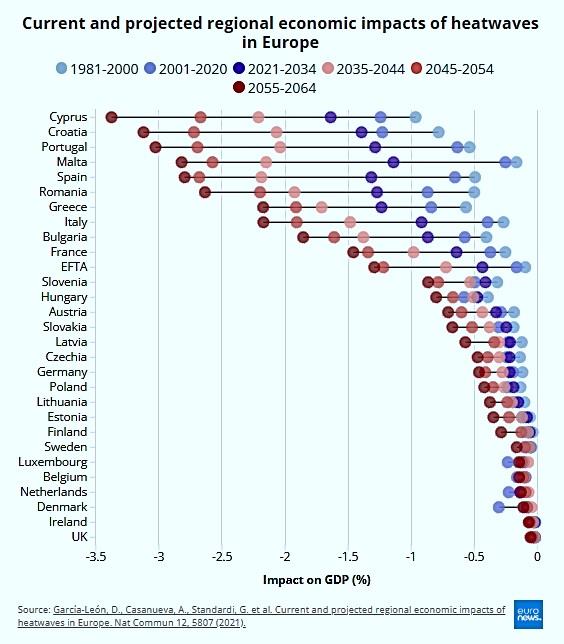
David García-León and his colleagues, in a study published in Nature Communications, examined heatwaves during four exceptionally hot years - 2003, 2010, 2015, and 2018 - and compared their impacts to the historical baseline of 1981 to 2010 (see chart). In those selected years, the total estimated economic damages from heatwaves ranged between 0.3% and 0.5% of Europe's gross domestic product (GDP). This represents 1.5 to 2.5 times the average annual economic losses from extreme heat during the 1981-2010 period, which stood at approximately 0.2% of GDP.
The threat to Malta is even bigger. While the economic impact in the baseline years was one of the lowest at 0.19% of GDP, by 2054 it is expected to reach around 2.9% of GDP, making it the fourth-most affected country in the EU. Sixteen of the member states will be hovering around the 0.4% mark.
Most people wouldn't know this number, but that does not mean they aren't worried. Almost all those who participated in the annual Climate Survey commissioned by the European Investment Bank recognised the need to adapt their lifestyle due to the effects of climate change. They ranked climate change second only to the cost of living among the challenges facing the country. Almost all of them believed that investing in adaptation now would prevent higher costs in the future.
Last year Warren Deguara, Principal Economist at the Central Bank of Malta, reported in an article in the bank's research bulletin that the physical risks of climate change are a serious concern for Maltese firms. Nearly 50% anticipate moderate to high impacts on their operations in the next decade, a figure that increases to 60% for a 20-year horizon.
All this indicates that, without enhanced climate action and mitigation efforts, the economic burden of climate-related extreme weather events will present serious challenges to Malta. Given our limited resources, mounting economic pressures could hinder economic development. The cumulative costs, driven by damage to infrastructure, loss of productivity, and increased cost of mitigation measures, underscore the urgent need for action to address climate change and its far-reaching consequences. Short-termism is exactly what we don't need.
Frans Camilleri is an economist. He studied at Oxford and University of East Anglia, is a former corporate head at Air Malta, and has served on various public and private boards.