If there is anything we have learned over the last five decades, it is that structural reforms generate long‐term growth benefits. This is true in both the economic and social fields, in Malta as in other countries. Yet one observes that few governments are embarking on major reform efforts, seemingly defeated by macroeconomic, institutional, and policy constraints.
Three critical reforms during the next couple of years will be the partial or entire phasing out of energy subsidies; changes in the pension system; and the introduction of proper governance. All are imperative for future economic growth and stability, face institutional or external challenges, and require consensus. A decision not to implement the appropriate reforms might be politically convenient, but pain will follow if the decision is postponed or shelved altogether.
Take the energy subsidies. We are spending around 1.3% of the Gross Domestic Product on them. As most observers, including the EU Commission and the International Monetary Fund, have pointed out, these subsidies mainly benefit the higher-income groups who consume more fuel. By reducing these subsidies, we can eliminate price distortions, promote more efficient energy use, and foster long-term inclusive growth.
Or consider pensions. The pensions we were paying until 2013 were completely inadequate, condemning a large percentage of people to poverty. Despite the tremendous progress over the last decade, we still need to do more. Pension spending accounts for 5.6% of Malta's GDP (EU: 12.2%) but will sharply increase as the population ages.
Nevertheless, ensuring adequate pensions may not be sustainable unless we reform the social security system to account for the changes that are occurring, mainly the low fertility rate and ageing workforce. Implementing reforms can help ensure the sustainability of the pension system and support employment, especially for young people.
All reforms generate tensions, but that does not mean that they are doomed to failure. Rather, they challenge the government and policymakers to turn abstract reform ideas into worthy objectives through what is often a messy process of implementation.
Effective reform revolves around well-designed changes that are launched at the right time to gain higher public support. Timing is crucial. Changes that are phased in gradually, against the background of good economic times, are usually viewed more favourably. Public resistance to reforms can be reduced by policies that focus on redistributing resources to those most affected, building trust in institutions, and effectively communicating the intent of the reforms.
Some reforms may face more resistance than others, even though they may not be as substantial. This applies to a comparison of the phasing out of fuel subsidies versus pension reforms. The cost to the public purse of fuel subsidies was €640 between 2024 and 2026. Their removal will surely raise a public outcry and will be harshly criticised by the Opposition unless there are some offsetting social programmes. On the other hand, pension reforms may be more palatable because their financial impact is not immediate and will not be felt by people only over a long period.
Structural reforms often face strong opposition, typically due to the existence of vested interests that may lose from the reforms, or to the uncertainty about who will win or lose. This opposition feeds into the political, social, and economic arenas in different ways. Even politicians committed to structural reforms will need to undertake a coalition-building effort to gain sufficient popular support for the reforms.
External conditions will impinge on the government's authority within the institutional political system, and hence its leeway to make reforms. If the government does not command a good majority in the Parliament; if economic conditions are weak; if external pressures are inimical, then the chances of securing popular support can diminish substantially.
The identity of the main actors who can interfere with the reform process is also a big factor. There may be trade unions or business lobbies who would prefer the status quo they know, rather than a new set-up with its uncertainties. Or the reforms might be the ideal instrument for some political parties to try to undermine the government of the day.
These conditions are crucial, since the actual implementation of successful reforms is typically shaped by the political requirements of forming sufficiently large political coalitions and of "buying out" the opposition of relevant veto players.
The tensions created by major structural reforms can only be addressed by engagement with civil organisations (businesses or civil society groups) and citizens. Obtaining public support requires a high degree of transparency, strong governance, and widespread genuine dialogue. This is indispensable, given that implementation problems or structural barriers in the external political and institutional environment can be daunting.
Quite often, the packaging of successful reforms will follow a "divide and conquer" strategy, where entrenched vested interests are isolated from each other. This can only be achieved if the pace of the reform is slow and if the government creates the conditions for a smooth and continuous reform process rather than appeal to a big-bang reform (remember Arriva and the subsequent disaster?).
Sometimes, this process also calls for reforms in other markets. Reforms in one sector, for example the social security system, may well spill over into other sectors, such as the labour market. This helps to create political momentum and modify the background economic conditions. The prime example of this was the huge success in tapering social benefits by incentivising more employment through the in-work benefit.
Public support is crucial for the success of these reforms, and governments can leverage various strategies to enhance this support. For one thing, it is essential to improve sentiment among key stakeholders in society. Research by the IMF highlights its importance, especially when families, civil society organizations, labour unions, and opposition groups back the changes.
The IMF developed a new method to gauge public sentiment. It analysed more than two million news articles tracking energy subsidy reforms in 170 countries since 1990 and pension reforms in 134 economies since 1960. The chart shows the relative importance of various factors.
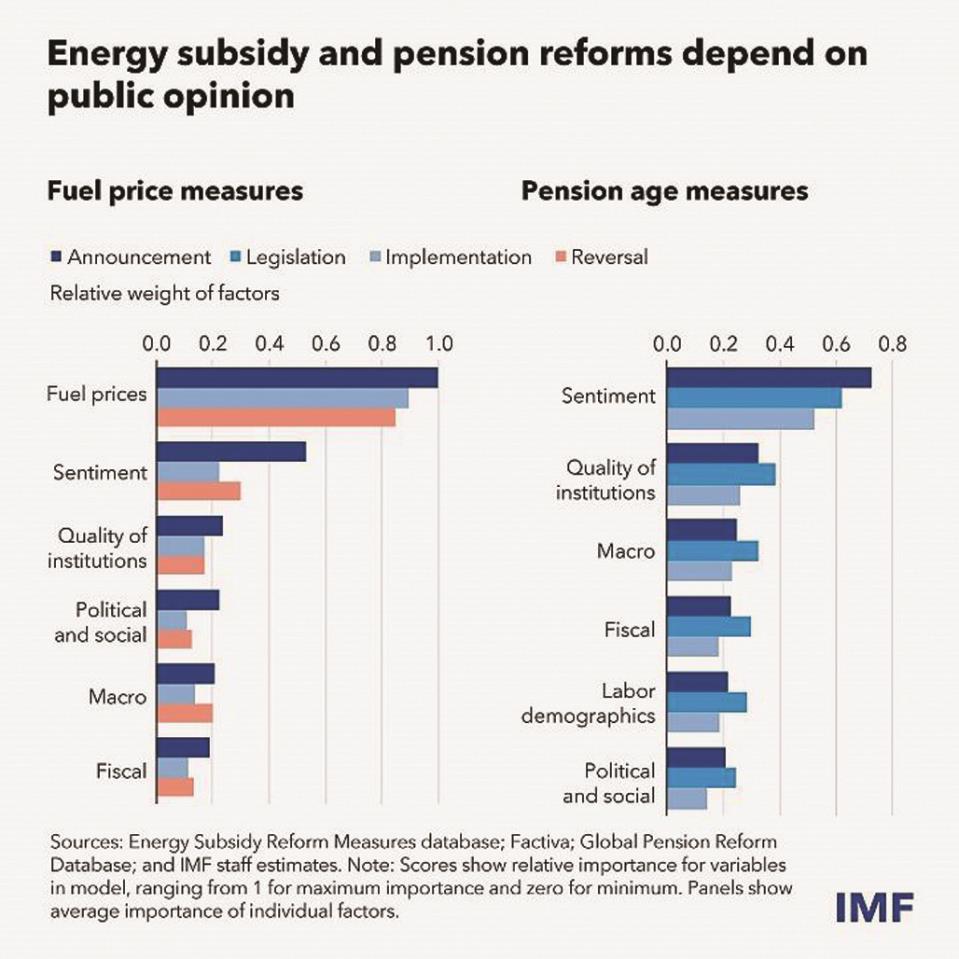
Sentiment just cannot be ignored, as do the quality of institutions. The analysis also showed that when possible, implementing gradual reforms allows individuals and businesses time to adjust, thus enhancing public support.
Quickly compensating those affected by reforms can help build support and reduce concerns. Australia managed to increase the pension age while providing a substantial boost in old-age benefits of over 10% for low-income retirees.
Effective communication and engagement with stakeholders are essential. By clearly explaining how these reforms improve the country's financial health and expand public services, concerns can be reduced, and support can be increased. In Morocco, a well-planned communication strategy highlighted that subsidies were not an effective way to provide social support, which helped alleviate worries and build backing for the reforms.
Ownership and political commitment are key to building consensus. In Uruguay, the president made raising the retirement age a central part of his government's policy and actively engaged with key political stakeholders to create consensus for the reform.
The Government must invest as much effort in clear communication, engaging in education and bringing stakeholders aboard, as it does in the technical aspects of complex reforms. Genuine transparency and governance are not an afterthought or a luxury.