The most commonly used measure of a country's economic activity and the overall well-being is Gross Domestic Product. It gauges the magnitude of economic production, affecting in turn what two of the main factors of production ̶ Capital and Labour ̶ earn. GDP growth is therefore an estimate of how the aggregate income of a country increases over time.
In recent times, there has been a hullabaloo about the use of GDP as an indicator of how well-off people are. This has led to the development of multiple indices attempting to measure well-being, life satisfaction, and happiness by both national, international, and private bodies. Although such indices are useful, critics argue that they rely to varying degrees on subjective assessments. With all its faults, GDP remains the universal measure of economic progress.
In any case, Malta's ranking in the OECD Happiness Index has not changed much over the years. Last year, we were the 18th happiest people in the EU and 48th out of 143 countries ̶ much the same as we were in 2013.
As a background to discussion on this topic, it is pertinent to be reminded that one of the main arguments in favour of EU accession was that this would set us on the road to a better standard of living. Well, it has. Between 2005 and 2012, nominal GDP grew by an annual compounded rate of 5.5 percent, while between 2013 and 2024 the rate rose to 9.8 percent per annum. This has translated into an annual growth of 6.3 percent per annum in GDP per capita over two decades.
Naturally, a country's aggregate income provides resources that can increase the incomes of families and individuals. But the extent to which economic growth is sufficient to improve the welfare of every individual in the country depends on how the benefits of growth are distributed across the society.
If all individuals benefit proportionately, then the impact on the average person would be sufficient to determine the economic forces at work and how to improve the welfare of each individual. On the other hand, if income growth does not rise proportionately, then the economic welfare of an individual is affected not just by aggregate economic growth but also by the distribution of income within the economy.
The impact of growth on inequality remains ambiguous and depends on the sources of growth. For example, growth propelled by skill-biased technological change can disproportionately benefit capital owners and skilled workers to the detriment of unskilled workers, whose earnings are generally low and who tend to be in the lowest quantiles of the income distribution. This type of technological innovation, while usually positive for economic growth, can induce an increase in inequality.
The income and wealth gap is tending to grow, and Malta has not been an exception. According to the latest data available from the National Statistics Office (EU-SILC 2924: Salient Indicators, 28 April 2025), both income indicators (the S80/S20 ratio and the Gini Coefficient) show that income distribution in 2024 improved over the 2023 level. The first indicator improved from 5.4 to 5.0 while the second one improved from 33.0% to 30.8% (a lower number means better distribution). But it remains to be seen whether this improvement will continue.
In the meantime, however, Maltese households continue to improve their real gross disposable income (RGDI) compared to that of other EU households. According to the latest figures from the EU Social Scoreboard, in 2023 their RGDI per capita had grown by 52.8 percent since 2008, compared to 11.0 percent among EU households.
One major reason for this is the body blow delivered to material and social deprivation. Over a decade, the incidence of such deprivation among employed persons has been reduced by 8.8 p.p., among retired persons by 13.1 p.p., and among the non-employed by 16.1 p.p. Looking at the reduction in deprivation through the income lens, one notices that it has been reduced by 14.4 p.p. in the 1st quintile income bracket and by 11.2 p.p. in the 2nd income quintile. Particularly welcome was a 10.1 p.p. drop in such deprivation among children below the age of 18 years.
Equally remarkable has been the plummeting severe material and social deprivation rate that has been more than halved over nine years. The decline has benefited those earning the lowest incomes the most ̶ in both the first and second income quintiles, where we now have lower rates than in the EU. Even more striking has been the reduction in the 3rd income quintile (those earning 40-60% of the median) where there has been a 70 percent drop. The rate among children has similarly been cut by more than half.
The depth of such deprivation (the number of items of which persons have been deprived) has been diminished to lower levels than the EU, whether the deprivation is of more than four items or more than eight.
Of course, inflation has a huge impact on real income levels. The war in Ukraine and trade upsets led to a spike in 2022-2023 all over the EU, though this has now subsided. Overall, the positive impact of the Government's anti-inflationary strategy is amply demonstrated by the annual average rate of change in the HICP, which has been 2.85% over the last six years versus 3.87% in the EU. Inflation in food and non-alcoholic beverages has only been marginally higher than in the EU, while that in housing and energy costs has been markedly lower (-25%).
The government has aggressively addressed the issue by a mix of policies, including an increase in income, improvements in benefits or allowances, general financial support to the economy, preferential tax treatments and reforms, rent reforms, and support for commuters. Of course, a major contributor to the fight against inflation were the unchanged energy bills for households.
Every now and then, one reads of suggestions that the government should introduce price controls. In a modern competitive economy in the EU, legally-mandated price controls do not work. Both economic theory and the historical track record on price controls is that they harm the economy in the medium to long term, even though there may be a limited superficial effect in the short term.
In recent weeks, the red herring of continuing energy subsidies has been raised again. It is argued that such subsidies should be phased out. The Minister of Finance has already explained that, while in 2002 the government spent almost 8% of GDP on food and energy subsidies, by 2025 that figure had dropped to 0.8%, despite the government spending around €200 million annually on energy subsidies. The forecast for 2026 is 0.7% of GDP. Is this something to worry about? "For many businesses, those €200 million a year are the difference between staying open or closing," Minister Caruana said.
A policy of austerity for austerity's sake is rubbish. This infamous policy was adopted by other countries with disastrous socio-economic outcomes. Malta has gone the other way: growing the economy at record levels to generate the financial resources for improved social outcomes.
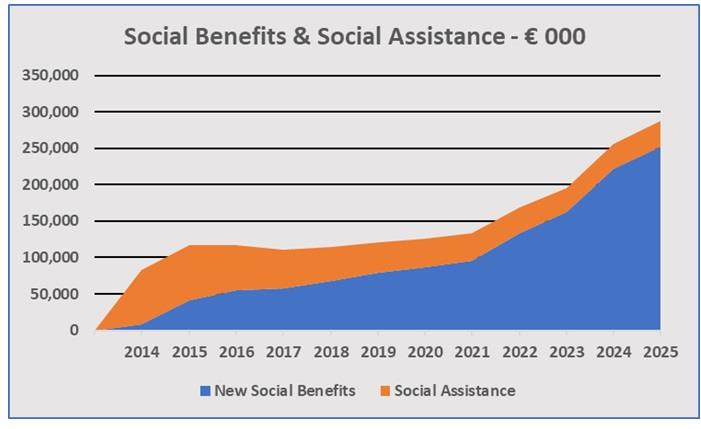
The chart shows expenditure on new benefits over the last 11 years (some 24 specific new benefits), which have increased at the rate of 35.7% p.a. compounded, reaching an estimated €252m in 2025. A partial impact of the expenditure can be glimpsed from the reduced need for social assistance to unemployed and vulnerable families, which have decreased by 6.3% p.a. compounded. Generating jobs means more dignity for all concerned.
In particular, this expenditure includes €411.2m spent on the Additional Cost of Living Bonus (ADCL) over the ears. In 2025 alone, the Government will have paid €121.9m on it. So, it seems that the Government is very aware of the different experiences of households, such that while particular attention is paid to low-income households, there is no discrimination against the middle class.
There is no doubt that the growth in GDP and GDP per capita have had a poverty-reducing effect. This does not mean that economic growth has affected everyone to the same degree. There will always be pockets where the government must intervene through social assistance and benefits. Budget 2026, with its tax cuits and improved benefits, should go a long way towards this. Whether it will lead to better income equality, or higher happiness for that matter, is another matter.