Income and wealth inequality have risen in many countries in recent decades. Malta is no exception. Rising inequality and wealth disparities stoke anxieties and social discontent, often driving increased political polarization and populism in society. An increasingly unequal society can weaken trust in public institutions and undermine democratic governance. For these reasons, rising inequality has emerged as a hot topic in political debates and public policy over the last decade.
The two most common measures of inequality are the Gini coefficient and the S80/20 ratio. The former is used to assess income or wealth distribution, ranging from 0 (all households earn the same income) to 100 (all the economy's income accrues to just one household). The S80/20 measures the annual income of the richest 20 per cent of households, compared to the poorest 20 per cent of households.
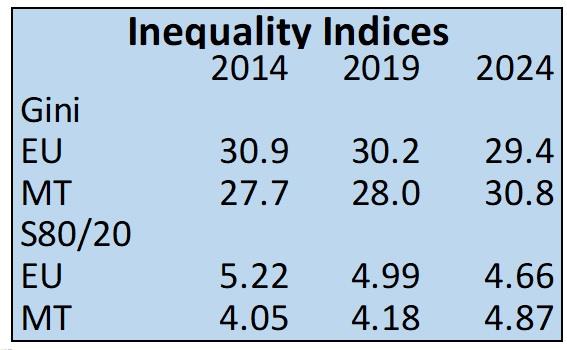
By these two measures, inequality in Malta has risen by 10% to 30.8 (Gini) and by 20% to 4.87 (S80/20) since 2014. In the EU, the opposite has occurred, with both ratios going down ̶ in other words, there is more equality than before. What is even more worrying is that Malta's ratios are now higher than the EU's.
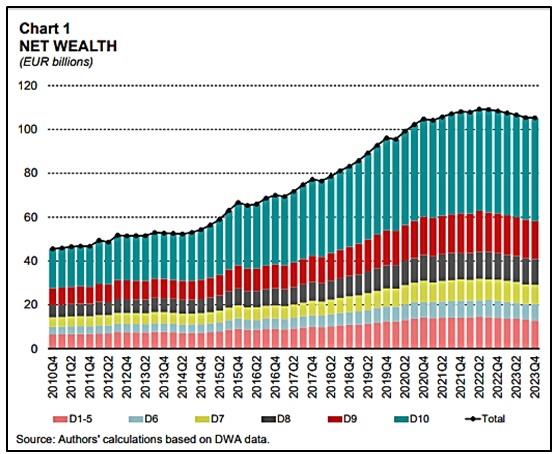
As of the last quarter of 2023, the wealthiest 10% of Maltese households held €47.1 billion (44.8%) of total household net wealth in the country, while the bottom 50% of households altogether held just €12.6 billion ̶ that's a factor of 4:1. Wealth distribution is even more skewed in the highest brackets, where the upper one-fifth of households hold above 25% of total wealth.
It's getting worse for people at the bottom. While the net wealth of the top 10% of households grew by almost 161% since 2010, that of the bottom half of households grew by 94%. The richest 10% alone, in fact, account for half of the increase in net wealth since 2010. As a result, the share of net wealth held by households in the bottom half of the wealth distribution dropped from 14.3% to 12.0% between 2010 and 2023. The other parts of the population also experienced declining shares, although their relative losses were smaller than those of the bottom half.
If you want it simpler, it means that the median wealth of those in the bottom 20% was €8,212 while that of those in the top 20% of households was €649,597 ̶ that's a factor of 79:1. As far as I'm concerned, those guys at the bottom don't even have the luxury of singing "If I were a rich man"; they're probably wondering whether they will make it to the end of the month.
Finally, to put all this in perspective, one needs to also keep in mind that total net wealth held by Maltese households has more than doubled since 2010 (increasing by €59.8 billion), to stand at €105.3 billion at the end of 2023. The growth reflects the appreciation in home prices and the accumulation of financial assets (Chart 1, Central Bank of Malta article, Quarterly Review 2024:3).
Wealth inequality is typically much higher than income inequality. Of course, higher wealth inequality feeds higher future income inequality through capital income and inheritance. Although in theory all income can be taxed, it is easier to do so in the case of those on fixed incomes compared to those who have flexible incomes, particularly if this income emanates from accumulated wealth. There is clear evidence that very rich people pay proportionally less tax than ordinary people.
I could not source relevant statistics from Malta. Suffice to say, however, that according to the OECD, the IRD in Malta adjusted 78% of all audits it conducted, compared to 69% in 57 other countries, while arrears of tax due were 131% of total net revenue compared to 29.3% in other countries. To me, this smacks of under-declarations and an ability by certain taxpayers to postpone their payments. It certainly is not the case of those who sing "If I were a rich man."
This probably explains why the ADPD, Moviment Graffiti, and Momentum, have called for higher taxes for the rich, including a wealth tax. In recent months, civil society organisations and trade unions in the EU have also urged governments to agree on bold tax reforms, including an EU-level coordinated tax on extreme wealth. Concurrently, support for taxing the super-rich is growing. A new poll by Greenpeace and Oxfam across 13 countries ̶ including France, Germany, Italy, and Spain ̶ reveals that 77 percent of people would be more likely to support a political candidate who prioritises taxing the wealthy. Even among millionaires in G20 countries, three-quarters support higher taxes on wealth, and over half believe extreme wealth is now a "threat to democracy".
Malta could raise an additional €43 million (0.25% of GDP) if it were to implement a moderate and progressive wealth tax, a study by the Greens/EFA Group in the European Parliament found in 2023. In addition, by ending tax abuse by wealthy individuals who hide their fortunes in other jurisdictions, Malta could recover €301 million in tax revenue. In total, this equates to 2.04% of Malta's GDP. This would finance an annual payment of between €464-€3,710 to each person below the poverty line, currently €12,258.
The call for the introduction of wealth taxes is about more than just revenue. It is about fairness and a liveable future. People want better healthcare, education, housing, public transport, and infrastructure, all of which will cost big millions. The climate change transition will also require heavy investment. This requires new, sustainable sources of funding, and taxing the ultra-wealthy could be part of the solution.
Mind you, from an economic point of view, the case for annual wealth taxes is not straightforward since they could reduce the incentive to save and invest. In practice, implementing a wealth tax could also be difficult. It would require the government to have a sophisticated unit to value wealth. Valuation would be extremely difficult for some assets, such as private businesses. Moreover, there is also the risk that tax evasion, tax abuse, and re-domiciliation of wealthy individuals could increase.
It is true that net wealth taxes may trigger investments in higher-return productive assets, but they may also encourage taxpayers to offset their taxable wealth by borrowing against such assets, reducing their overall tax liability. This behaviour could discourage long-term investments, potentially reducing overall efficiency in capital allocation.
This explains why wealth taxes have fallen out of fashion. The number of OECD member countries levying a net wealth tax declined from 12 in 1990 to only 4 in 2024; in Europe, only Spain, Norway, and Switzerland have it. Many economists prefer proper taxation of high returns and income to that of wealth.
Of course, we all know that the rich tend to find ways not to pay. For instance, many bill personal expenses, such as food and transport, to their company, lowering their taxable income. This is why they spend lavishly on the company card. One only has to be at the check-out counter of certain fashion or household stores to see women quoting VAT numbers to the cashier, debiting their purchases to family companies.
Moreover, very wealthy people often earn a large fraction of their income as capital gains, which many governments tax at a lower rate than income. While our government imposes a Final Withholding Tax (FWT) of 8% on the selling price of real estate and a tax of 35% on profits for specific assets like shares and intellectual property, there is no general capital gains tax on all capital appreciation. Some rich people borrow against their assets to fund consumption. This "buy, borrow, die" wheeze reduces tax bills because loans are not taxable as income. Others classify their earnings as profits rather than wages to take advantage of lower corporation-tax rates.
Mind you, some recent statistics divulged by the Minister of Finance might question the extent of the problem. He revealed that persons paying the top 35 per cent tax rate generate one-third of all income tax collected in Malta, despite making up just five per cent of the total tax-paying population. Each of the 13,582 individuals taxed at Malta's top rate pay an average of €26,000 in annual tax.
At the other end of the scale, more than four times as many - 60,492 - pay no income tax at all since they make under €9,100 per year. Meanwhile, another 44,040 are on the 15 per cent tax band ̶ those on yearly incomes between €9,101 and €14,500 ̶ and collectively generate €17.4 million. This means that 37.8 per cent of workers - those on the zero and 15 per cent bands - are responsible for just 1.7 per cent of all income taxes generated.
Those on the middle 25 per cent tax band make up the majority of both taxpayers and amount paid, with 158,147 persons (57 per cent of all workers) generating €666 million (64 per cent of the total) between them.
All this will change this year as a result of the recent Budget measures. Thresholds for single persons, married couples and parents will rise between €2,300-€2,900 and they will save between €435-€675 pe annum, depending on the kind of household. The 35% rate will remain applicable on income of exceeding €60,000.
This tax overhaul and largesse have become possible because, according to Minister Caruana, during the first six months of last year the government gathered more than €300 million in arrears due to the State. This was also possible because the use of AI tools has and better enforcement have increased the percentage of tax forms returned in time to 93%, whereas more income is being taxed than ever before.
As a result, there is no political will to introduce a wealth tax in Malta. For the moment, the Minister of Finance seems to be relying on a combination of more sophisticated means to tax income and enforcement measures to raise revenue. In this, he is succeeding. Whether it will be enough to give him the financial wherewithal to fight inequality is another matter.