Next at il-Kamra ta' Fuq is the debut solo exhibition by Pietru Farrugia, who will be taking us on a journey through snippets of intricate dreams throughout the month of July.
This is not my first collaboration with Pietru. In fact, he is no stranger to il-Kamra ta' Fuq, having participated in a pop-up exhibition at the gallery last year.
Now for the mandatory background check. Pietru Farrugia works with graphite, ink, silverpoint, and prepared papers. His drawings explore dreams, residue, repetition, surface, and the quiet evidence of things having passed. His work as a psychotherapist and symbolic theologian (a thinker concerned with the symbolic dimensions of human experience) informs his engagement with image, memory, and what remains after experience. It is precisely these ideas that unfold throughout his debut solo exhibition, Record of Nighttime.
The title Record of Nighttime immediately evokes the idea of a personal archive, not a diary in the traditional sense, but a collection of traces left behind by the unconscious. Rather than documenting dreams as complete narratives, the exhibition records fleeting impressions, emotions, and fragments that surface in the quiet hours of the night before gradually dissolving with waking.
Record of Nighttime gathers a selection of drawings in graphite, ink, and silverpoint on prepared and unprepared papers, drawn from an ongoing body of work rather than presented as a closed collection.
The drawings are created slowly through repeated contact between hand and paper. Line builds upon line, while countless small marks accumulate into figures, landscapes, objects, and symbols. Gradually, the surface becomes dense enough to hold an image in time, though not always to reveal it fully. This measured process is inseparable from the artist's thoughtful choice of materials.
 Graphite, ink, and silverpoint each demand a different relationship with the image. Graphite allows for revision and deepening, ink commits each gesture permanently, while silverpoint leaves an exceptionally delicate metallic trace that shifts subtly with light and the passing of time. The silverpoint drawings, in particular, evoke the elusive quality of dreams. Their images hover delicately on the surface, appearing and disappearing as the light changes, much like the fragmented memory of a dream that lingers upon waking, suspended between fading away within moments or remaining etched in one's memory for years.
This meticulous attention to process extends to the very paper itself. While some sheets are worked directly, others are carefully prepared using rabbit-skin glue, ground, and bone ash, transforming the surface into an active participant in the drawing rather than merely its support. The paper is rubbed, scratched, stained, stippled, darkened, and revisited repeatedly until something slowly begins to emerge.
But why capture dreams? For Pietru Farrugia, dreams have long occupied a deeply personal space. Some of his earliest memories are of sharing dreams with his mother, while later in life they became part of his therapeutic training and inward exploration. This intimate relationship with dreams quietly permeates the works, not as explicit narratives, but as atmospheres charged with mystery, ambiguity, and quiet introspection.
Some drawings emerge directly from dreams, while others originate from what remains after a dream has passed. A skull, a star, a body, a doorway, or a distant landscape may appear with surprising clarity, yet never become entirely fixed. The works are less concerned with illustrating dreams than with preserving their residue: a fleeting mood, a symbolic fragment, or the emotional imprint of an experience that has already begun to dissolve. They remain intentionally open to interpretation. Occasionally, Farrugia offers subtle clues through the evocative titles of individual works, yet viewers are ultimately invited to construct their own narratives, allowing memory, imagination, and personal experience to complete the image.
Allow me to take you on a short, albeit complex, journey through the night by exploring some of the works featured in the exhibition.
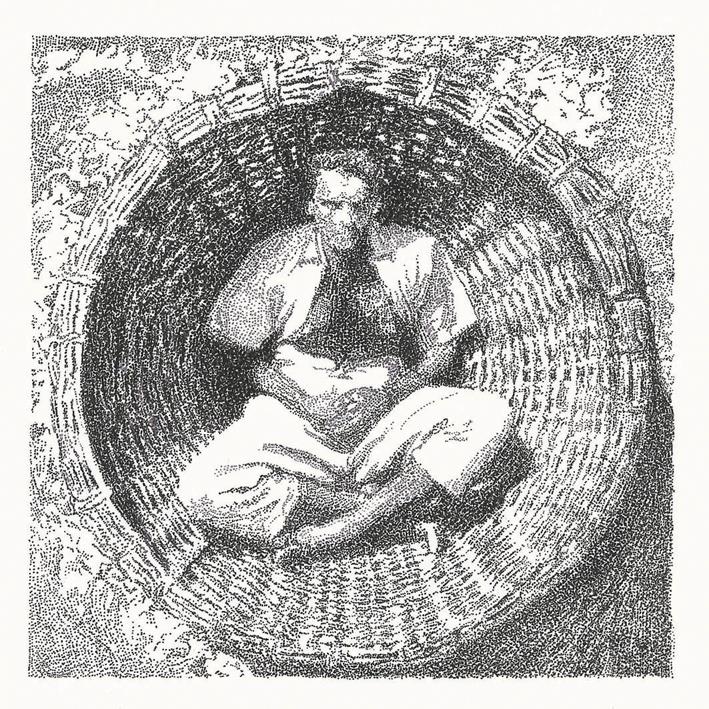
I will begin with a series of drawings executed in a 'pointillist' manner. From a distance, they appear as remarkably detailed images, but as one moves closer, it becomes apparent that they are constructed almost entirely from countless dots and dashes. This meticulous technique reinforces the fragmented nature of dreams, where clarity and ambiguity coexist, and the boundaries between the real and the imagined become increasingly blurred.
One such work is Diogenes, a square composition depicting a bird's-eye view of a large rattan basket. Nestled comfortably inside lies a man with his legs crossed, gazing directly back at the viewer. The unexpected scene carries a dreamlike quality, familiar yet quietly surreal.
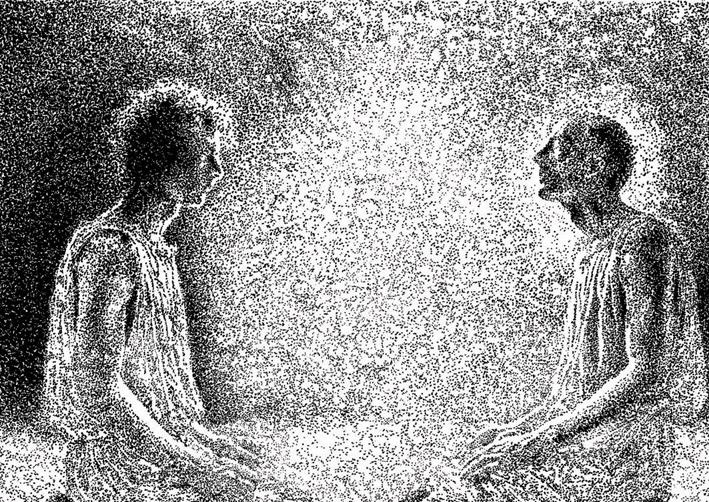
In Qalb, two male figures kneel facing one another, their encounter dominated by an immense source of light whose origin remains unknown. This luminous presence overtakes the composition, becoming both its visual and emotional centre, while inviting multiple interpretations.
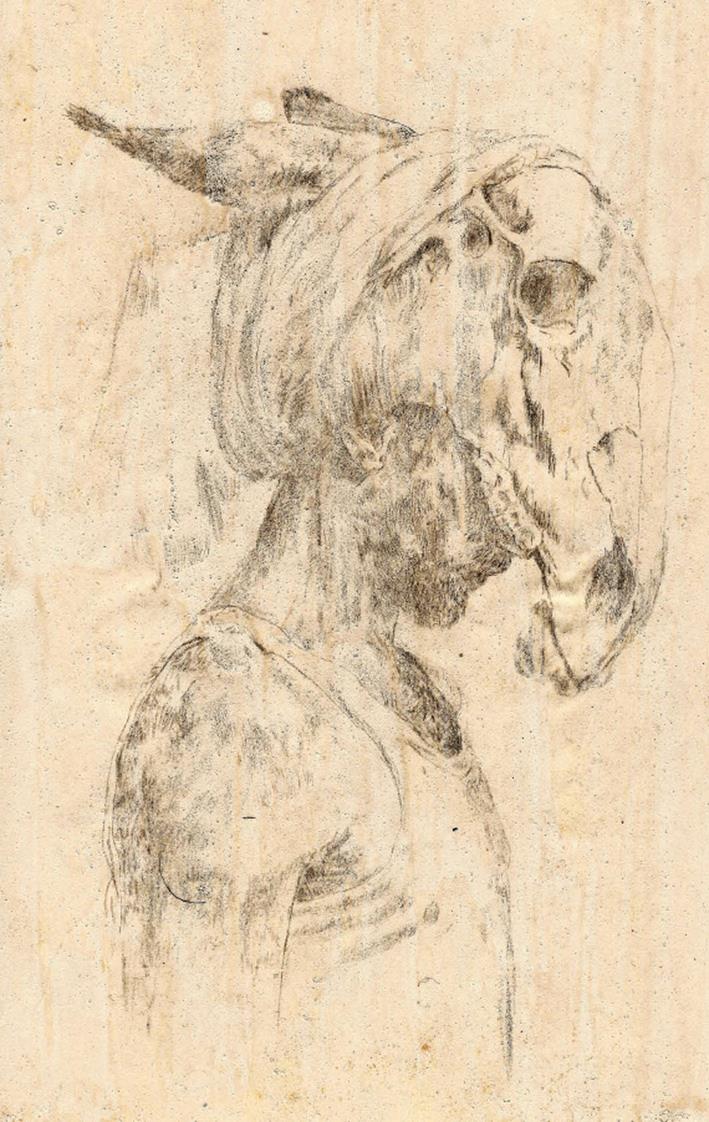
Moving on to another medium, I would like to mention one of my personal favourite works. Hmar is executed in silverpoint on paper prepared with rabbit-skin glue and bone ash, giving the surface a warm, coffee-stained tone that evokes the feeling of an aged document or a memory preserved across centuries. The work depicts a male figure dressed in a simple white vest, wearing the skull of a donkey as a striking mask or headdress, its skin folded back towards the pointed ears. Macabre or intriguing? Take your pick.
One of the most fascinating aspects of silverpoint is that the delicate metallic lines gradually darken over time through oxidation. When first created, the drawings possess an almost ghostly presence, their imagery appearing as elusive as dreams themselves. As the years pass, however, the lines become more pronounced, as though these fragile memories refuse to disappear and instead slowly strengthen with time.
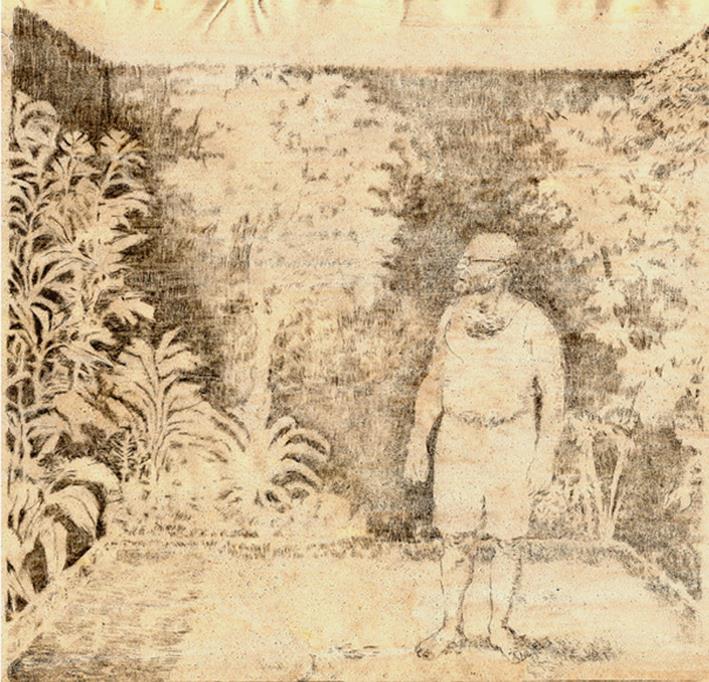
Another work created using the same medium and prepared surface is Kjostru. Here, Farrugia demonstrates remarkable sensitivity in allowing the colour of the prepared paper to become an integral part of the composition. The warm tone naturally forms the surrounding shrubs and greenery, enveloping a barefoot male figure standing within an intimate courtyard. Rather than simply serving as a background, the paper itself becomes an active element in constructing the atmosphere of the work.
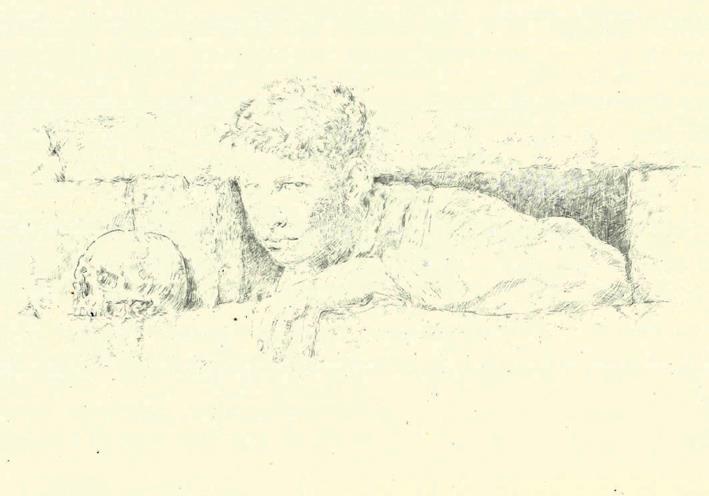
Kristofru, executed in silverpoint, this time on clay-prepared paper, depicts a young man emerging from an opening in a wall, casting the viewer a look that seems to say, "You caught me!" Adding to the intrigue, positioned just beside the opening is a human skull, a quiet reminder that beneath the work's playful humour lies something far more enigmatic.
Another work that particularly fascinates me is Pjaneta, executed in graphite and ink. It portrays a man dressed only in an undershirt and underwear, kneeling before a wheeled clothes rack. Hanging from it is a single garment: a cape constructed entirely of leaves, immediately recalling, as the title suggests, the pjaneta traditionally worn by priests. The juxtaposition of the everyday with the ceremonial creates a striking image that lingers long after viewing.
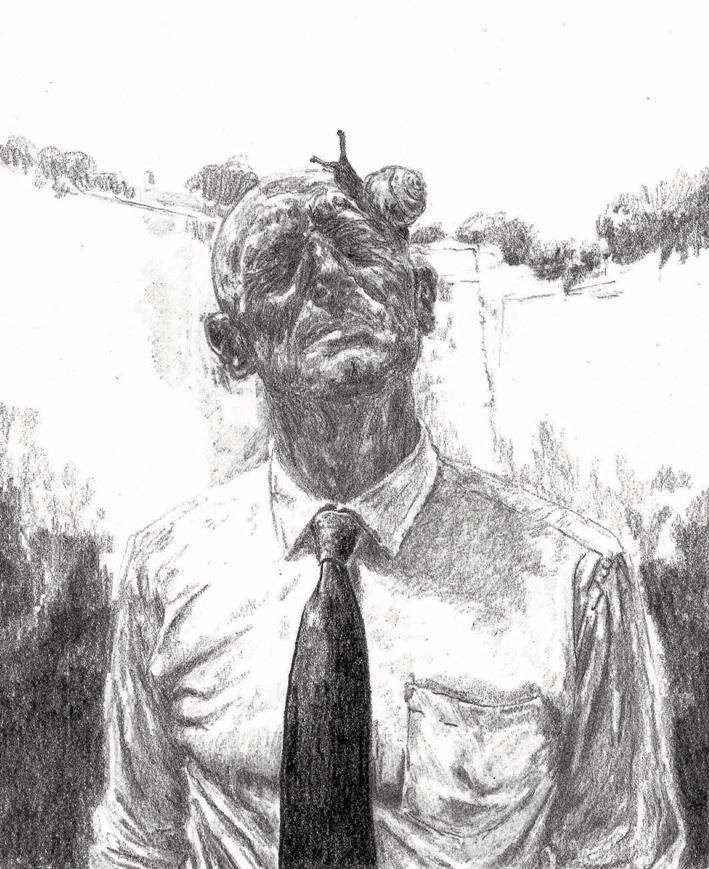
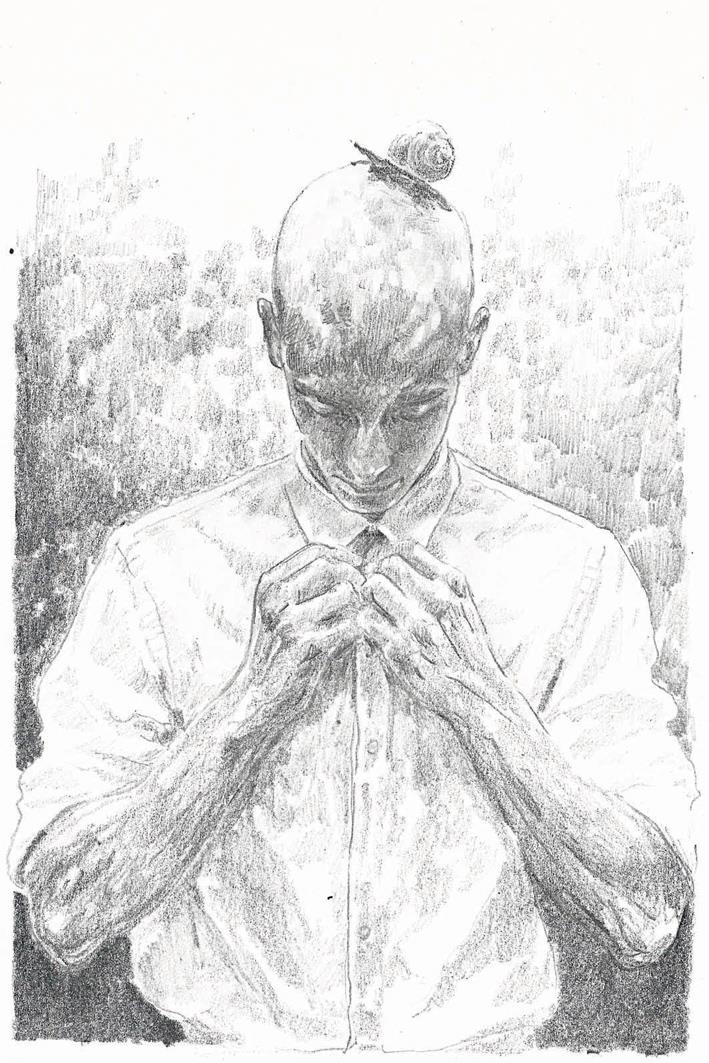
Two graphite drawings, Bebbuxu I and Bebbuxu II, depict male figures dressed in shirts, each wearing an unexpected accessory: a large snail resting upon the head. Although they appear dressed for the routines of everyday or corporate life, the presence of the snail invites reflection. Perhaps it symbolises a longing to slow down, a quiet resistance to the relentless pace of contemporary life.
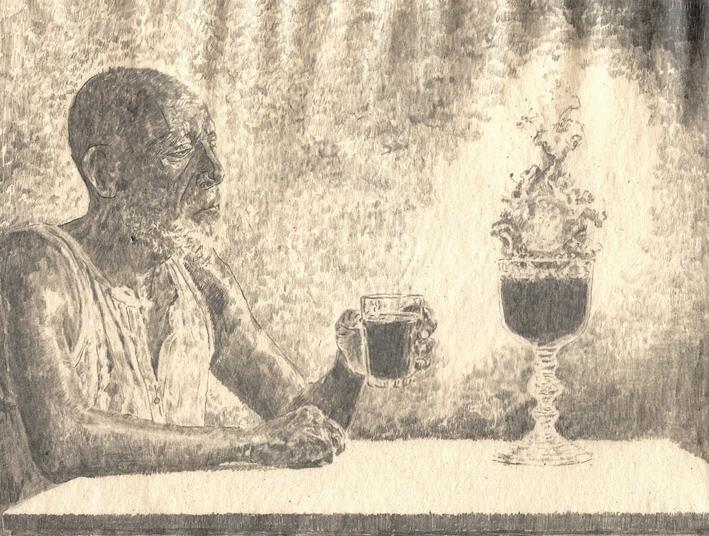
Farrugia even manages to transform the familiar ritual of drinking wine into something layered with mystery. In Inbid, an elderly man, holding an unconventional drinking vessel, stands before an ornate chalice filled with wine. Wisps of smoke rise gracefully from its surface, making the vessel appear less like a glass and more like a potion prepared for an unknown ritual. As with many of the works in the exhibition, certainty remains elusive, and viewers are left to construct their own interpretations.
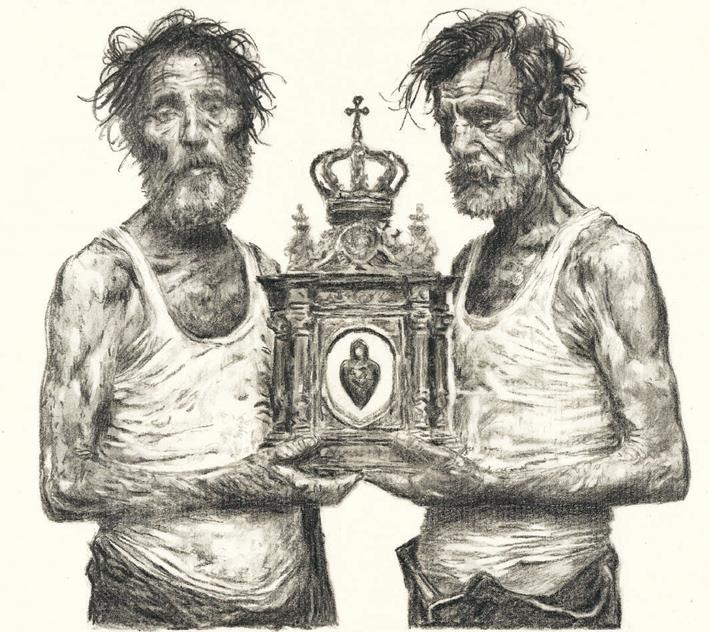
Relikwa is another of my favourites. Two elderly men, who could easily be mistaken for twins, appear as though they have only just risen from bed, their hair dishevelled and their trousers still unbuttoned. Together they carry an extraordinarily elaborate reliquary, crowned at its summit and containing a floating heart. The scene is both humorous and deeply symbolic, balancing the ordinary with the sacred in a way that feels entirely characteristic of Farrugia's dreamlike world.
Ultimately, Record of Nighttime rewards patient looking. Its greatest strength often lies in what remains almost hidden: a field of densely accumulated marks, the delicate shimmer of a silverpoint line, or a figure slowly emerging from the surface. These drawings are not simply images but quiet records of contact between hand and paper, night and waking, memory and material. Rather than offering answers, they invite viewers to linger within uncertainty, allowing each work to unfold gradually through observation and imagination.
A special mention must go to Umberto Buttigieg, whose constant presence and support have accompanied this exhibition in countless ways. Thank you, Pietru and Umberto, for such a memorable experience.
Record of Nighttime is on view at il-Kamra ta' Fuq, Mqabba, until 26th July. For more information and opening hours, follow il-Kamra ta' Fuq on social media.