Esther Sant and Betty Hanley Lee have never been paid a cent for their work, not even for the fuel they spend driving between Mater Dei Hospital and the homes of women they support. For 19 years, the chairperson and vice-chairperson of the Action for Breast Cancer Foundation have run the organisation as volunteers, and in an interview with The Malta Independent on Sunday, they detailed how that work has secured free prostheses, funded cutting-edge diagnostic tests and, as recently as this March, donated a high-tech ultrasound machine to the State hospital's rapid access clinic.
The foundation the two women lead, set up in March 2007, now counts a long list of tangible achievements behind it, from the removal of VAT on mastectomy bras to the funding of genomic testing that spares dozens of women unnecessary chemotherapy each year. Sant and Hanley Lee say every one of those changes began with a gap they identified themselves, either as patients or as volunteers working alongside patients.
Malta yearly records roughly 400 new breast cancer diagnoses, including around four in men, up from 267 in 2007, the year the foundation was founded. Sant co-founded the organisation with the late Helen Muscat, a nurse who died in October 2013, after the pair found the system "lacking" following their own experiences with breast cancer. Hanley Lee, who was diagnosed with breast cancer in 2005 and later trained as a mastectomy fitter, became a member "almost from day one".
Their first campaign targeted what they describe as an effective monopoly over breast prostheses. For years, women leaving hospital after a mastectomy were referred to a single private supplier who fitted patients from her garage in Mosta after 5pm. Patients eligible for a subsidised prosthesis under a hospital referral form were, Sant and Hanley Lee said, sometimes told they would only receive the higher quality item if they paid extra out of pocket. Sant and Muscat took the issue to a Times of Malta journalist at the time; only after a second article was published did the Ministry order an investigation. The result was the appointment of dedicated breast care nurses to handle fittings in-house and the introduction of open tenders for properly certified silicone prostheses.
That campaign fed directly into one of the foundation's earliest formal wins: between January and March 2011, the foundation successfully lobbied government to secure free, high-quality breast prostheses for mastectomy patients, supplied through the breast clinics at Mater Dei Hospital and Gozo General Hospital. The following year, in April 2012, they began donating specialised mastectomy bras, at an average cost of €50 each, to the same two clinics, an ongoing service that continues today. The system, they explained, operates on a rotation basis: the foundation provides bras in three styles and across all sizes, and replenishes stock as clinics return used packaging. In October 2024, their advocacy secured a further concession when Legal Notice 355 removed VAT from mastectomy bras sold at retail level.
Equipment donations have run in parallel with that patient-support work. In August 2007 and again in April 2012, Sant and Hanley Lee's foundation paid for two biopsy guns, at €2,041 each, to speed up core needle biopsies at a hospital that, in the organisation's early years, had access to only one such device. A digital microscope costing €2,866 followed in June 2010, supporting Mater Dei's multidisciplinary team in case reviews and treatment planning, while a gamma probe worth €10,006 was donated in December 2012 to improve the identification of sentinel lymph nodes during surgery. That same year, the foundation also funded a pigmentation machine for the hospital's plastic surgery department to support nipple reconstruction after breast surgery. Most recently, in December 2024, it donated four scalp cooling machines costing a combined €105,280, intended to reduce hair loss during chemotherapy, and in March this year it added a high-tech ultrasound machine to the rapid access clinic at the Sir Anthony Mamo Oncology Centre, aimed at cutting delays in diagnosis and assessment.
On the treatment side, Sant says the foundation's most significant early success came in June 2008, when it secured government approval for HER2-targeted medication to be provided free of charge to patients with HER2-positive tumours. The treatment had previously cost around €600 per 450mg dose. More recently, in October 2023, the foundation secured funding for Oncotype DX testing, a genomic test that determines whether patients with early-stage breast cancer are likely to benefit from chemotherapy. Around 55 women a year fall into the grey area the test is designed to resolve: patients whose pathology gives no clear answer on whether chemotherapy would help. The test scores tumours on a scale of one to 100, with a score above 26 indicating a likely benefit from chemotherapy.
To persuade the Health Ministry to fund it, Sant and Hanley Lee commissioned an economic study, costing €5,310, that calculated the wider costs of unnecessary chemotherapy, including hospital bed nights, lost working days and emotional strain, against the roughly €3,000 the test itself had previously cost per patient. "The minister is not emotional... he works on medical economics," one of the two women said, adding that the government agreed to fund the test once it was presented with figures rather than an emotional appeal.
Patient welfare beyond the purely clinical has also featured in Sant and Hanley Lee's work. Since September 2015 the foundation has provided newly diagnosed patients with folders to keep all treatment-related information in one place, and since March 2016 it has offered free psychological support, up to 15 sessions per patient, available to both patients and their families. Around 30 to 35 people access the service each year, a figure that Sant and Hanley Lee describe as modest compared with the hundreds of new diagnoses recorded annually. Nevertheless, they emphasise that the service fills a real gap, as some patients may find it easier to speak to a counsellor than with a partner or spouse.
Despite the list of wins, Sant and Hanley Lee point to persistent strain within the health service. They noted that the breast clinic they work most closely with recently lost one of its three specialist nurses, leaving two nurses managing what was already, in their words, a busy caseload even with three. They see this as symptomatic of a wider staffing shortage across the health service rather than an issue specific to breast care.
Screening policy remains an unresolved frustration for the pair. They have lobbied for years to lower the age at which women are automatically invited for a national mammogram from 50 to 45, and to bring forward screening to 40 for women with a first-degree relative who has had breast cancer or a known genetic risk. Sant and Hanley Lee said they believed a manifesto commitment to widen screening access was made ahead of the March 2022 general election, but say they have yet to see it acted upon. They also want to see a dedicated breast unit established at Boffa Hospital as it is redeveloped into a wider screening centre, offering mammography and walk-in assessments for anyone with a suspicious symptom, alongside referrals from GPs and the national screening programme, without patients having to wait months for an appointment.
Asked why diagnoses have risen so sharply since 2007, Sant and Hanley Lee point to a combination of greater awareness, which they say is driving more women to come forward and be screened, and lifestyle factors including poor diet, sedentary routines and a tendency to cancel or postpone mammogram appointments under time pressure. They argue that delayed diagnosis, whether through fear, denial, or GPs underestimating early symptoms, remains one of the biggest threats to patients' prognoses, and urged anyone with concerns to seek a second opinion rather than accept reassurance at face value.
Hanley Lee, who has spoken publicly about her own diagnosis and mastectomy since 2005, said going public with her story helped push her toward volunteering, at a time when she knew no one else on the island who had experienced breast cancer. She went on to train as a mastectomy fitter and has continued to volunteer with breast cancer patients ever since, including at the National Cancer Platform based at the Sir Anthony Mamo Oncology Centre.
Reconstructive surgery, now available through Mater Dei's plastic surgery department, has advanced considerably since Sant and Hanley Lee's early years with the foundation, when patients seeking breast reconstruction had to go private. They describe reconstruction as, in some respects, a harder journey than the mastectomy itself, since it typically involves not one operation but a series of corrective procedures, and note that many women who have been through it describe the physical weight of a prosthesis and the loss of sensation as an ongoing mental as much as physical adjustment. They also stressed the value of open, face-to-face conversations within families about hereditary risk, pointing to their own experience of passing awareness down through generations, from mothers and grandmothers who had the disease to daughters and granddaughters now encouraged to examine themselves and understand their family history from a young age, rather than relying solely on school talks or online information during Breast Cancer Awareness Month each October.
Looking ahead, Sant and Hanley Lee's immediate ambition is a permanent home of their own. The foundation currently rents its premises, a cost they say diverts money that would otherwise go directly to patients. "All our money goes to our patients," one of them said, adding that after nearly two decades of lobbying, equipment donations and patient support delivered entirely as volunteers, they intend to keep pushing for expanded screening and a fully staffed breast unit, "because it shows passion... we're all volunteers. Nobody gets paid".
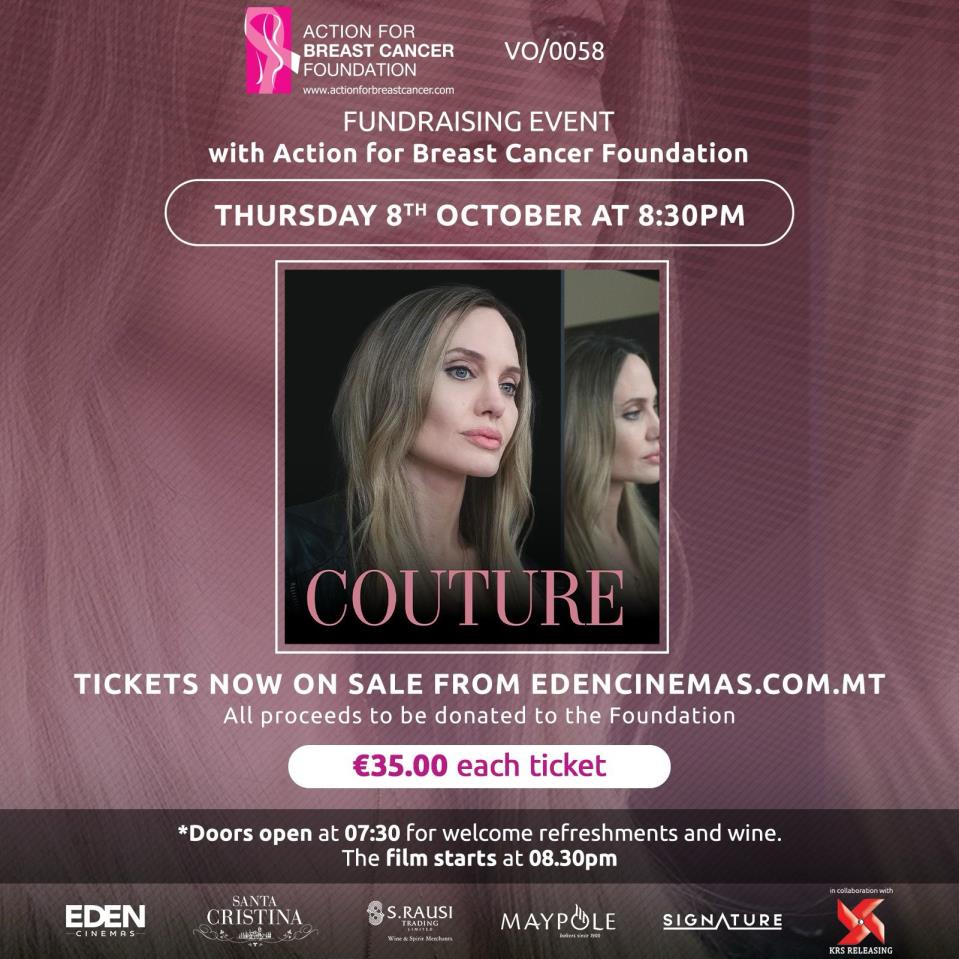
Readers wishing to support the foundation's work can do so on 8 October, when the Action for Breast Cancer Foundation is hosting a fundraising screening of 'Couture', starring Angelina Jolie, at Eden Cinemas, with a reception of wine and finger food from 7.30pm ahead of the 8.30pm screening. All proceeds go directly to the foundation. Tickets are on sale now at edencinemas.com.mt