Poverty remains a stubborn fact of life in Malta, as it does in richer countries. Persistent socio-economic disadvantage has a negative impact on the life outcomes of many Maltese children. There are numerous reasons why people fall into poverty, including limited access to education and a lack of basic necessities.
Malta did not even have an action plan to tackle poverty until 2004, when it was required by the European Commission prior to accession. Official standardised EU-comparable poverty tracking (such as Eurostat's EU-SILC) for Malta only began around 2004/2005, but local household budget surveys from the National Statistics Office estimated the at-risk-of-poverty rate to be around 13% to 15% around the year 2000. Children and youths in particular were found to be a vulnerable group with 20% of children and youths of less than 16 years of age below the at-risk-of-poverty threshold after social transfers in 2004.
Since then, progress in reducing the monetary rate of risk of poverty (60% of the median equivalised income) has been rather insignificant in general, with the rate hovering around 15%-16% in the EU (including Malta), though some countries like Ireland and Denmark have been able to reduce it to around 12%. However, the wider rate of poverty and social exclusion, statistics for which only started being compiled in 2015, has improved by three-four percentage points to 19%-20% in both the EU and Malta.
The PL's 2013 electoral manifesto rather foolishly promised the eradication of poverty in Malta. This was based on a total misinterpretation of the EU's poverty statistics. The EU does not talk about absolute, but about relative, poverty ̶ that is, about how poor people are with reference to median income. It can therefore happen that incomes rise but poverty deepens, because the median income of the population rises faster than the income of certain categories of people. In this statistical world, poverty can never be eradicated because there will always be a certain percentage of people below 60% of that median.
Welfare handouts, economic empowerment, and active inclusion have improved the lot of people ̶ as measured by the EU's material and severe material deprivation rates ̶ such that these two kinds of deprivation have almost disappeared in Malta. But poverty and social exclusion haven't.
What concerns me today, though, is not poverty in itself, but rather the connection between education and poverty and how education can be a powerful tool in breaking the poverty cycle. This is because recent research by the University of Liverpool and the University of Manchester, commissioned by the Joseph Rowntree Foundation, reveals that growing up in poverty triples a young person's risk of being locked out of education and stable work. Pretty much the same story emerges from other countries' studies.
Consider that 23.8% of children under 16 years of age are at the risk of poverty and social exclusion in Malta (the rate in the EU is 24.2%). This is some four percentage points higher than the overall population's rate. We are letting down almost a quarter of our children, knowing that poverty has a negative influence on student behaviour, achievement, and retention in school.
Research in Malta and elsewhere shows that childhood poverty directly causes lower test scores, poor mental health, and a higher chance of becoming NEET (Not in Education, Employment, or Training). It also reveals that the length and timing of poverty deeply shape a student's final academic success. On the other hand, global data is clear: improving school quality remains one of the strongest tools to lower poverty rates, with each extra year of schooling raising future earnings by about 9%.
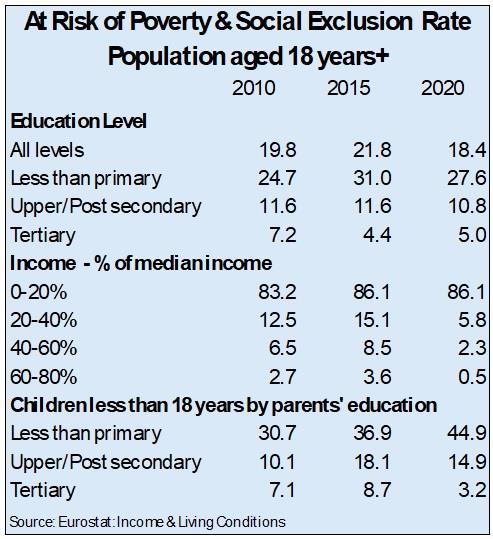
My chart provides some insight into the link between education and poverty. It is clear that people with less than primary education are five times more likely to be at risk of poverty and social education than those who have had a tertiary level of education. A secondary education helps, but people with this level of education are still twice as likely to be poor than those in tertiary education.
An equally telling link is that between children's poverty rate and the educational achievements of their parents. Children whose parents have less than a primary level of education are fourteen times more likely to be in poverty than those who parents had a tertiary education. A secondary education by their parents would at least have helped reduced the likelihood of being in poverty to four times.
What does this all mean for incomes through their lives? The chart also shows how those at risk of poverty are those with low incomes. The rate is almost 45% for those earning between 0-20% of the median income in the country, dropping sharply for people with a secondary/post-secondary level of education, and becoming minimal for those with tertiary qualifications. The rates highlight a cycle of poverty where individuals and families struggle to make ends meet and are unable to improve their standard of living.
Another important conclusion from longitudinal studies of the academic growth curves of students during the school year and over the summer was that much of the achievement gap between low and high socio-economic status (SES) could be related to their out-of-school environment (families and communities). Parental involvement, such as frequency of outings and problem-based play, creates greater intellectual stimulation and educational support for children. Where it is lacking, children's education suffers.
The reality on the ground in Malta is that we are failing in educating our children to avoid the risk of poverty. The latest statistics from the OECD's Pisa scoreboard confirm this beyond any doubt, with scores and proficiency levels declining across reading, mathematics and science. The average mean scores for 15-year-old have dropped by 40, 33, and 12 points respectively since 2015.
The propaganda section with the Ministry of Education was quick to highlight some positive aspects. It told us how attractive the apple was, that some parts of it were sweet and crunchy, and that it was brightly coloured. The rotten core is what matters. The ministry did acknowledge "certain persistent challenges," but dismissed them as "outside the direct control of school authorities." Nonsense. The dinosaurs in the ministry refuse to learn from many fine examples abroad.
What is persistent are the Education Ministry's failures through the years. Our Pisa scores in reading, mathematics and science now are 27, 24, 8 points respectively lower than they were in 2009. Our 2025 scores were lower than the corresponding OECD country averages. SES remains a predictor of scores, according to the OECD, accounting for roughly 6% of the variation in science performance, for example.
What is striking is that, while official policy is that family-centred policies and parental collaboration are central to students' academic success, policy has rarely been followed up by meaningful family and community engagement. For example, all over the world there are several examples of such engagement in active learning approaches to a comprehensive early childhood curriculum. They involve parents closely in planned activities in the key subject areas of language and literacy, mathematics, science, and music. In a study of such programmes, children who participated were more likely to have graduated, held a job, had higher earnings. and have committed fewer crimes.
Similar positive effects of preschool intervention were found in projects that enlisted children from low-income families between infancy and five years of age to receive a high-quality educational intervention that was customised to their needs. The project used games focused on social, emotional, and cognitive areas of development. Children were evaluated at 12, 15 and 21 years of age, and those who had received the intervention had higher cognitive test scores, a greater academic achievement in reading and maths, had completed more years of education, and were more likely to have pursued further education. Interestingly, the mothers of children participating in the programme also had higher educational and employment status after the intervention.
Is it not even the case that there is a stage beyond which it becomes too late for interventions to be successful. In Canada, the highly successful Pathways to Education project has helped children succeed in secondary and post-secondary schools. The core elements of the programme include a contract between the student, parents and project; student-parent support workers who advocate for the student at school and connect parents to the project and/or school; four nights a week of tutoring (by volunteers) in the community; group and career mentoring located in the community; and financial support, such as money for public transit and scholarship money for postsecondary education dependent on successful academic work and graduation.
The problem with our education bureaucrats might be that they don't know how to do Google searches. One old and eminent early intervention programme I discovered is the Chicago Child Parent Center programme. The project targets students who are between preschool and grade 3 through language-based activities, outreach activities, ongoing staff development, and health services. Here, there is no set curriculum; the programme is tailored to the needs of each child. One crucial feature of the programme is the extensive involvement of parents, where they are offered services to improve their knowledge, increase engagement in their children's education, and hone their parental skills.
The reaction of various academics and bodies to the PISA scores was scathing. Momentum called any supposed education miracle as a "myth" while the Opposition described the results as a "devastating indictment." Going beyond political criticism, academics have put the blame on the lack of a targeted strategy focused on critical thinking, foundational literacy, and lack of proper management of technology in classrooms.
What we have is a leaning Tower of PISA. In Pisa, the tower was stabilised to avoid any further leaning. in Malta, PISA needs to undergo structural re-engineering techniques not just to stop the rot, but to make it upright.