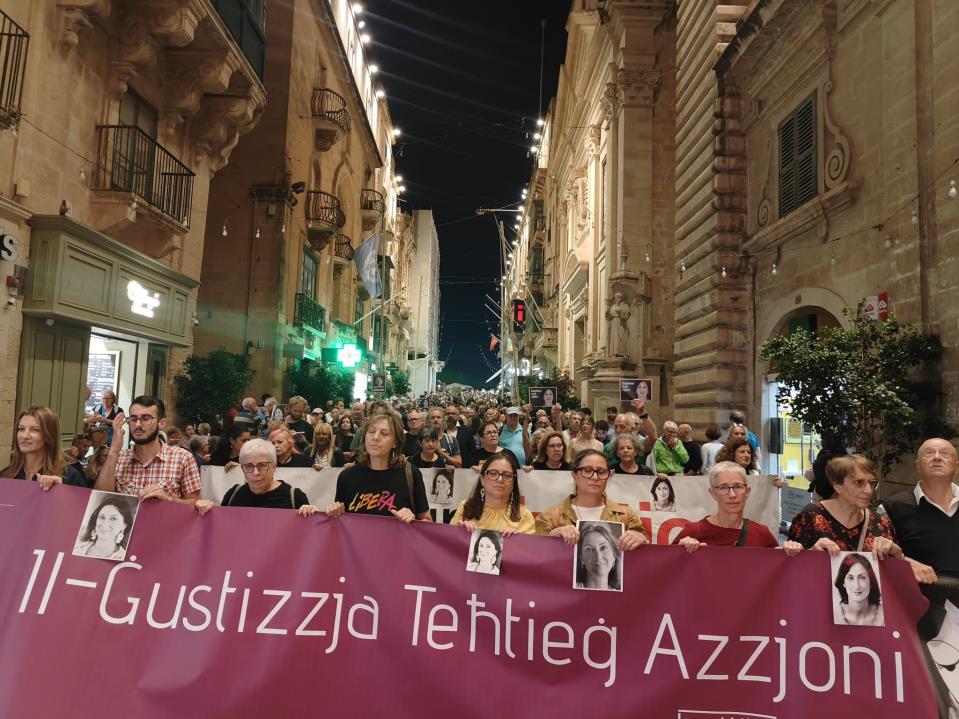
Protesters gathered in Valletta this evening, marking exactly nine years since investigative journalist Daphne Caruana Galizia was killed in a car bomb soon after she left her home in Bidnija.
What began as an island-wide tremor of shock has transformed into a resilient, enduring movement for democratic survival, given a fresh spark last month after the acquittal of Yorgen Fenech of charges related to conspiracy and complicity in the murder.
A series of activities were held all throughout the day, starting off with an event organised by the Institute of Malta Journalists next to the memorial dedicated to Daphne at the Great Siege Monument, opposite the Law Courts in Valletta.
It followed up with a memorial service in Bidnija, on the site when Daphne was killed, and a Mass in Valletta, which preceded the protest march later in the evening.
Four distinct voices - spanning international legal advocacy, cross-border anti-mafia solidarity, and local civic resistance - took to the podium at the end of the protest march to deliver a sobering assessment of Malta's present and a fierce demand for its future.
Anna Myers, an international lawyer specialising in whistleblower protection, who described Caruana Galizia's assassination not as an isolated tragedy, but as a systemic assault on truth-tellers everywhere.
Myers drew a direct line from Malta to Slovakia - invoking the murder of Ján Kuciak and Martina Kušnírová - to illustrate how these dark milestones catalysed pan-European legislation against abusive Strategic Lawsuits Against Public Participation (SLAPPs) and corporate retaliation. "There is absolutely no reason why - in my simple view of the world - that when speaking up about possible wrongdoing or risk of harm that one comes across in the course of one's working life should suddenly cast someone on to a lonely road, full of risk and obstacles and fear," Myers noted, capturing the isolation often faced by those who expose corruption.
Reflecting on the wider European awakening sparked by these tragedies, Myers emphasised the power of collective presence: "We are standing in the public space, we are holding that space open to remember Daphne as a real person, not a symbol, to be with her family whose lives were changed forever, to see each other and know that together that we can and will make a difference." She underscored that democratic checks and balances only function when citizens actively nurture them and protect vulnerable truth-tellers from institutional backlash.
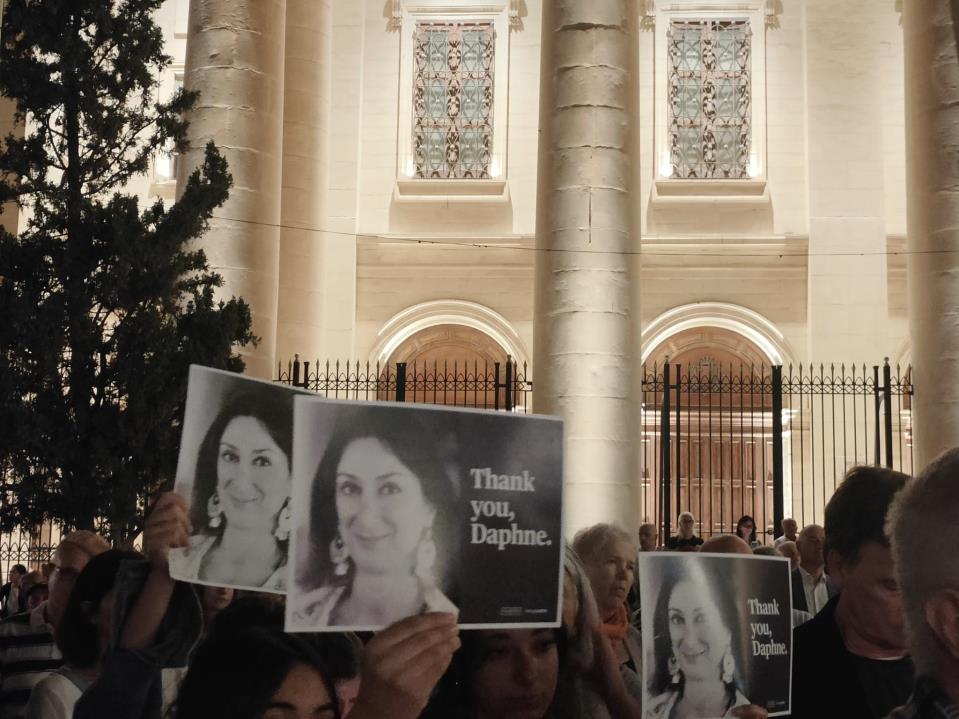
"I remember that democracy only works if we nurture it, we continue to engage with it, investigating, to do our jobs well, to support our communities, to protect the vulnerable and to call out those who had the power to act and did not do it in our collective interest, but did so in their own interests," she said.
Francesca Rispoli, representing the Italian anti-mafia network Libera, spoke about the dangerous allure of silence, or omertà. "Nine years ago, a bomb tried to silence her. Nine years later, we are still here. And our being here is the answer," Rispoli said.
Rispoli challenged the complacency of everyday life, urging citizens to look in the mirror rather than turning away from injustice. "With the way I live, am I helping what I say I condemn? With my silence? With my resignation? With omertà? With saying 'that is just how things are'?" she asked, linking local political apathy directly to the wider web of organised crime that feeds on legal loopholes and grey zones.
Rispoli reclaimed the historical insult hurled at Caruana Galizia - that she was a "witch" - transforming it into a badge of honor for anyone daring to ask uncomfortable questions. "They were women who knew things. Women who asked questions. Women who did not obey, who did not stay quiet, who could see what others pretended not to see," Rispoli said. "So what does it mean to be a witch today? It means looking for the truth when everyone says there is nothing to see. It means speaking when it would be easier to stay silent."
"It means not being afraid of power. If this is what a witch is, then Daphne was a witch. And tonight, in this square, we must all be witches," she said.
Local activist Louiselle Vassallo addressed the righteous anger felt by those who refuse to let the murder fade into administrative oblivion. Vassallo didn't mince words regarding the Maltese government's feet-dragging, pointing out that five years after a landmark public inquiry, the Prime Minister continues to ignore vital recommendations while treating the journalist's permanent roadside memorial in Bidnija with calculated avoidance.
Vassallo fiercely rejected the label of negativity often pinned on activists demanding accountability. Directing her frustration at the political leadership, she criticised the government's indifference to organised crime legislation and its physical neglect of the Bidnija site. She said that silence guarantees neither safety nor peace, but rather the slow erosion of justice and civic responsibility.
Repubblika president Vicki Ann Cremona placed the ongoing struggle into a broader constitutional framework, warning that institutional hatred and manufactured division are actively deployed to alienate citizens from systemic corruption. Cremona recalled Caruana Galizia's relentless courage in uncovering scandals like the Panama Papers, 17 Black, and Electrogas, which exposed the murky ties between business and political power.
Cremona noted how hatred was weaponized against Daphne to distract the public from institutional theft.
Cremona highlighted the recent Civil Constitutional Convention organised by Repubblika as a vital first step toward reclaiming public life from partisan capture, urging citizens to rely on civic imagination rather than waiting for compromised politicians to reform themselves.
In the morning activity organised by the Institute of Maltese journalists, president Nicole Meilak noted that Caruana Galizia was killed simply because someone believed she knew too much, calling the assassination not only a cruel murder of a writer, but a direct attack on the public's collective right to know.
Meilak acknowledged that while people may disagree with a journalist's methods or writings, violence crosses a line that must never be accepted. She stressed that violence against journalists takes many forms beyond physical harm, highlighting how online harassment, digital bullying, and malicious lawsuits continue to be used to intimidate reporters and silence critical reporting.
She called on the public and media community to maintain zero tolerance for violence while standing firm in defending public scrutiny.
Reflecting on recent developments in court, Meilak shared the profound shock felt by many when Yorgen Fenech was acquitted of charges linked to the murder, describing how hopes for justice were shattered after years of waiting.
She pointed out that when public faith in institutions and legal processes falters, the role of independent journalism becomes even more vital in uncovering the truth.
Concluding her address, she urged journalists to recognize the true value of their work in informing the public, describing this commitment to truth as the most meaningful way to honour Daphne Caruana Galizia's enduring legacy.