Malta remains the worst place in the European Union in which to do business, according to the World Bank’s ‘Doing Business 2014’ released on Tuesday.
The influential report, which is referred to by international investors when determining foreign direct investment locations, places Malta as the 103rd most friendly place in the world in which to do business out of 189 countries gauged this year. Malta’s ranking was 102nd in its debut to the index last year.
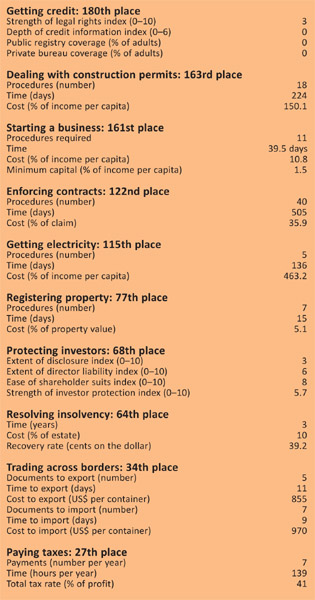
The main sore points about doing business in Malta, according to the World Bank, were in the areas of getting credit (180th) starting a business (161st), dealing with construction permits (163rd), getting electricity (115th) and in enforcing contracts (122nd).
Areas in which Malta performed better in the index were registering property (77th), protecting investors (68th), paying taxes (27th)trading across borders (34th), and resolving insolvency (64th).
Malta’s dismal 103rd rank this year reflects more than a little poorly on Malta, which was also in 28th place among the EU28. New EU recruit Croatia had the EU’s next lowest rating but still significantly higher than Malta at 89th, followed by Romania (73rd), the Czech Republic (75th), Greece (72nd) and Italy (65th).
The EU ranks were led by Denmark (in fifth place after, in order, the US, New Zealand, Hong Kong and Singapore, which topped this year’s rankings). 18 of the EU 28 ranked in the world’s top 50 and as such are apparently at least twice as easy to do business with than in Malta.
The report, subtitled Understanding Regulations for Small and Medium Size Enterprises, compares business regulations for domestic firms in 189 countries. Among the Malta contributors to the World Bank report are the country’s top law, audit, shipping and architectural firms, the Malta Environment and Planning Authority, the Finance Ministry’s Customs Department, the Inland Revenue Department, and the Malta Financial Services Authority, the Land Registry, and Enemalta Corporation.
The Doing Business report sheds light on how easy or difficult it is for a local entrepreneur to open and run a small to medium-size business when complying with relevant regulations. It measures and tracks changes in regulations affecting 10 areas in the life cycle of a business: starting a business, dealing with construction permits, getting electricity, registering property, getting credit, protecting investors, paying taxes, trading across borders, enforcing contracts, and resolving insolvency.
Overall, Singapore and Hong Kong top the Doing Business list of the 10 most business-friendly places in the world. Rwanda, the Russian Federation, and Philippines are among the most improved in the annual survey of 189 economies, while the gap between the best and worst performers in the survey is narrowing as countries foster entrepreneurship and trade.
“This year, we see a higher number of reforms – 18 per cent more – the second-highest number since the financial crisis,” said Rita Ramalho, programme manager for Doing Business at the World Bank Group.
“This pick-up in pace of regulatory reform is good news particularly for small and medium-size businesses – the main job creators in many parts of the world.”
The increase is part of a decade-long trend in which countries are shortening the amount of time it takes to start a business and streamlining the process of exporting or importing goods, to name two examples of reform, she observed.
But, the report notes, over the last year Malta had undertaken just one reform that helped ease doing business in Malta, by having made ‘dealing with construction permits less costly by significantly reducing the building permit fees’.
“Countries want to be more competitive and to be prepared for when their markets are more open to international trade,” said Ms Ramalho.
They also want businesses to be able to survive competition from foreign firms, she added.
“Governments across the globe realise the private sector is an important motor of development and job creation,” she added. “And they realise it’s important to have the right regulations that enable the development of the private sector.”
The full report can be downloaded free of charge at www.worldbank.org