While Malta’s GDP growth continues to outpace that of the euro area, as does employment growth resulting in a lower unemployment rate, banks in Malta continue to practise lending rates to small business that are among the highest in the euro area.
Presenting the Central Bank’s annual report on Tuesday, CBM Governor Josef Bonnici showed a graph which shows that lending rates practised in Malta are the fourth highest in the euro area.
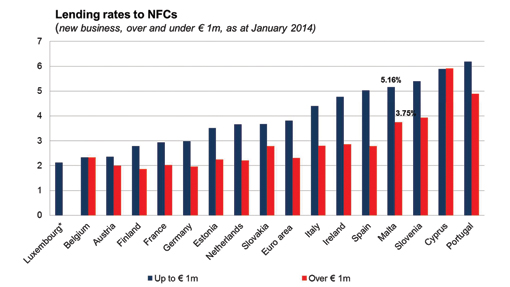
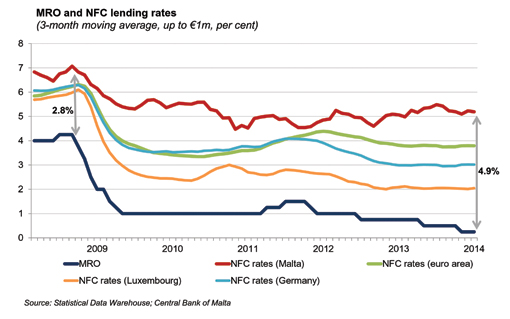
Besides, SME lending rates in Malta are not in synch with the MRO. The rates in Malta are higher than the euro area average even if the latter is biased upwards due to stressed countries.
The spread between SME lending rates in Malta and MRO rates was at 2.3% before 2009 and widened to 4.9% by the end of last year.
More worryingly, credit growth in Malta and that in the better performing countries have recently turned negative, although it remains above that of stressed countries.
In other words, the Governor added, Maltese SMEs are facing lending rates that are far higher than those faced by their counterparts not just in Luxembourg but also in distressed countries Spain and Italy.
The slowdown is more pronounced in the construction sector but credit to other corporate sectors has also turned negative.
The Governor then increased his take on the banking sector. The banking sector in Malta is diversified between core domestic banks, non-core domestic banks and international banks.
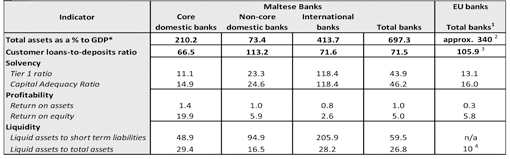
Comparing these three sectors is instructive especially when compared to the EU banks.
Total assets as a percentage to GDP: Core Domestic banks: 210.2%; Non-core domestic banks: 73.4%; International banks: 413.7%; EU banks: approximately 340.
Customer loans to deposit ratio: Core domestic banks: 66.5%; Non-core domestic banks: 113.2%; International banks: 71.6%; EU banks: 105.9%.
Solvency: Tier 1 ratio: Core domestic banks: 11.1%; Non-core domestic banks: 23.3%; International banks: 118.4%; EU banks: 13.1%.
Capital Adequacy Ratio: Core domestic banks: 14.9%; Non-core domestic banks: 24.6%; International banks: 118.4%; EU banks: 16.0%.
Profitability: Return on assets: Core domestic banks: 1.4%; Non-core domestic banks: 1.0%; International banks: 0.8%; EU banks: 0.3%.
Return on equity: Core domestic banks: 19.9%; Non-core domestic banks: 5.9%; International banks: 2.6%; EU banks: 5.8%.
Liquidity: Liquid assets to short-term liabilities: Core domestic banks: 48.9%; Non-core domestic banks: 94.9%; International banks: 205.9%; EU banks: n/a.
Liquid assets to total assets: Core domestic banks: 29.4%; Non-core domestic banks: 16.5%; International banks: 28.2%; EU banks: 10%.
Governor Bonnici quoted from press statements made by the Chamber of Commerce and GRTU which claimed that even bigger companies are finding difficulty in sourcing funds. Enterprises in the tourism sector and SMEs in particular regularly report frustrations. Others point out that they exist in international competition, competing against companies with better access to finance.
The European Commission itself in its recent report pointed at the efficiency of the financial sector and asked whether there is something odd in a sector dominated by two big banks.
On the other hand, BOV has been very successful with its Jeremie initiative while a similar initiative by Malta Enterprise does not seem to have taken off properly.
What Malta needs, the Governor concluded, is a development bank. A development bank can help bring funds to Malta and create important dynamics to fund big projects in Malta.
Banks in Malta are profitable and well capitalised and the core banks have a good return on equity. They are also very strong and very liquid. The modest downsizing of the banking sector (mainly the international sector) is largely driven by the banks’ anticipation of new regulatory requirements, consolidation efforts by parent companies and preparation for the Asset Quality Review.
As everyone knows, the Single Supervisory Mechanism that is being set up by the EU has taken off and, in Malta, Deputy Governor Alexander de Marco together with the Malta Financial Services Authority is handling the whole preparation for the AQR and the Central Bank is confident Maltese banks will do well.
This is why the Central Bank has recently issued what it called an Overhaul of Banking Regulation 09. Based on the EU’s CSR 5 it takes measures to further strengthen provisions for loan-impairment losses in the banking sector, to mitigate potential risks from exposure to the real estate market.
Non-performing loans are on an upward trend, This is more pronounced with regard to the overall figure while the resident households are mainly keeping to their schedule of payments.
So the overhaul intends to improve the banks’ overall coverage ratio and strengthen their provisioning practices and provide a buffer zone to further strengthen the banks’ capital and mitigate potential risks from the lending portfolios.
The amendments include:
- Allocate an amount of capital from distributable profits to a reserve equal to 2.5% of NPLs less impairments and interest in suspense, as defined in IFRS. For certain overdue NPLs, the requirement rises to 5% and can be raised further by MFSA
- Align the definition of NPL’s and forbearance with the newly established European Banking Association draft Technical Standard on Supervisory Reporting on Forbearance and Non-Performing Exposures
- Recognise incurred losses as early as possible within the context of the IFRS; and
- Set up an appropriate governance structure, a robust credit risk management framework and reporting systems.
Shareholders sometimes grumble that this means less return to shareholders but this is a trade-off that has been found necessary in the circumstances.
Coming to an end in his presentation, Governor Bonnici reiterated that bank charges in Malta are higher than in many other places.
One would have thought that with the changeover to internet banking, charges would be lower, but that has not been the case.
Other countries do things differently. When he lived in Luxembourg, the Luxembourg banks went the other way: they reduced costs of internet banking to encourage people to switch over to internet banking. Here, even to transfer funds between the two main banks costs. At the end, one is almost driven to writing a cheque since this is cheaper.
During question time, Paul Abela, from GRTU, complained that the private sector, especially the SMEs, are finding it difficult to get funding by banks because of bank and other charges.
He was almost instantly replied to by Charles Borg, BOV CEO, who pointed out that the decrease in overall lending by banks has happened because some large items have repaid their loans. If those loans are not replaced by other loans, one would get a decrease in the overall lending figure.
Over 90% of the bank’s clients are SMEs and by last January over 600 SMEs were being funded through the Jeremie scheme.
As for the cost of funding, BOV does not get its funds from ECB but from deposits by clients. It is a good thing that banks in Malta are liquid.
Many businesses in Malta get most of the funds they need through overdrafts even though this is more expensive. Many SMEs start from a low equity base. This is an additional risk for the bank which has thus had to finetune its lending structures.
The Maltese banking system now emerging from the five years of international crisis realises that the banks in Malta, the regulator and the government all played their part. But banks in Malta are still operating in an open market and the bank, in particular, has received many requests to open up, for instance, in Italy.
Governor Bonnici replied, pointing out that it is lending rates that are higher in Malta than elsewhere.
While the previous speaker had almost boasted his bank does not have ECB loans, Prof. Bonnici argued that on the contrary, the bank should have used this facility.
It is true that banks in Malta have excess liquidity but the banks should use this to offer loans at more competitive rates. This would help make Maltese companies more competitive.
While deposit rates are in line with the EU average, the lending rates are much higher than the EU average. While it is true there is credit risk attached to SME lending, there is still no reason why this has to be higher than in other EU countries.