Economic activity in Malta continued to outperform the weak growth in the EU in the first half of 2014.
A strong rebound in investment is projected to boost growth to 3% in 2014, before moderating somewhat over the forecast horizon. The budget deficit is projected to gradually decline over the forecast horizon, while the government debt is forecast to remain stable.
Growth in first half of 2014 higher than anticipated...
The Maltese economy continued expanding at a robust rate in the first half of 2014. Annual real GDP growth surprised positively and reached 3.2%, up from 2.5% for 2013 as a whole. Growth was driven by buoyant domestic demand, particularly thanks to investment and public spending. Net exports also contributed positively as a drop in exports, driven by a further contraction in the electrical machinery industry, was more than offset by a decline in imports.
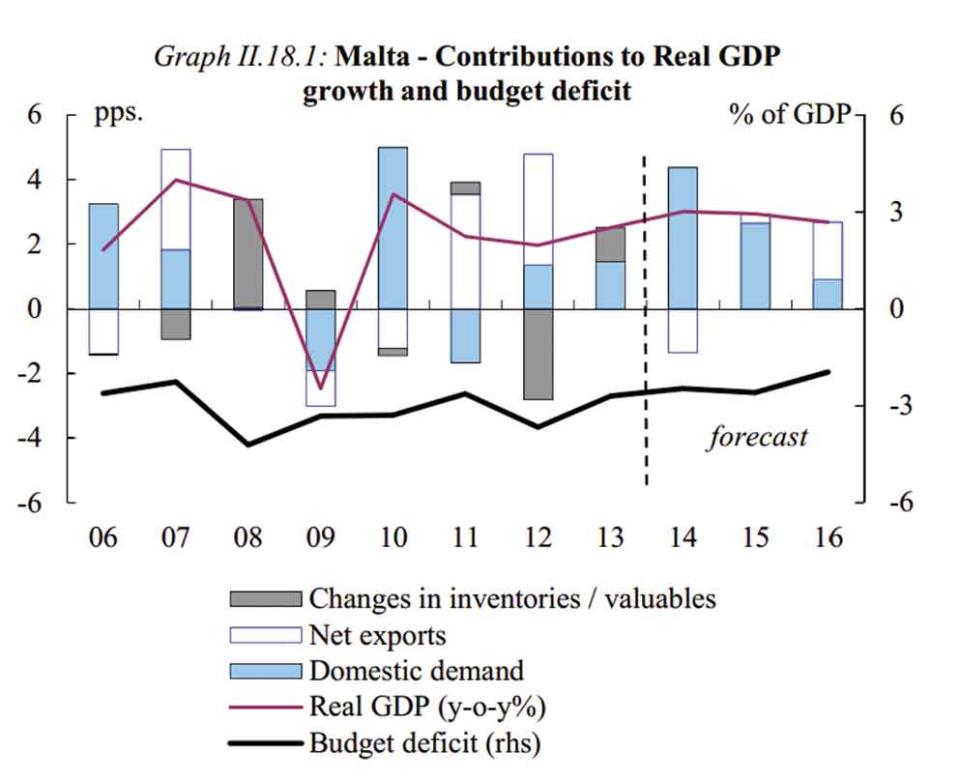
...and is expected to remain strong over the forecast horizon.
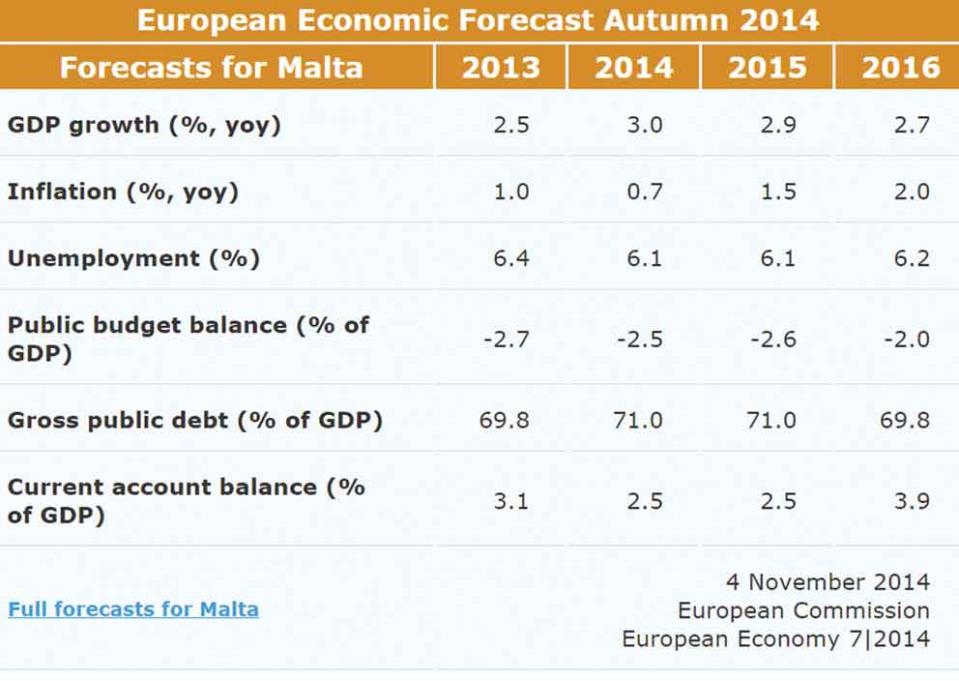
Overall, real GDP growth is projected to reach 3% in 2014 and moderate gradually to 2.9% in 2015 and 2.7% in 2016. Large scale energy projects, including the construction of a power plant in 2014-15 are expected to be a major driver of growth over the forecast horizon. Improving business sentiment and the absorption of EU funds, as projects funded under the 2007-13 financial framework are coming to an end, are expected to provide a further boost. Private investment in equipment and machinery is set to benefit from improving financing conditions, reflected in a gradual decline in interest rates, but bank credit standards for the construction sector are not expected to loosen notably.
The strong investment profile is expected to impact Malta's external trade figures over the forecast horizon due to the high import content of investment. Net exports are forecast to contribute negatively to growth in 2014, as the growth in imports is seen to pick up and outpace the relatively weak exports in the second half of the year. The expiration of the major energy-related projects in 2015 should result in a moderation of imports, while the upturn in global demand and especially the recovery of the electronics industry is projected to boost exports.
Favourable labour market developments and growing disposable income, also related to the lowering of electricity tariffs in 2014, are forecast to spur private consumption over the forecast horizon. At the same time, after peaking in 2014, the contribution of public consumption to growth is projected to moderate.
Risks are mainly concentrated around the investment outlook. Slippages in the energy projects would shift the growth profile forward, while the improvement in investor sentiment and the foreign investment in the energy sector could provide a further boost in 2015-16. The depreciation of the euro could boost demand for Maltese exports from outside the EU.
Price inflation is projected to pick-up
HICP inflation was low in the first nine months of 2014 because of the reduction in electricity tariffs for households in April and very moderate increases in food prices. Overall, HICP is projected to average 0.7% in 2014 as a whole before gradually picking up to 2% in 2016. This increase is expected to come mainly from a stabilisation in energy prices and a normalisation in food prices inflation. The expected lowering of electricity tariffs for industry in 2015 is projected to keep input costs contained and, in turn, services inflation stable, thereby offsetting upward pressure from households' growing disposable income.
Deficit under control despite growing spending
The general government deficit is expected to improve marginally in 2014 to 2.5% of GDP, from 2.7% in the previous year. Current revenues are projected to increase thanks to the favourable macroeconomic outlook as well as to the revenue increasing measures included in the 2014 budget, namely increases in indirect taxation, a new programme to grant Maltese citizenship to foreign individuals and families and the introduction of a new tax regime for rental income. In addition, in July, a new scheme intended to enable taxpayers to adjust past irregular declarations of income was launched. Despite the restrictions on recruitment envisaged by the 2014 budget, employment in the public sector has increased due to the temporary nationalization of the transport system as well as higher recruitments mainly in the health and education sectors. Therefore current expenditure is expected to increase, also due to higher than expected subsidies to the transport sector as well as intermediate consumption. Net capital expenditure is expected to fall due to a lower capital injection into Air Malta, compared to the one in 2013.
In 2015, under the no-policy-change assumption, as the 2015 budget was not presented before the cut-off date of the forecast, the deficit is expected to increase marginally to 2.6% of GDP, also due to a further capital injection into Air Malta, higher than the previous year one (0.5% of GDP).
In 2016, using the no-policy-change assumption, the deficit is expected to decline to 2.0% of GDP, thanks to a favourable growth outlook and to the expiration of the public support for Air Malta. After having decreased by more than 1 pp. of GDP in 2013, the structural deficit is projected to stabilise in 2014 and to deteriorate marginally in 2015. In 2016, the structural deficit is expected to improve by ½ pp. of GDP.
The general government debt-to-GDP ratio increased to 69.8% in 2013, also on account of a debt-increasing stock-flow adjustment. Despite the expected repayment of some tax arrears from Enemalta (the public energy utility corporation), the debt ratio is projected to continue increasing in 2014 thanks also to a higher cash buffer at the end of the year, before moderating somewhat by 2016.