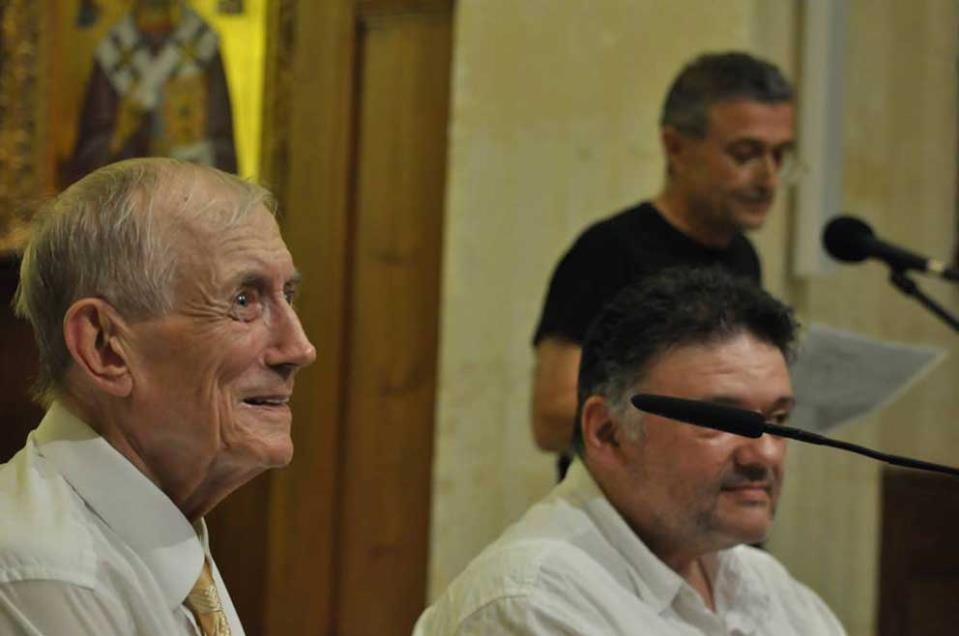
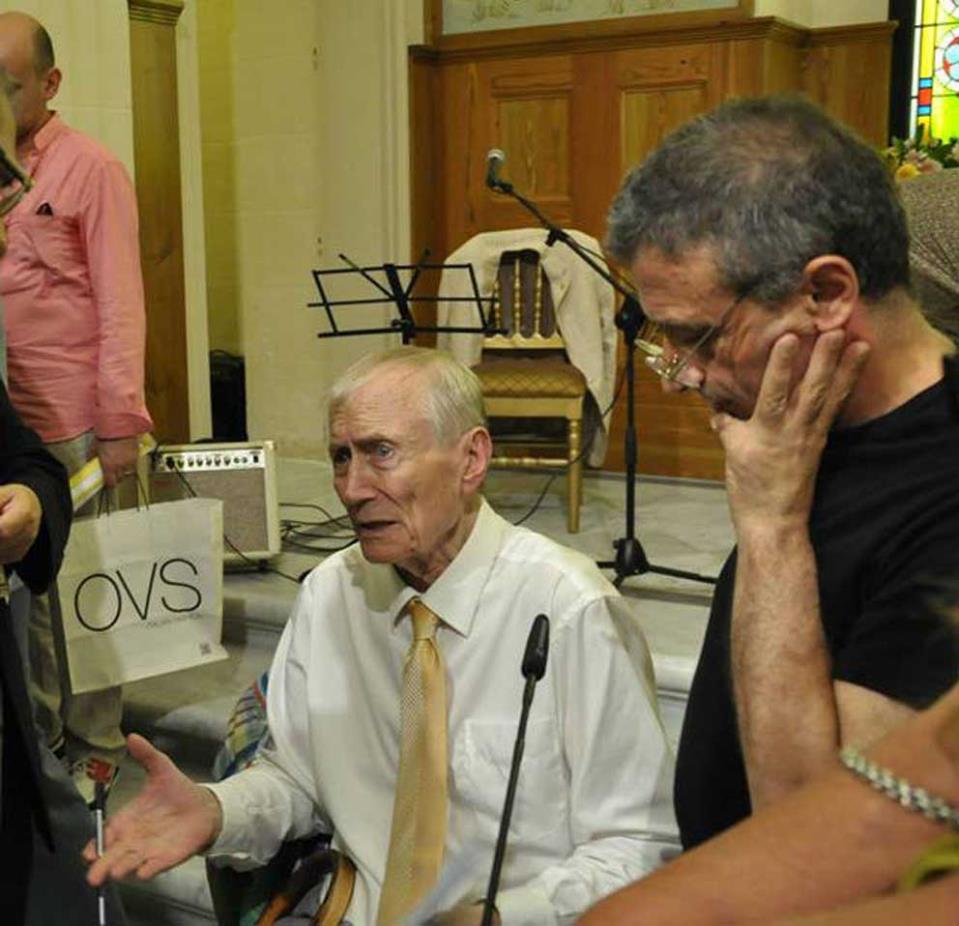
The news which Albert Marshall delivered to me during a meeting of ours some time ago was, to say the least, unexpected. Not only was I invited to meet Yevgeni Yevtushenko, one of the most important poets of the 20th century and one of the most dedicated to his rebellion, but over and above Marshall insisted that I should recite Yevtushenko's 'epic' poem, Babi Yar, in Russian and also in Maltese (my own translation carried out together with the help of Olvin Vella) at a literary evening in the Russian Chapel at San Anton Palace.
This obviously incited profound memories and nostalgias. Yevtushenko, together with another Russian, the singer-troubadour Vizotskii, was a highly significant personality, especially during the shifts of the 1960s. His was likewise a reflection on the rebellious protest which was gripping the world fifty years ago. It was the time of Bob Dylan and of Woody Guthrie, together with the Italian singer-songwriters. It was an age of new hopes, vehement fights against Western imperialism led by the United States, the attack against the Vietnam War, the phenomenal uprisings of world populations to secure their independence (including the Maltese), radical global changes, the total confusion in the battle between the communist system and that of capitalism. There was the romanticism of Castro's and Che Guevara's victory, the victory of the Maghreb world against the French occupier reflected in the works of Fanon, the existentialist philosophical writings of Camus and Sartre, and the aborted revolution of the 1968 'movimento studentesco' which turned the whole world upside down.
On the other hand, there were those who experienced the invasion of the tragic experiment of the Warsaw Pact in Hungary in 1956 and in 1969 in Czechoslovakia. Many forget that these severe riots were instigated and operated by communists themselves, with the ambition to create a socialism built on acumen and a "human face". Jan Palach's tragic end is still remembered as a heroic act.
Malta was passing through politico-religious schizophrenia, with Mintoff in the avant-garde of the Maltese fight for independence in this radical new and progressive world, and the Nationalist Party maintained an alliance with the Church in its path towards a conservative victory for Independence from the existing archaic British system. Within this transformation was a volcanic eruption from Maltese writers and artists who felt the era's urge for a new language which would reflect radically new situations: Mario Azzopardi, Oliver Friggieri, Joe Friggieri, Daniel Massa, Albert Marshall, Alfred Sant and others. In one way or another the Moviment Qawmien Letterarju (Literary Awakening Movement) developed an intellectual and spiritual relationship with the works of Yevgeni Yevtushenko. It is unsurprising that, in fact, Mario Azzopardi named his son Yevgeni to honour the Russian poet.
My first 'contact' with Yevtushenko transpired during these times, in the threshold between the end of the 1960s and the beginning of the 1970s. Many were the groups and activities of the left: Xirka ghal Gustizzja Socjali (Guild for Social Justice), Grupp Kontra (Group Against), Henri Dogg, Cellola Kommunista (Communist Cell), Pitazzi Homor (Red Copybooks), Azzjoni Marxista (Marxist Action), Front Socjalista (Socialist Front), and others. Yevtushenko always formed part of the bitter and heated discussions amongst these groups. I distinctly recall the debates on his poetry between myself and Evarist Bartolo, today the Minister of Education.
The second encounter with him occurred when I left Malta to continue my studies in the Soviet Union and I began to involve myself in the artistic and cultural scene of this country. I remember being at an incredibly large stadium filled with the silence of a hundred thousand, illuminated by Yevtushenko's voice as he recited his poetry.
Over time I began to settle down and engage in my studies whilst gathering a good circle of friends. I met and became great friends with a man who helped me very much: Vladimir Tsverkun, today a Ukranian philosopher. He took me to his family's home during the winter holidays, an event which became an integral part of my sojourn in the USSR, where I was introduced to his grandmother. Here is where I learned of the atrocious story of Babi Yar. They took me there where I saw a fascinating monument. And here is where the third encounter with Yevtushenko occurred. Vladimir read the poem Babi Yar to me. I quivered with fear. His grandmother recounted how the grass was constantly shifting with the breaths of hundreds of thousands of people buried alive beneath.
The poem Babi Yar became a part of me.
The great love I have towards the Soviet Russian composer Shostakovich led me towards the fourth encounter with Yevtushenko when I assisted in the 1974 phenomenal concert of Shostakovich's Symphony No. 13 with words by Yevtushenko, the same used to compose the poem Babi Yar. Shostakovich died soon after.
Time kept on ticking. Who could have imagined that Yevtushenko and I would have brief meetings in the Kremlin in the corridors of Soviet power when I became Ambassador of Malta to the Soviet Union (1979-1987). Yes, one could say they were over in the blink of an eye. And today, after thirty years, not only do I meet him again, but I also read his poetic masterpiece in his presence.
Babi Yar
No monument stands over Babi Yar.
A steep cliff only, like the rudest headstone.
I am afraid.
Today, I am as old
As the entire Jewish race itself.
I see myself an ancient Israelite.
I wander o'er the roads of ancient Egypt
And here, upon the cross, I perish, tortured
And even now, I bear the marks of nails.
It seems to me that Dreyfus is myself.
The Philistines betrayed me - and now judge.
I'm in a cage. Surrounded and trapped,
I'm persecuted, spat on, slandered, and
The dainty dollies in their Brussels frills
Squeal, as they stab umbrellas at my face.
I see myself a boy in Belostok
Blood spills, and runs upon the floors,
The chiefs of bar and pub rage unimpeded
And reek of vodka and of onion, half and half.
I'm thrown back by a boot, I have no strength left,
In vain I beg the rabble of pogrom,
To jeers of "Kill the Jews, and save our Russia!"
My mother's being beaten by a clerk.
O, Russia of my heart, I know that you
Are international, by inner nature.
But often those whose hands are steeped in filth
Abused your purest name, in name of hatred.
I know the kindness of my native land.
How vile, that without the slightest quiver
The antisemites have proclaimed themselves
The "Union of the Russian People!"
It seems to me that I am Anna Frank,
Transparent, as the thinnest branch in April,
And I'm in love, and have no need of phrases,
But only that we gaze into each other's eyes.
How little one can see, or even sense!
Leaves are forbidden, so is sky,
But much is still allowed - very gently
In darkened rooms each other to embrace.
-"They come!"
-"No, fear not - those are sounds
Of spring itself. She's coming soon.
Quickly, your lips!"
-"They break the door!"
-"No, river ice is breaking..."
Wild grasses rustle over Babi Yar,
The trees look sternly, as if passing judgement.
Here, silently, all screams, and, hat in hand,
I feel my hair changing shade to gray.
And I myself, like one long soundless scream
Above the thousands of thousands interred,
I'm every old man executed here,
As I am every child murdered here.
No fiber of my body will forget this.
May "Internationale" thunder and ring
When, for all time, is buried and forgotten
The last of antisemites on this earth.
There is no Jewish blood that's blood of mine,
But, hated with a passion that's corrosive
Am I by antisemites like a Jew.
And that is why I call myself a Russian!
Article edited and translated by Nikki Petroni