Klabb Kotba Maltin has just launched Oliver Friggieri's new book L-Istorja tal-Innu Malti - Kif Sar u xi Jfisser, an original account of how the national anthem of Malta was composed in 1922. Medical doctor Robert Samut wrote the musical motive and Dun Karm produced the lyrics. Due importance is being given to Mro Paul Nani who later provided the harmonisation and helped in the diffusion process of the hymn among schoolchildren.
The book answers a number of questions. What incident caused the idea of composing the anthem? Why was the anthem composed by a medical doctor? Why did the British Government take so long (from 1922 to 1941) to give official recognition to the anthem?
All the research Professor Friggieri has been doing about the creation of the so-called Innu Malti is set against the political background of the era and the hymn is interpreted in terms of the conflict between supporters of Nerik Mizzi, Willie Savona and Gerald Strickland, which largely explains why Dun Karm formulated a prayer for unity and peace in his anthem.
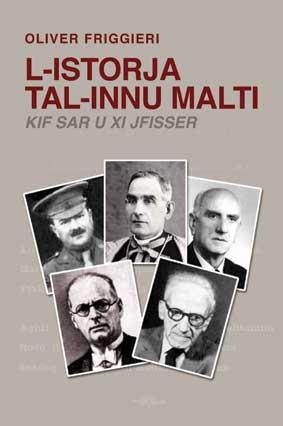
These are some of the aspects dealt with in detail in L-Istorja tal-Innu Malti: Robert Samut, Dun Karm and Albert V. Laferla in the early 1920s; the collaboration between Dun Karm and Prime Ministers Joseph Howard and Francesco Buhagiar; the occasion on which the hymn was composed by Samut; the role of the Malta Union of Teachers in the early recognition of the hymn; the official recognition in Parliament in 1941; the Hajduks-Malta football match and the people's reaction to the fact that the Maltese anthem was not played together with the other ones.
One of the most interesting aspects of this book is the publication for the first time ever of a manuscript by Dun Karm with an original, early version of his own Innu Malti, quite different from the one officially known. The early edition was composed on 25 November 1922, whereas the anthem was first performed in public a month later.
The final part of the book provides a highly detailed analysis of a word-by-word analysis of Dun Karm's lyrics. Both Biblical and political influences are identified and analysed. The words jaħkimha, ħniena and sid are explained and justified for a number of reasons. Prof. Friggieri's conclusion is that the anthem includes the three main components of Maltese national identity: Christian tradition, Semitic language, European culture. The fact is also explained that in the midst of controversies related to the English-Italian Language Question, Dun Karm came forth with an anthem made up completely of words of Semitic origin.
L-Istorja tal-Innu Malti - Kif Sar u Xi Jfisser (number 262 in the Klabb Kotba Maltin series) is profusely illustrated. Almost all the illustrations are being published in this book for the first time. Professor Friggieri is the author of numerous books, more than 60 of which have been published in foreign counties. He has published numerous scholarly articles in international academic journals. He writes in Maltese, Italian and English.