The launch of the Malta University Press publication France in the Maltese Collective Memory: Perceptions, Perspectives, Identities after Bonaparte in British Malta took place on 23 October at the Auberge de Provence, the surviving Auberge out of three in Valletta. Guests were welcomed with a glass of champagne courtesy of Est, Est Est the wine consultants of Sliema.
The event was held downstairs as there was a Heritage Malta exhibition going on upstairs. I just about managed to get a seat as many turned up for the event which was chaired by Prof. Henry Frendo, Chairman of the Malta University Press who introduced the panel, the popular Minister of Justice, Culture and Local Government, the Hon. Owen Bonnici, the Ambassador of France M. Michel Vanderpoorter and Prof. Anthony Aquilina. They all referred to Dr Xuereb’s Ph.D. thesis (for that was the origin of this book) and to Maltese identity during the colonial period and up to present times.
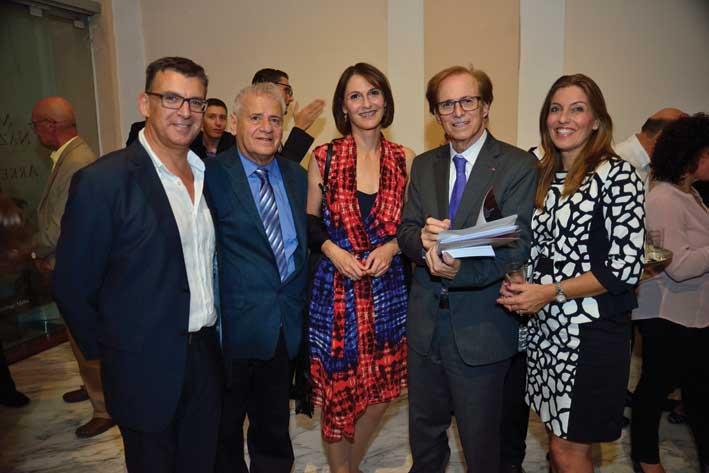
The launch was given a light touch with the presence of the Historical Re-Enactment Group of Malta whose president is Martin Degiorgio. They were there in their colourful costumes and sang several chansons de l’Armée Française. For the occasion Sandro Debono, Curator of the Fine Arts Museum coordinated with Vanessa Ciantar, Curator, Malta Archaeological Museum and displayed an authentic arrêté issued on 26 July 1798 and signed by Commissioner Ransijat and Secretary Doublet proposing the preservation of the archives of the Inquisition.
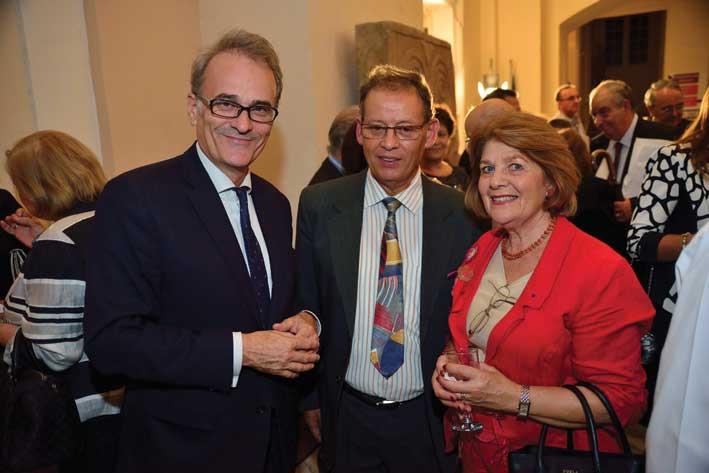
Minister Bonnici addressed the distinguished audience and spoke of Malta’s multicultural identity. He said how today as Minister of Culture “I am aware not only of the numerous artistic activities to which the country is committed all year round but also of the ingredients that make us think the way we do about all those matters – artistic or otherwise – that make us Maltese, Mediterranean and European.” Referring to Malta’s multicultural legacy from the Mediterranean and North Europe the Minister concluded by saying that “we would be more than wise if we were to cherish this cultural mix and foster further blends to merge all, past and present, into a future universal collage. In so doing, however, one must never forget that being Maltese – that is multicultural in itself – overrides all other considerations.”

The Ambassador of France (I just love the excellent English spoken with a French accent!) highlighted various approaches of the author’s analysis of Malta, past history and referred to how the French interlude has been ‘misjudged’ for far too long. M. Vanderpoorter hoped the book will further consolidate the Island’s relations in many aspects including tourism. Some 120,000 French tourists choose Malta as their destination annually he told us.
Professor Anthony Aquilina from the Department of Translation, Terminology and Interpreting Studies of the Faculty of Arts at the University of Malta welcomed Dr Xuereb’s publication as a breath of fresh air regarding the period 1798-1899. He said that correcting false impressions and perceptions through painstaking and investigative research, as the author did, is of the utmost importance. “In the absence of authentic testimony by the Maltese peasant protagonists, albeit manipulated by ecclesiastics to rise against the new liberal rulers only ten weeks after their arrival, Xuereb patiently sifted through it all, decomposing and recomposing it along the way, until he could handsomely make up for the deafening silence.”
Dr Xuereb concluded with a visual presentation tracking some of the main events under the French and the British colonial periods. He backed his arguments with various facts as illustrated not only in history books but also in the public space of Valletta where remembering and forgetting was manipulated in such a way that it produced a distorted collective memory. The author pointed out that Maltese citizens today suffer from a historical malady that tends to remember misinterpreted aspects of its colonial past more than its authentic history. Malteseness, for example, is conspiculously absent from our numerous Valletta monuments and memorials, he remarked.
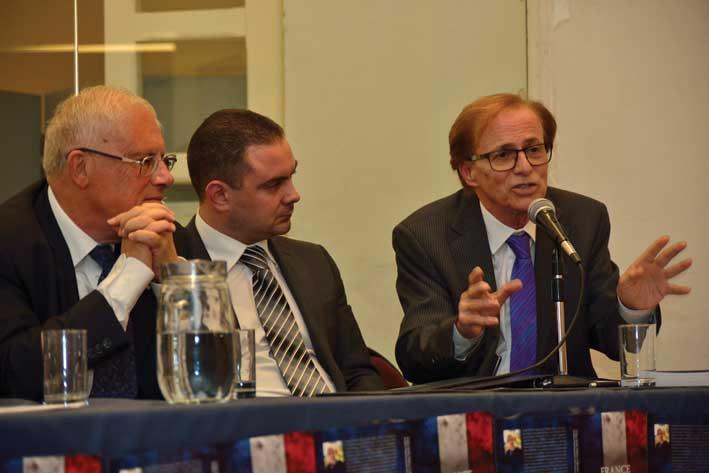
The evening was further enhanced with a Vin d’Honneur during which the author had the opportunity to sign copies of his book.
Just a few personal remarks. I liked the way Charles called Henry Frendo “a public historian” by which he means that Prof. Frendo generously shares his knowledge which is what should happen but does not.
Prof. Frendo referred to Charles’s ‘bees in his bonnet’ which are widely publicized by Charles himself: he would like to see the statue of Queen Victoria removed from Valletta’s main square; the George Cross removed from our flag, for example. He told me his is going to start a movement so that the George Cross is removed. He can be certain that there will be other movements which will campaign for the opposite. There was also talk of Treasury Street changing its name to Triq L-Ugwaljanza for goodness sake. But I entirely agree that the statue of La Valette should be placed at the entrance to Valletta which exists thanks to the vision of this great man. I would certainly join a movement for that to happen.
Prof. Carm Vassallo who is always deliciously irreverent remarked from the audience that we could not possibly foresee how Malta would have developed if Napoleon and the French had stayed on. “Perhaps we would have produced better croissants,” he quipped.
Let’s face it Napoleon has always been a controversial figure and writing about him is a risky business. There are blind worshippers for whom he is a hero and the equally challenged detractors who see in him only the petty tyrant. My feelings about him fall in between. By the same token, most historians find themselves negotiating a slippery path between approval and censure of this most controversial and somehow still very relevant figure. Like Nero, Napoleon consciously and consistently mythologised his person and his actions, making use of every available medium – art, the press, ceremonial – and the whole gamut of the cultural canon of the day. By giving his own gloss to every event, he wrote his own legend. Napoleon did not, on the whole, do or say things out of emotional impulse or any moral sense of right and wrong. Most of his actions were calculated and followed a political programme. The swarthy little Corsican general attained such heights by the promotion of an image, through picture and print, of the young general as saviour of the nation. But this could only happen because there were those who colluded with him. The brilliance of his propaganda and his ability to represent his life as fairytale helped enormously. In his short time here he quickly began to rebuild Malta according to an entirely new blueprint as he had done in France. You can see that this would not have gone down well with the conservative and powerful nobility and the all powerful members of the church.
I am greatly looking forward to reading the book.
Dr Xuereb will this morning at 10.30am speak about the book at Sir Temi Zammit Hall, University of Malta.
[email protected]