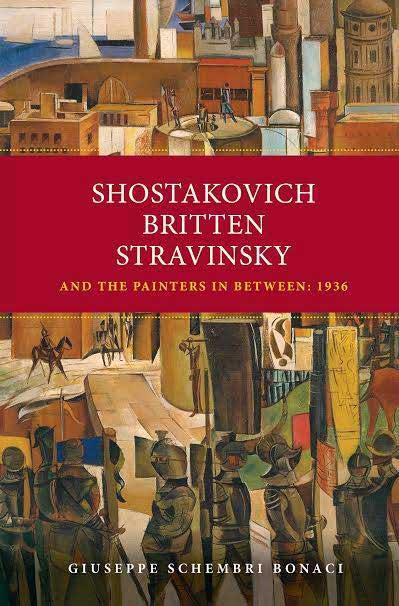
Over the past few years the quantity and quality of academic publications produced by Maltese academics or researchers working at the University of Malta have been on an upward trajectory. It is elating to walk into a local bookshop and discover new academic titles covering seminal historical, social, political, economical and artistic events, especially when these are tackled by means of an international comparative approach. The most recent of these was released only a week ago. Dr Giuseppe Schembri Bonaci's Shostakovich, Britten, Stravinsky and the Painters in between: 1936 is a decisive book, significant to both the national and global academic world.
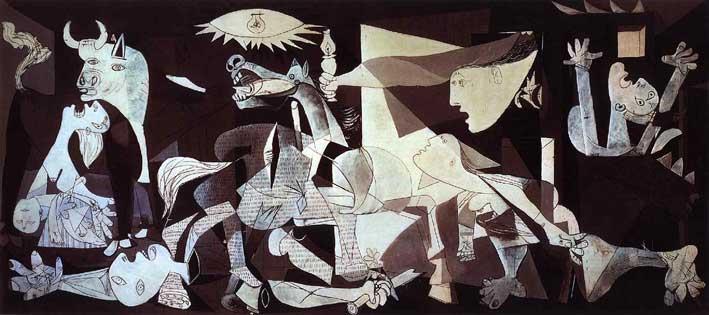
Dr Schembri Bonaci, senior lecturer in the Department of History of Art and artistic director of the Mdina Cathedral Contemporary Art Biennale, provides an in-depth study of the art-power conditions of a highly tumultuous period in human history, the year 1936, and its surrounding events; a time when nations were on the cusp of the Second World War while still recovering from The Great War and technological innovation was infiltrating all spheres of human activity, be it military or creative. It was the year in which the Spaniard Pablo Picasso painted his Guernica following the Nazi bombing of the Northern village in the artist's native country, when Charlie Chaplin's film Modern Times was first shown, and when the monumental exhibition Cubism and Abstract Art curated by Alfred H. Barr Jr opened at the Museum of Modern Art in New York City. Modern society was experiencing a new and disquieting visual landscape and artists created an "image-world" which represented this materiality.
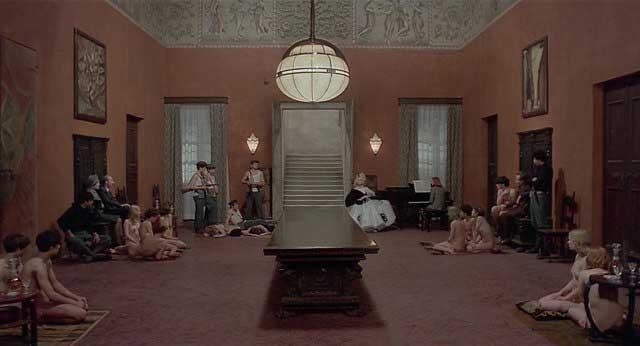
The relationship between art and reality is studied through an analysis of perception, which, as the author argues, is determined by the dominant structures of thought. He examines the inextricable link between art and power using two fundamental art theoretical concepts. Michael Baxandall's Period Eye explains how our mode of seeing is determined by experience, which is itself determined by power. This is discussed together with TJ Clark's assertion that art is inherently subversive, and is thus able to undermine the established political order. Dr Schembri Bonaci's methodological approach led to the understanding, one with which he is evidently uncomfortable, that there exists a direct relationship between modernism and totalitarianism. The "self-annihilation" of modernist art was caused by its fostering of an aesthetics of ugliness, an argument illustrated with reference to Pier Paolo Pasolini's film 120 Days of Sodom and Georges Bataille's writings on the transgression of values, among others.
This publication forms part of a larger project being undertaken by the History of Art department at the University of Malta, led by Dr Schembri Bonaci himself. Together with the research students in the department and the students of the newly opened MA in Fine Arts course, the study of Maltese 20th and 21st century artists is flourishing. In fact, the arguments presented in this book should not be considered as extraneous to the Maltese Islands, as Maltese art and artists were greatly affected by the political climate in Europe. In 1936, many of the Maltese modern masters were studying in Rome, caught between the tense Allied-Fascist politics and the battle of Italian culture against British citizenship as the definition of Maltese identity. The sculptor Antonio Sciortino suffered greatly under such conditions, with the British Academy of Art in Rome, of which he was director, being indefinitely suspended precisely in the year 1936, forcing Sciortino to return to Malta and into a creative drought.
Such a challenging academic undertaking which investigates the links between art and reality, power and perception, is extremely relevant to the local contemporary artistic context. There has been a substantial increase in artistic activity over the past decade or so, and art critical and theoretical writing plays an essential role within such developments by instigating public and scholarly debate. With the absence of a high level of discussion among the artistic community, the current mediocre level, save for a few exceptions, of art production and curating will continue to exist uninterrupted. Silence has resulted in the execution of second-rate monuments to influential statesmen (Guido De Marco, La Valette), poor government-endorsed projects (V18's Prospettiva installation) and incongruously configured exhibitions. This idle attitude has even led to a decline in art education.
To confront all this, there are those who are working towards a meaningful and intellectual improvement of the Maltese contemporary art scene, which can only be achieved through proper analysis which considers the local situation as a consequential part of a global whole. Provincial perceptions of island inferiority have generated platitudes which allow artists to withdraw to a safety zone, distant from the competitive scrutiny of the art world. Yet with many Maltese artists exhibiting their works and receiving recognition all over the globe and celebrated foreign artists showing their work here, Malta is certainly not cut off from the rest of the world. This will be exemplified next year, since an international event of a magnitude previously unforeseen in Malta is going to be held in Mdina, which will fill the Medieval-Baroque city with great contemporary art by multimedia artists from various nations. The aim of the Mdina Biennale is to create a space for artistic creativity and beauty through intellectual collaboration.
In his book, Dr Schembri Bonaci argues for the importance of creative collaboration in the arts, especially when faced with the horrors of social reality. Through the illustration of the calamitous developments of the later 1930s, Dr Schembri Bonaci elucidates how the art-power mechanisms of the past have come to determine the present state of art, politics and society. His profoundly-researched account of the past serves as a landmark, a point of return, by which to understand why the art world accepts shit cans, urinals and live sexual performances as art, and to analyse the implications of such on beauty. Art helps us to comprehend reality through beauty, but with the negation of beauty in the arts, have we also lost the capability to grasp ourselves? The author concludes that art must return to that of Dostoevsky, to Faustus and Don Quixote, to its subversive nature which confronts power and challenges dominant aesthetics. Dr Schembri Bonaci's erudite arguments which are presented in this milestone publication place Maltese scholarship at the forefront of the contemporary academic debate on art and politics.
The author is indebted to Prof. Ivan Callus (Department of English, University of Malta) and Dr Marjorie Trusted (Victoria and Albert Museum, London) for their continuous and enriching discussions.