The Governor of the Central Bank, Josef Bonnici, was as usual the main speaker at the annual dinner offered by the Institute for Financial Studies held at the Hilton.
The following is the full text of the Governor's speech.
The aftermath of the crisis provides an important starting point for the discussion of competitiveness, which will be the main theme of my remarks tonight.
I will commence by focussing on Chart 1, which compares the performance of various economies since the onset of the crisis. All the curves start from a common point of 100 in 2008. Setting the Maltese economy aside for a moment, several considerations stand out. The real GDP of the euro area has yet to return fully to its 2008 level, and the same can be said about the United Kingdom. In fact, the euro area economy is currently 1.9% smaller than in 2008, while the British economy is 0.5% smaller.
Chart 1 - GDP since 2008
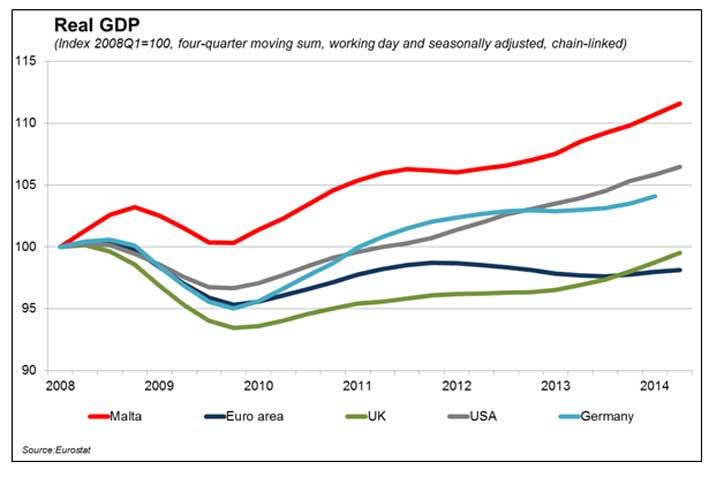
The euro area average is composed of countries recovering at different speeds. For example, Germany is a top performer in the euro area, though its economy has lagged somewhat behind the United States. In fact, German output is currently 4.8% higher than in 2008, while in the US it is 6.5% higher.
Where does Malta fit in all this? As the chart shows, Malta compared favourably throughout the crisis and the aftermath. The contraction at the trough in 2009 was relatively moderate. The path taken in the recovery has been stronger - in fact consistently stronger - than in the other economies shown in the chart. Output is at present 12% higher than in 2008.
I believe that a number of factors have shaped the course taken by the Maltese economy.
Malta passed through a liberalisation and restructuring experience that saw the exit of inefficient entities and businesses mostly prior to EU accession in 2004. This process of rationalisation, which occurred only a few years before the start of the crisis in 2008, made the overall economy resilient and in a better position to weather adverse events in external markets.
Post-2008 growth was enabled by the smooth entry into the euro area, which coincided with the start of the crisis in 2008. The transition was facilitated by the fact that in the preceding decades, there was no recourse to monetary financing of government debt, generally no recourse to currency depreciation to offset internal competitiveness issues, while fiscal policies were in large part prudent.
Another consideration relates to the growth of new sectors which improved the capacity of the economy to offset downturns in external demand. Diversification is often more difficult to achieve in relatively small economies. However, the degree of diversification in the private sector in Malta is remarkable, and has resulted primarily from the growth of financial services, internet related services and aviation servicing, along with the re-orientation of both the tourist sector and manufacturing.
Although we have experienced higher GDP growth, we must be aware that some of our competitors are starting to benefit from the structural reforms and internal devaluation that they went through in response to the impact of the financial crisis on their economies. Chart 2 displays unit labour costs in the euro area since 2002, distinguishing between the stressed economies and the relatively unstressed ones. The path of Malta's ULC is displayed separately. The chart shows that Malta trends lower than either of the two groups. However, one also notes that costs in the stressed countries have been levelling off, so that Malta's competitive advantage has somewhat narrowed.
Chart 2: Nominal unit labour cost
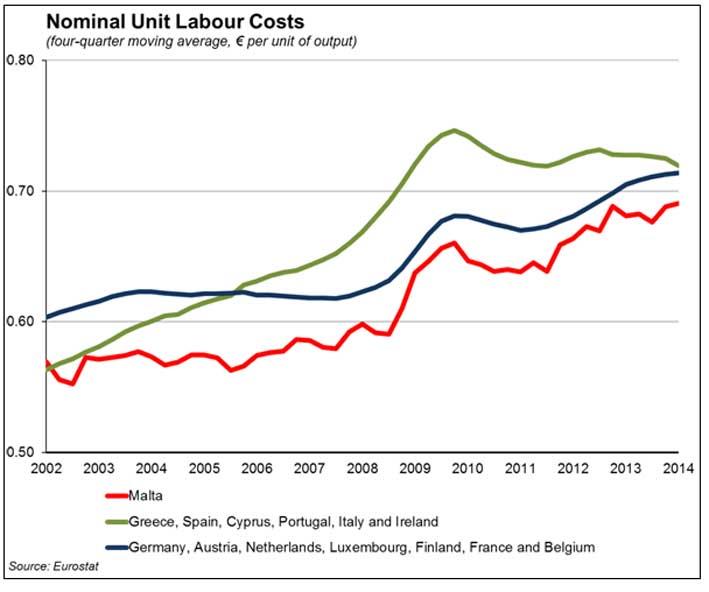
This suggests that Malta must remain extra attentive to the factors that influence competitiveness. Over the course of the crisis, Malta's economy was never in need of austerity measures, which in itself is a manifestation of economic and financial-sector resilience and good governance. But at this stage, we need to ensure that our competitive edge is not eroded.
Structural and fiscal policies in the euro area
Turning to current policy issues at the euro area level, one of the major challenges is the choice of the right instruments, or finding the proper balance between demand-oriented and supply-oriented policies.
In view of the serious damage caused by the financial crisis, there is widespread realisation that a durable solution to the current economic stagnation needs to be built around a structural reform programme. Over time these reforms would result in a greater degree of competitiveness, improving the growth potential of the economy. In the short run, however, such supply-side reforms often involve transitional costs. Hence the importance of demand-side measures that alleviate the impact on those that are negatively hit by structural reforms. This would prevent deflation and high levels of unemployment.
Unfortunately, the choice of policy instruments has been severely constrained by the absence of space to manoeuvre on the budgetary side. Indeed, the financial crisis hit the European economies at a time when a number of member states had unsustainably high public debt levels, leaving less room for demand management. Major structural reforms and internal devaluations, which included outright cuts in nominal wages, were inevitable, and these had to be effected without the possibility of complementing them with appropriate compensation on the demand side. The result is a prolonged and painful recovery with permanent effects on potential economic growth, in some countries driving a disinflationary process.
A further challenge arises from the fact that in the Eurosystem the centralised monetary stance is accompanied by a fragmented fiscal effort on the part of the various national governments. This contrasts with, for example, the United States where both monetary and fiscal policies are more centralised and hence they can be harmonised towards a common goal.
While these limits on national fiscal policies have influenced the slow momentum of recovery, there are still various options that can address this weakness. On the fiscal side, the recent proposal by the Commission to create a European Fund for Strategic Investments is one way of funding large scale investment projects that would promote competitiveness and boost activity in stressed areas. The fund would be backed by guarantees from the EU budget and the European Investment Bank. A complementary policy is the switching of government expenditure to more investment and growth friendly areas, while reducing bureaucracy and other inefficient expenditure.
Monetary policy in the euro area
Against this background, the role of monetary policy has become, and is likely to remain, more accommodative in the euro area. The ECB has played a major role in supporting economic growth using its interest rate policy - now at near zero levels - and policies designed to influence credit provisioning and risk reduction. The ECB has also reaffirmed that, if necessary, further measures will be taken to counter the risk of a prolonged period of low or negative inflation and to bring inflation to its medium-term target of under but close to 2%.
The possibility of a deflationary situation materializing in the euro area is of concern as its dynamics would raise real interest rates. It would penalize investors and increase the burden of holding business inventories. It would also discourage consumption, as buyers await lower prices by delaying spending. A de-anchoring of inflation expectations carries a risk of the euro area becoming stuck in a stagnant environment for a prolonged period of time. Basically, a deflationary scenario would be inconsistent with what is needed to support an economic recovery in Europe.
The effectiveness of monetary policy in the euro area depends on a properly functioning banking sector, since the transmission of monetary stimulus operates at least partly through the bank lending channel. In the euro area, the debt overhang in the private sector and the balance sheet position of the banks have been hampering the transmission and effectiveness of the ECB's accommodative policy measures.
Chart 3 - Injection and absorption of liquidity by the Eurosystem
Turning to Chart 3, the solid line shows that in spite of the various measures adopted by the ECB, whether those operating through the interest rate channel or through credit volumes, the net injection of liquidity remains relatively low. The upper part of the chart, in blue, shows the liquidity injected by the ECB into the euro area economies. The lower part, in red, shows the balances deposited with the Eurosystem by euro area banks. The chart also shows how a large part of new liquidity was deposited back at the ECB by banks. The objective of the current Targeted Long-Term Refinancing Operations (TLTROs) is to inject more liquidity at a low rate that is fixed for four years while the negative deposit rate is to discourage funds going back to the ECB.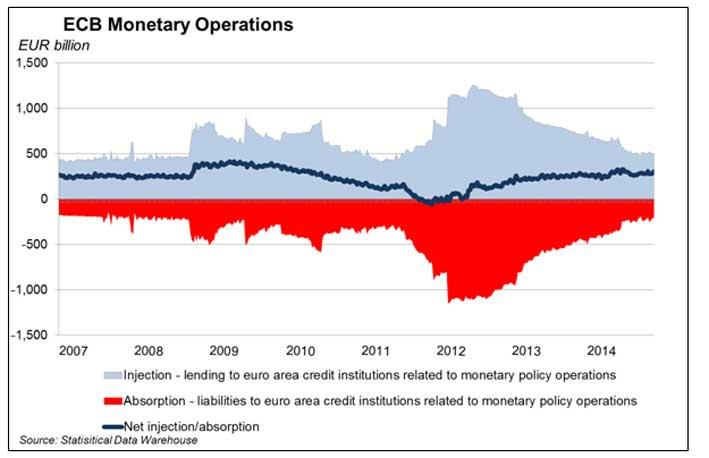
There are indications that the contraction in credit supply is bottoming out. This signals a potential turnaround in credit dynamics in the euro area. Also, the latest ECB's Bank Lending survey saw banks report a further easing of overall credit standards. The various announced measures are expected to inject liquidity into the system in two different ways, namely through direct asset purchases and through bank borrowing from the Eurosystem. Both routes essentially transfer risks from the financial system to the Eurosystem, and hopefully should lead to a greater ability to fund investment in the economy. In the process, the Eurosystem's balance sheet will expand.
Prudential reform in the euro area
I will now turn to financial stability issues. As you are aware, the Comprehensive Assessment of major banks undertaken by the ECB marked the start of a trilateral relationship between banks, national competent authorities and the ECB in its role of supervisor of banks in the euro area. The Single Supervisory Mechanism's micro-prudential responsibilities will complement the existing ECB's macro-prudential role in shaping the future of banking in the euro area. Banking supervision, viewed as one of the tools at the disposal of the ECB, will help ensure financial stability which is needed to sustain macroeconomic growth. The demanding Asset Quality Review and stress tests coupled with an overall result that exceeded expectations set a positive mood in the market and should lead to easier access to bank funding for investment growth.
Financial sector dimension of Malta's competitiveness
Turning to the Maltese context, it would be a pity if the low-cost credit conditions that are being offered by the ECB are not fully exploited in Malta. Broadly speaking, the overall participation in the TLTRO programme by core Maltese banks has been somewhat disappointing, with the participation of very few banks and with the actual take up being way short of the limits available.
On the positive side, we have noted the introduction of a lending scheme that a domestic bank is funding from the ECB's TLTROs. These TLTROs provide funds at very favourable terms - at a very low interest rate that is fixed for four years. Although the size of this particular scheme is limited, one hopes that it can be expanded and emulated by other banks. Such programmes are a prime example of the banking sector fulfilling its role of promoting economic growth by providing the necessary low cost funding, while at the same time contributing to the profits of the bank.
It is worth noting also that competitiveness does not depend only on costs; as the crisis has reminded us, financial stability is equally essential. In Ireland for example, it was the poor governance and risky credit practices of commercial banks that drove the country into the crisis, even though the competitiveness indicators were very positive.
Generally speaking, Maltese banking is run on a prudential and cautious business model and this is particularly true of the systematically-relevant banks, which manifest for example a low loan-to-deposit ratio. Nevertheless, we have stepped up our efforts, jointly with the MFSA, to ensure that the soundness of the banking system is not only preserved but also enhanced.
The Joint Financial Stability Board between the Central Bank and the MFSA has contributed to major initiatives, notably amendments to the Banking Rules 09 and 12. These amendments will improve the overall coverage ratio and strengthen provisioning practices. They also boost bank capital and reserves to mitigate potential risks from lending portfolios. The amendments also address the risks arising from banks' concentration in the real estate sector.
I want to take this opportunity to commend our banks, particularly those participating in the Comprehensive Assessment, as this was a very challenging year. The changes I just mentioned coincided with the new requirements and rules under the Comprehensive Assessment. I recognise that these changes may impact profitability in the short-term, but sound governance sets the stage for sustainably higher returns in the longer term.
Banks are now subject to the single rule book and this calls for increased awareness and focus to meet these new challenges. This will reduce the overall risk in the financial system both in Malta and elsewhere.
Going forward, there are other challenges that will need to be addressed by our financial system in order to further mitigate certain risks.
In the aftermath of the sovereign debt crisis there is a heightened recognition that a more diversified investment portfolio would reduce the risk exposure related to the bank-sovereign nexus. Looking into the future, further diversification of our sovereign debt market may be warranted. It would be advisable if, going forward, stable alternative options are identified to complement current practice. Long-term placements with certain international wealth funds, for example, would ensure that government securities can have a more diversified investor base and possibly reduce government's borrowing costs at the same time.
There is a further consideration that I have raised on previous occasions - one that would enhance the effectiveness of the intermediation role in our financial system, and address some of the funding gaps, resulting possibly in instances of market failures. Malta lacks a consistent supply of long-term finance that would efficiently fund a project addressed to SME funding needs or to finance structural, economic, social and environmental policies in connection with the long-term financing of priority projects. If we look at other countries, such as Germany and France, they managed to cater for SMEs as well as for other environmental and infrastructure investment through promotion or development banks. A development bank would contribute to economic growth by funding sectors and projects that are not catered for by commercial banks on their own. The Central Bank looks at such an initiative as a necessary diversification of our financial base. I understand that progress is being made on this initiative and I find this to be a very positive development.
The road ahead
Against a rapidly changing economic landscape, Malta needs to be attentive to take advantage of its flexibility and adaptability. In the past years, the Maltese economy went through significant structural change. Not only by diversifying into a number of new growth sectors such as aviation services, pharmaceuticals and internet related activity, but also by upgrading its investments in the traditional sectors. For example, the tapping of new source markets for tourists in European cities that were newly serviced by low-cost airlines allowed the hospitality sector to overcome the recession-driven weak demand in already serviced markets. Similarly, the financial and other services sectors continued to expand, thanks to the right conditions for growth, including the appropriate legislative environment.
There are a number of reasons for being positive and optimistic about Malta's potential growth in the future. In contrast to various developed countries, Malta has some structural issues that, if addressed, can provide opportunities for an ongoing momentum to growth.
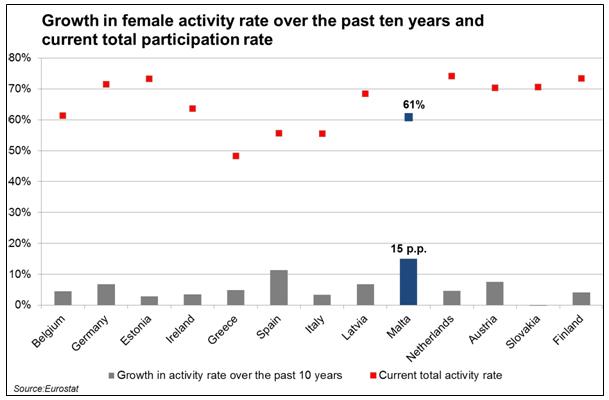
Take for example the labour participation rate in Malta. Although it is among the lowest in the euro area (as shown in Chart 4), Malta has gone a long way in achieving progress on this issue. Over the past 10 years, Malta registered the largest increase, among the member states, in the female activity rate, which rose from 36% in 2004 to over 50% this year. The recently introduced incentives for female participation will continue to steer our labour market in the right direction, also boosting Malta's potential economic growth.
Chart 4 - Labour market participation rate
At the same time, we also observe a higher number of foreigners who are contributing to economic activity in a variety of sectors. First, it has to be remarked that an expanding labour force through this route is in itself a sign of Malta's strong rate of economic growth relative to other areas of the EU. Secondly, it reduces the likelihood of skill gaps in the labour market. Though this added flexibility needs to be recognised for the positive effect it has on potential output, the role of retraining programmes by the ETC remains of utmost importance in better matching skills with vacancies and further reducing the rate of unemployment.
Turning to the fiscal dimension, government forecasts the deficit to decline to 2.1% of GDP this year and to 1.6% in 2015. This is a financially responsible objective which needs to be truly maintained. The government debt-to-GDP ratio has reached around the 70% level. This ratio needs to plateau and eventually to drop and this requires sustainable management of both budgetary inflows and outflows.
Clearly, budgetary performance depends on economic performance as higher growth ensures higher tax revenues. In turn, faster growth is only possible by producing and delivering more goods and services. This can only be attained by being competitive.
Moreover, other significant challenges remain. Inefficiencies in public administration processes hamper the development of the Maltese business environment and need to be improved, so as to better support competitiveness and encourage foreign direct investment.
As I already mentioned, there is also room for further improvement in the business environment in terms of access to credit. The cost of credit in Malta remains on the high side and further easing would help our businesses to invest at a lower cost. Going forward, various initiatives are envisaged to improve the current situation, including the introduction of a credit register that will be administered by the Central Bank. A credit register will narrow the information gap that exists in the Maltese banking system by reducing asymmetric information between borrowers and lenders. It also improves risk management thereby contributing to a better performing loan portfolio and as a result, a lower cost of capital.
Ladies and gentlemen, let me close with a few concluding remarks.
As you are well aware, the banking sector across the euro area is passing through regulatory and supervisory changes that are sometimes viewed as expensive and imposing unnecessary burdens on the sector. This is a short-sighted assessment. Though dividend pay-outs may be lower in the short-run, their sustainability will be strengthened in the longer term. Similarly, higher bank capital does not necessarily lead to lower volumes of loans over the long run. Instead, a higher capital base mitigates balance sheet risk, lowers bank funding costs, hence allowing banks to charge a lower risk premium on their loans, to the advantage of both lenders and borrowers.
The crisis has uncovered various shortcomings in corporate governance in the banking sector, mainly in areas like risk management and internal controls, compensation, corporate structures and transparency. Some Maltese banks have yet to adopt a number of necessary risk oversight practices that would ultimately benefit the banks and their stakeholders.
What needs to be stressed is that reputation is a key asset of Malta's financial system which cannot be taken for granted. Efforts to safeguard financial sector reputation need to be on-going and undertaken by all concerned in the financial sector.
Reforms in the banking system need to be accompanied by structural reforms in other parts of the economy. However, this can only be possible if the economy is growing sustainably. Within the context of limited fiscal space, there is a need for the appropriate environment to encourage investment and stimulate growth in the private sector. Going forward, we need to enhance Malta's competitive position in order to attract a higher volume of capital investment in the future. A strong education and skills base, an upgraded infrastructure and a clean and sustainable source of energy are essential elements that would pave the way for future investment.
The financial sector provides an important contribution to output and employment growth in Malta. Going forward, the sector also has room for expansion in a range of activities that link it with the domestic economy in the sense that value is added in Malta by engaging the services of financial experts, lawyers, accountants and so on, but catering to demand abroad, such as in the Mediterranean region and beyond. For example, the recently announced initiative to create space for a new commercial activity in the form of facilities for Islamic banking is consistent with this vision for Malta.
Enhancing our competiveness requires a constant search for new areas of activity as well as strengthening and refining the currently successful ones. It is the only way that we can ensure that the standard of living can keep increasing and that the value added of the Maltese economy can keep advancing.