OVERVIEW
• Malta's economic growth prospects remain strong relative to the eurozone,
but we view the government's debt burden as a constraint on policy
flexibility.
• We consider Malta's domestic banks to be well-capitalized, although we
consider that loan loss provisioning levels remain low.
We are therefore affirming our 'BBB+/A-2' long- and short-term ratings on
Malta.
• The stable outlook balances our view of Malta's economic prospects
against its high, though declining, government debt burden and contingent
liabilities.
RATING ACTION
On Jan. 9, 2015, Standard & Poor's Ratings Services affirmed its 'BBB+/A-2' foreign and local currency long- and short-term sovereign credit ratings on the Republic of Malta. The outlook is stable.
RATIONALE
The ratings are supported by our view of Malta's fairly strong institutions, its resilient economy, and our expectation of further fiscal consolidation. A sizable government debt burden and contingent liabilities constrain the ratings.
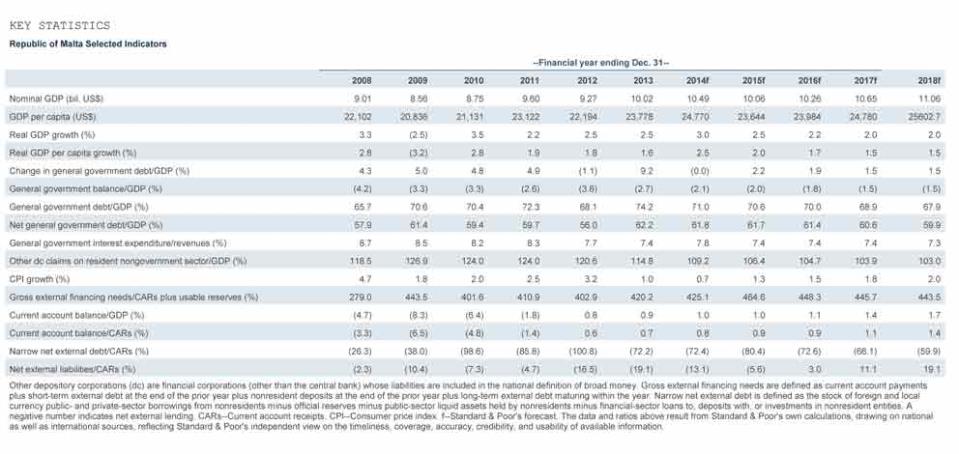
We estimate that the Maltese economy grew by about 3% in 2014, and we project that it will expand by just over 2% annually on average during the next four
years. We believe Malta will continue to grow more quickly than the eurozone (European Economic and Monetary Union) as a whole, notably thanks to investments in the energy sector. These investments include the laying of an interconnector cable to Sicily in 2014 and the building of a new liquefied
natural gas plant in 2015-2016. The government sold a 33% stake in main domestic provider of energy generation and distribution Enemalta Corp. and a
majority shareholding in the BWSC power plant to Shanghai Electric for a total of €250 million. In addition, we understand Shanghai Electric plans to invest €70 million to convert the BWSC power plant to gas from June 2016. These investments alongside government mandated cuts to utility tariffs are boosting domestic demand. Last year, electricity prices for households were lowered by 25%; electricity charges for companies will be cut by the same percentage in
March 2015. Lastly, rising real wages and broader female participation in the labor market have increased household disposable income.
Even after adjusting for re-exports, Malta is a very open, services-oriented economy. Consequently, we consider that its growth performance relies on external demand for services in key trading partners, which is subject to downside risks over our 2015-2018 forecast horizon.
The low corporate tax rate has attracted significant foreign investment into Malta's banking, insurance, and gaming industries, implying that the economy would be sensitive to potential pressure for standardization of corporate tax regimes in the euro area. We continue to expect that net exports will help fuel growth beginning
this year, after two years of negative contributions, mainly on the back of good performances in the tourism sector (notably related to a favorable euro/sterling exchange rate) and e-gaming, and a rebound in microelectronic manufacturing. We therefore anticipate that Malta will run a small current account surplus over our 2015-2018 forecast horizon, as it has since 2012.
We estimate 2014 general government debt net of liquid assets at 62% of GDP, with a decline to 60% of GDP by 2018 mainly owing to rising output. We estimate general government gross debt at 71% of GDP in 2014.
We estimate the 2014 general government deficit at 2.1% of GDP, versus 2.7% in 2013, reflecting higher tax receipts and supportive nominal GDP growth. We forecast that general government accounts will improve slowly through 2018, primarily owing to GDP growth. We project that spending will be at about 43% of GDP on average over our forecast horizon, higher than the 2008 peak at
42.6% of GDP.
Under our criteria, we see two sectors that present contingent fiscal risks to public finances: banking and nonfinancial public enterprises (NFPEs). Malta's
domestic banking sector operates alongside a large offshore sector.
Under the results of the European Central Bank's (ECB's) comprehensive review of Europe's largest banks, including the European Banking Authority's EU-wide
stress test, released in October 2014, Malta's banks included in the review are well-capitalized. At end-October 2014, the deposit-to-loan ratio in the
banking sector was 151%. Malta's banking system has been historically deposit funded. At midyear 2014, assets of core domestic banks amounted to 212% of
GDP.
We project, however, that this ratio will rise owing to Malta-based Mediterranean Bank PLC's rapidly growing balance sheet. As of end-September 2014, its balance sheet amounted to €2.7 billion, or about 34% of 2014 GDP. Of the other banks that intermediate fully in the local economy and that would, in our opinion, receive government support if needed, the total balance sheets
of Bank of Valletta accounted for €8.3 billion at end-September 2014 and HSBC Malta amounted to €5.2 billion at end-June 2014.
The remainder of the domestic market comprises small, specialized financial institutions, which, in our
view, would only be able to seek support from their shareholders in case of need.
The continued rise in nonperforming loans (NPLs) to 9.5% by mid-2014, from 9.2% at end-2013 and 8% at end-2012, remains a challenge for the economy. Part of this increase relates to a regulatory change in the definition of NPLs.
Almost half of the NPLs are concentrated in the construction and commercial real estate sectors. On the other hand, household mortgages are mostly performing with strong loan-to-value ratios. Banks' aggregate loan loss provisioning has improved and the NPL coverage ratio reached 42% in September 2014, a level that we still consider to be low despite collateral posted for
the unprovisioned portion of NPLs.
We believe the government will not support offshore banks in case of financial distress and that they will therefore turn to their foreign parents in the
event of financial need. However, the offshore banks dominate Malta's international investment position. At end-October 2014, the Maltese banking sector's external liabilities totaled about 400% of GDP, or €31.6 billion. We understand that foreign banks use Malta as a booking center for their own financing needs. Although domestic banks attract nonresident deposits,
contributing to ample liquidity positions, their core funding is domestic.
Nevertheless, in light of their size, they could strain the external liquidity of Malta's broader financial system under a stress scenario. Excluding the offshore banks, we consider Malta as a whole to be in a net external debtor position.
Malta's contingent fiscal liabilities stemming from NFPEs derive mostly from Enemalta's government guaranteed debt (9% of GDP as of end-September 2014).
Enemalta will likely not generate profits until 2017, according to our latest estimates (see our summary analysis "Enemalta Corp.," published March 4, 2014,
on RatingsDirect). We further note that the current drop in international oil prices is helping Enemalta's future expected return on investments.
Membership in the eurozone provides Malta with a strong monetary anchor and access to funding at low nominal interest rates. Nevertheless, we believe that membership in a monetary union increases the onus on member governments to support competitiveness through fluid labor, product, and services markets, and to build up fiscal buffers against future shocks. This is more the case now than in June 2014, given that the ECB is undershooting its medium-term price stability target of close to, but lower than, 2% for the eurozone as a
whole.
OUTLOOK
The stable outlook balances our view of Malta's economic prospects against its high, though declining, government debt burden and contingent liabilities.
We could raise our ratings on Malta if the government's reform program boosts growth and reduces the government debt burden or contingent liabilities more quickly than we currently expect, without a return to significant current account deficits.
We could lower the ratings if fiscal slippages increase the Maltese government's net debt burden or if contingent liabilities materialize.
Negative pressure could also emerge if Malta's large financial sector were to experience sizable disinvestment or weakening access to external debt and
deposit financing.
RELATED CRITERIA AND RESEARCH
In accordance with our relevant policies and procedures, the Rating Committee was composed of analysts that are qualified to vote in the committee, with sufficient experience to convey the appropriate level of knowledge and understanding of the methodology applicable (see 'Related Criteria And Research'). At the onset of the committee, the chair confirmed that the information provided to the Rating Committee by the primary analyst had been distributed in a timely manner and was sufficient for Committee members to make an informed decision.
After the primary analyst gave opening remarks and explained the recommendation, the Committee discussed key rating factors and critical issues in accordance with the relevant criteria. Qualitative and quantitative risk factors were considered and discussed, looking at track-record and forecasts.
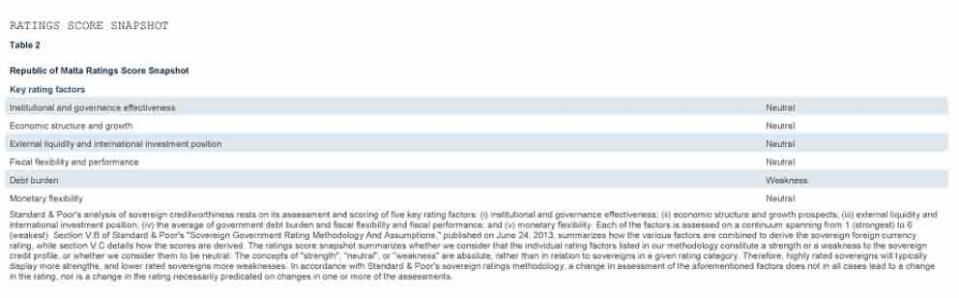
The committee agreed that the rating factor debt burden had deteriorated. All other key rating factors were unchanged.
The chair ensured every voting member was given the opportunity to articulate his/her opinion. The chair or designee reviewed the draft report to ensure consistency with the Committee decision. The views and the decision of the rating committee are summarized in the above rationale and outlook. The weighting of all rating factors is described in the methodology used in this rating action (see 'Related Criteria And Research').
RATINGS LIST
Ratings Affirmed
Malta (Republic of)
Sovereign Credit Rating BBB+/Stable/A-2
Transfer & Convertibility Assessment AAA
Senior Unsecured BBB+
Short-Term Debt A-2
Malta Freeport Corp. Ltd.
Senior Unsecured* BBB+
*Guaranteed by Republic of Malta