Giuseppe Schembri Bonaci
Adam Chang is a Chinese artist who today lives and works in Sydney, Australia. His participation in the Mdina Biennale 2015-16, has been recently confirmed, together with that of 94 other artists who will be part of this phenomenal wave of artists arriving from all over the world.
Chang is one of the most sought after contemporary artists of today. He is considered as one of the most influential artists in the world. He was born in China in 1960, and so experienced Maoist China. Thus, one can see a strong connection between Chang's art and this cultured personality who was a seminal figure to communist China and also the political world of the 1960s. Chang's work Mao with Terracotta Army Marching has become iconic in the contemporary art world. He is a six-time finalist for the Archibald Prize, twice a finalist for the Doug Moran National Portrait Prize and winner of the Archibald Prize in 2011 (the most important prize for portraiture in Australia). This artist will be participating in the Mdina Biennale.
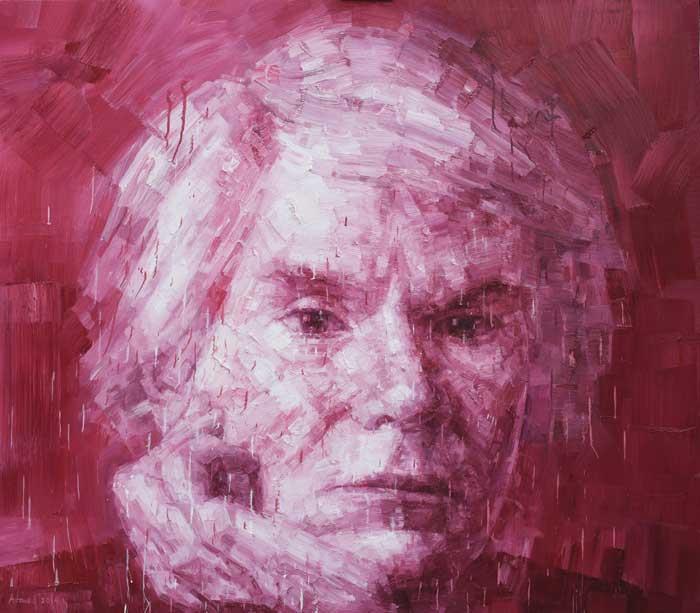
In Australia he works upon strong exciting and expressive tonalities which, as I have already said, place him among the highest regarded contemporary artists. He creates works which appear to swim in their own transparency yet are simultaneously crystal clear. They are reminiscent of traditional Chinese painting and techniques. At the same time they are modern and one could even say modernist; he insists on conveying the vital and necessary relationship which exists between art and society, particularly - for him - the identity and society of China. However, he doesn't stop there: his work transcends the particularities of a singular identity and society. On the contrary, he espouses universal values.
An extremely interesting aspect about Chang is that he attempts with intriguing success to synthesise traditions of classical European art with traditional Chinese art, and with this tool he is permitting a modern interpretation of present times.
The confrontation and placing of the figures Mao Tse Tung, Andy Warhol and of Ai Wei Wei near one another and among the terracotta army is alluring, and he brilliantly exposes the contrast between them. His works all show a struggle towards the spiritualisation of man, against the destructive path taken by man to live in progress which could lead to the total annihilation of self. Withal, Chang does allow a ray of light to be felt.
A French artist who will also be participating in the Mdina Biennale is Gildas Le Reste, the director of the École d'Arts Plastiques (Chatellerault, France). A reputed artist who used to form part of the group of famous Spanish artist Miguel Barceló. I met him together with other artists when I visited Paris recently. We discussed many problems regarding contemporary art and even the role we wish to the Mdina Biennale within this international debate on art. He was very enthusiastic about my idea that the Biennale should not only be a space where all are allowed to hang works or install a project but it must transform itself into a forum. Le Reste's participation concerns that which he calls an "echo" on the beautiful icon of St Paul in the Mdina Cathedral Museum. He works on paper which is humid and uses a technique which is known as "soak and stain". Yet instead of seeing simple stains, one may see stains of forms which encroach upon internal contemplation. It is no surprise that he chose this icon of St Paul for his work to create a dialogue with this gem.
Artists from all over Europe will be coming to Malta for the Biennale; from Italy, the United Kingdom, Spain, France, and Germany. There will also be artists from the Maghreb; Tunisia, Egypt, Lebanon. Now there are also participating artists from Syria, Iraq, Iran, India, China, Australia and Chile. All will gather together in Mdina later on this year for this event to become a visual forum on contemporary art.
Not only this: the Mdina Biennale is linking and developing its activities together with other activities, not only visual ones but also those which concern new evolutions in the study of art. Thus, we are working for festive activities to also become centres of analysis on the modern state of contemporary art.
Together we must see, experience, study and discuss the role of art in this period of the collapse of values and a total collapse of the spirituality of man. In other words, the Mdina Biennale is offering a space of great historical civilisations to the post-modernist era of today so that together we may understand that which is happening around us, and maybe we'll be of modest inspiration to the dramatic evolution of art even on an international level.
Thus, the Mdina Biennale is creating fantastic relationships with local and international institutions so as to establish this centre of reciprocal experiences.
Among these institutions there is the Department of History of Art in the Faculty of Arts at the University of Malta. This department has today grown into a centre of historic initiatives, both locally and abroad. The profound research carried out by Prof. Mario Buhagiar is well-known outside of Maltese shores.
His findings and his erudition, academic integrity and his vast experience make him the father of art history in Malta. Likewise his work is internationally recognised. Prof. Buhagiar's publications on the evolution of art in Malta and even in the Mediterranean region have become important reference books within the international academic sphere.
Unfortunately, many ungrateful and envious forces have tried without success to hide the masterpieces of thought and study which Prof. Buhagiar managed to create. He established the meaning of what the History of Art in Malta is, as a subject which merits an international academic level of study. Today, the definition of history of art in Malta cannot be developed without entering into the work of Prof. Buhagiar.
Keith Sciberras, another professor, a specialist on Caravaggio and Mattia Preti, placed the Maltese Melchiorre Cafa' on a new and modern international pedestal. His writings are part of international scholarship on the Baroque. A Baroque scholar cannot today avoid quoting the research of Prof. Sciberras.
By means of these researchers the rich archive of studies on the artworks that exist here in Malta is a unique treasure. Over the past 20 years, under the guidance of these two scholars, the students in the Department have studied and created a whole artistic map of Malta which previously was completely undiscovered and concealed under cobwebs and horrendous mediocrity. Studies which concern church art, public and state art, private art, architecture and their historical development have all been carried out due to the inception and prosperity of the History of Art Department. This knowledge and information is manifested in published studies or those archived at the University of Malta.
In fact, on 1 December of last year at the Wignacourt Museum in Rabat (modernised due to Prof. Sciberras' efforts and curated by ex-students of the Department), Prof. Buhagiar launched his new book on the development of art from early times until Malta formed part of the Byzantine world, another rich and profound academic publication. This work is another link in the chain of his writings on Maltese art in Christian and Islamic times and beyond.
International conferences, symposia among great scholars with a forum of world institutions in the United States, the United Kingdom, Spain, Germany and Italy are all indebted to the work of Professors Buhagiar and Sciberras.
The Department of History of Art together with the MA (Fine Arts) programme are integral to the development of the Mdina Biennale. The artists whose participation is confirmed have already found the chance to visit Malta or will be visiting in the near future to see the beautiful spaces which will be occupied with art during the Biennale, and to discuss their projects with the artistic director. This is not all: they are also involving themselves in the university programmes within the Department of History of Art.
The students are not only active in the normal university programme but are involved in the organisation of this event. They are discussing and widening their experience in the curatorial field. They are directly encountering renowned artists from different countries and, obviously, they are facing hard difficulties and thus have an excellent opportunity to develop professionally and enter into the art scene both from an artistic side and also as curators and managers.
The organisational group of the Mdina Biennale with the Department of History of Art and also with other important institutions will give birth to future experts on diverse spheres, the theoretical and the creative fields, and also the managerial sector.
The more we plant seeds in the minds of these excellent students, the more beautiful our future will be. Yes, for every good step the winds of jealousy and bureaucracy will rise up to engender illusionary fear. However, the closing of one door will give us the possibility to smash open a thousand.
Article edited and translated by Nikki Petroni