Jennifer Montagu is an Honorary Fellow of the Warburg Institute in London, where I had the great fortune of meeting her whilst conducting my own academic research. For quite some time, she was responsible for the unique archive within this institute, an essential one for the academic world. She also held the Slade Professorship of Fine Art at the University of Cambridge. Her positions at the National Gallery, Washington and at the Collège de France were important and vital to her research. She is a Trustee of several institutions including the Wallace Collection and the British Museum. Her modesty is so profound that it is slightly frightening, especially when considering the many honours she was given; LVO, CBE, and others.
From studying Political Science and the wish to become a sculptor, Jennifer chose the path which placed her at the centre of international studies concerning Baroque art. And it was this precise path which led her to Malta. Amongst others, she collaborated with Prof. Keith Sciberras, the Head of Department of History of Art at the University of Malta. She has always held the Department in high esteem, and was even involved as a post-graduate examiner and visiting lecturer.
She speaks with academic authority, yet her frontal modesty is incredible. She was fortunate to have been in the company of great giants such as Ernst Gombrich and Kenneth Clark. Research intertwined with continuous debates and discussions, and as she herself stated, just one lecture per week and some sherry were important ingredients to create a much needed research atmosphere. She studied at the Courtauld Institute, one of the most prestigious centres of research in the history of art: the same institute where the founder of the Department of History of Art and also its former Head of Department studied, Prof. Mario Buhagiar. She pursued her studies at the Slade, and research in Paris and Versailles. Her name received worldwide recognition when she began to study artists who were not yet understood, including Alessandro Algardi. The study on artists who were, one could say, completely ostracized because of the totalitarian dominance of Gian Lorenzo Bernini, was the source for a society which she founded together with Anthony Blunt, another internationally famous, even infamous, scholar. The society was given the name 'Society of the Enemies of Bernini'. In fact, Blunt was then studying Borromini and she Algardi, two artists who were dangerous rivals to the monopoly which Bernini created for himself. It is interesting that even the Maltese Melchiorre Cafà played an important role in this anti-Bernini movement. Prof. Keith Sciberras, a former student of both Prof. Buhagiar and Jennifer Montagu, followed Montagu's path with his studies on Cafà. This sculptural rivalry repeated itself once again in the modern period, when Auguste Rodin overshadowed all other sculptors, which likewise engendered a counter-movement with artists such as the Italian Medardo Rosso and the Maltese Antonio Sciortino and Josef Kalleya. This competitive relationship between sculptors will be the theme of a conference currently being organized by the Department of History of Art.
Many are the publications which have today become fundamental to Baroque studies. Amongst them one must mention 'Roman Baroque Sculpture: The Industry of Art'. Nicholas Penny and Joseph Connors always stressed that Montagu managed to build a structure of impeccable research. This book in particular shows the relationship which existed between the artist and their contemporary society. She enters into the sociological and the economic sphere and studies how these affected the development of sculpture. One must state, as Nicholas Penny maintains, that Montagu managed to revive buried works and also, due to her pen, formerly-considered minor artists managed to find their rightful place within the hierarchy of art.
Her role as a scholar has been so great, that the academic world organized a symposium in honour of Jennifer Montagu.
There were many profound and exciting contributions during this symposium dedicated to this person so ambitious within the study of history of art, particularly in the field of the Baroque. The participants were themselves personalities of international fame. There was Jeremy Warren, a curator of the Wallace Collection, London, Walter B. Ford from the Institute of Art in Detroit, Louise Rice from New York University, Frits Scholten from the Rijksmuseum, Amsterdam.
International participation included E. Desmon Lee, Professor Emeritus at the University of Washington, professors and researchers from the J. Paul Getty Museum, Los Angeles, and the Metropolitan Museum of New York. Pierre Rosenberg, honorary president-director of the Académie Française, the Louvre Museum, Paris and Maria Giulia Barberini from the National Museum of Palazzo di Venezia in Rome were both present. There were also several participants from different universities and from international centres of global repute. Amongst them was Prof. Keith Sciberras who presented a paper 'Algardi's Cristo di Colosso: A Cardinal-Nephew, an Inquisitor, a General and the English Langue', one which created much discussion amongst those present.
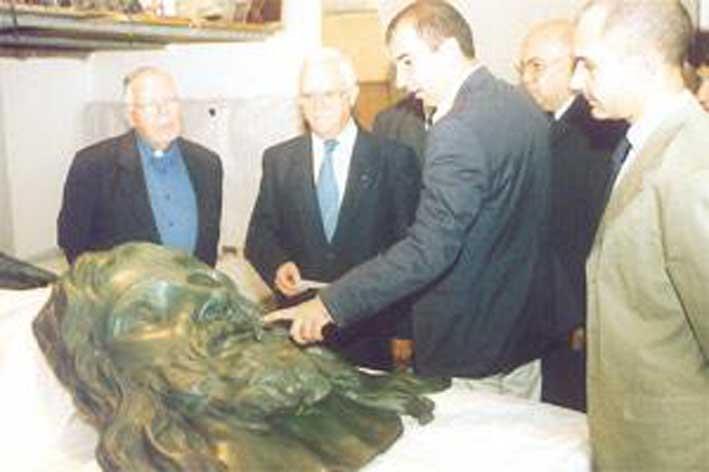
During Prof. Sciberras' presentation, a beautiful, even an emotional reaction erupted when he showed a photo of himself with Jennifer Montagu in a crane wearing safety helmets to see the high-up monument of Christ on the façade of St. John's Co-Cathedral. Prof. Sciberras talked about his research and spoke in detail of the commissioning of Algardi's work. He analysed how this work reflected the wishes of Alessandro Zambeccari, a nobleman from Bologna, Knight of Malta and Lieutenant-General of the Papal IGFNA. Sciberras described how this nobleman created certain intrigues to win many promotions and even to get his hands into the Priory of England. He could not do this through normal methods and so he founded a strong lobby by means of the Roman Curia. He worked towards a close friendship with the Inquisitor of Malta, Fabio Chigi (who would in the future become Pope Alexander VII), with the help of his friend Francesco Barberini.
This complicated and complex story is important for us to see how and why certain art commissions come about, and the political agendas hidden within these choices. In fact this story is testimony to the relations which exist between power and political hegemony and art. To me personally it shows, as Prof. Sciberras sustained, the continuous struggle of the Knights of Malta to gain their own sovereignty and independence from Rome. Algardi's statue is proof of all this, besides it being a brilliant example of Roman Baroque sculpture in Malta.
The symposium was organized under the name of 'The Eternal Baroque'. As said at the beginning of this article, this was held so that the international world of art history could commemorate and celebrate the name and work of Jennifer Montagu. This is not only evidence of the academic authority which Montagu holds but also evidence of the affection which international scholars have towards this admirable woman. Everyone praised her generosity and willingness to share her experiences and findings with all. In Prof. Sciberras' own words;
"Jennifer Montagu has been one of my most important academic mentors, especially when I was working on my Ph.D. and on Melchiorre Cafa'. I cherish so many meetings at the Warburg Institute in London, the Hertziana in Rome, and at St John's in Malta. She promoted my first essays in international academic journals and opened many university and sacristy doors for me. She instilled in me the passion for metal sculpture, and shaped the way I look at sculpture. Her scholarly discipline, archival perseverance, and academic humility are beyond the ordinary."
The papers which were delivered during the symposium will be published this year in a book edited by Maria Giulia Barberini, Mary L. Levkoff, Carolyn H. Miner, Guilhem Scherf and Jeremy Warren.
Article edited and translated by Nikki Petroni