Prof. Alain Blondy
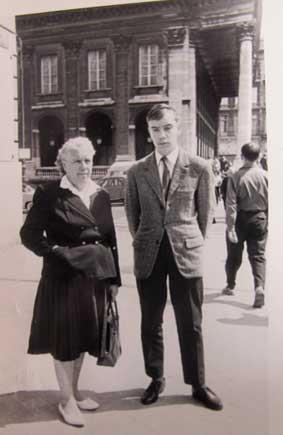 When I was born my mother, Reine-Marguerite, was 43. My father had just come back from England where he had spent the entire war and my mother was recovering from a four year long exhausting struggle against the German Occupation of France. Their reunion was in August. A few months later she went to her gynecologist's who told her: 'Your menopause is four months old'. As my parents were both 'old', he recommended a therapeutic abortion because I had all the chances of being born stupid. She refused but she did not want to change her way of life.
She was always travelling and the first time I crossed the border I was six months old. Until I went to college, I visited with her all the democratic European countries, but never the communist or fascist ones. She taught me that freedom is the only thing worth struggling for. I was allowed to be a child at home, but I had to behave well when we were in public.
'Don't embarrass me', was her leitmotiv. I learnt not to speak loudly or to get up from the dining table without asking for permission. She used to say that a worm is not fed to remain a worm but to give birth to the most beautiful butterfly possible; and that a child has to build the man he is to become. Even now, I often wonder: 'Do I exist or do I simply live?'; "Am I a man or am I only a human being?". When she died, more than 20 years ago, for the first time she distressed me.
Prof. Arnold Cassola
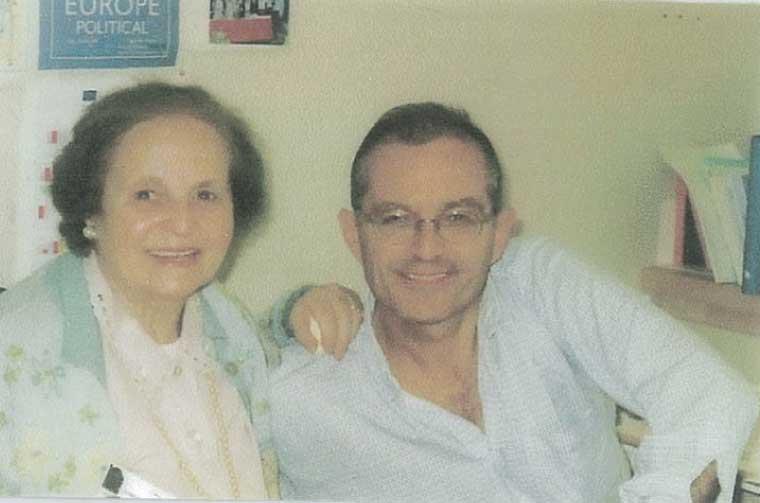
I still picture myself as a little child being tucked in bed by my mother, Ethel Jane, lovingly telling me 'Il-Bambin ta' Praga tieghi'. The comfort and security that 'tucking in' used to give me is something I cherish till this day.
Looking back at things now, ten years after her death, I must say that my mother was really an exceptional woman (which mother isn't?). One of the not many women who used to work in Malta already in the late Thirties; one of the first women to keep on working after getting married in the late Forties; one of the first women to go back to work six weeks after giving birth to me, her only child, in 1953.
She was a very altruistic person, always optimistic, never seeing anything negative in life, always ready to give a helping hand to anybody who needed it, and a very patient woman indeed.
Daughter of John F. Marks, one of the first Malta Labour Party pioneers, married to Albert M. Cassola, a staunch nationalist and a close follower of Gorg Borg Olivier, she ended up giving birth to Arnold...of Alternattiva Demokratika!
She never spoke about politics at home, apart from the odd comment to point out how boring all this stuff was (she could also be ironic!). Yet, the men in her life were all involved in politics... though in three different parties. A very patient woman indeed!
But she never depended on these men for her living, She worked first as a teacher, then as the Head of the typing pool with the British Army at Castille (where I spent my childhood from 3 to 5 pm after school!), and ended up as the Admiral's private secretary, the last employee to be laid off by the British services on 31st March 1979.
Over 40 years of work - there were no child centres in those days - and 84 exciting years of life, made up of travelling, theatre and other cultural activities. She lived life to the full and enjoyed it. Ciao, and thanks for all that you gave me, Ma.
Charles Flores
There were two facets to my mother, Katie: the strong woman and the stronger woman. She was strong when dad, a Royal Navy cook, was earning good money, and she insisted one still needed to be careful with spending. She was stronger when dad one day vanished into thin air and she had to bring us three siblings up on her own. By her example, when we hardly knew what was really happening, mum quietly put into practice the phrase "when the going gets tough, the tough get going" long before Billy Ocean made it popular with his famous song.
Katie, a resolute Zejtun woman who until very late in life vividly described the first WWII bomb that tragically hit her village as people came out of church, passed away just over two months ago at 93. She fought until the end, ironically burdened by creeping dementia.
As the only boy in the family, I had to take some sort of lead, but I know I wouldn't have taken it without her. It is sad that when a loved one passes away, we strangely often remember the more mundane moments: like mum trying to wake me, a deep sleeper, up after a night's editorial shift, or using two different pots while cooking - one with onions, the other without onions for me!
Dr Charles Xuereb
French philosopher and literary giant Albert Camus speaks of la mer (the sea) and la mère (mother) in the same breath. He does not only exploit the identical rhyming of the two common nouns but also the abundance with which we perceive their immensity, our fathomless concept of where life begins and our everlasting relationship to find the equilibrium of the time we spend on this planet. Away from the Christian and romantic idea of motherhood, now rapidly being eroded by new patterns of developing family structures, many persons construct memories that shape their very existence. Indeed our first memories, with rare exceptions, start picking up at toddler time giving most of us a sense of bonding, security and belonging. On the other hand the absence of a mother in one's life very often creates an eternal search for survival. Leonardo da Vinci, according to a new study, seems to have been obsessed by the lost memory of his mother Caterina, possibly an Arab servant of a friend of his wealthy Florentine father.
I shared my mother, Paolina, with another eight siblings. My parents had three successive twins and the image I have of her is of a woman almost resigned to giving birth and rearing children. Like most Maltese families in the harbour cities in the early 20th century her father and brothers were in the Navy thus imprinting on her a dedicated sense of propriety and order about the house and its members. She loved us, and later her many grandchildren, with unbounded enthusiasm making huge efforts to give equal psychological fortitude to all, especially to those who needed it most while growing up. In her big family plan we were all invited to give a helping hand to keep the system running, allowing us the freedom to seek our paths. Quite a charming catalyst without much fuss was my mother who passed away at age 86 ten years ago.
Dr Petra Caruana Dingli
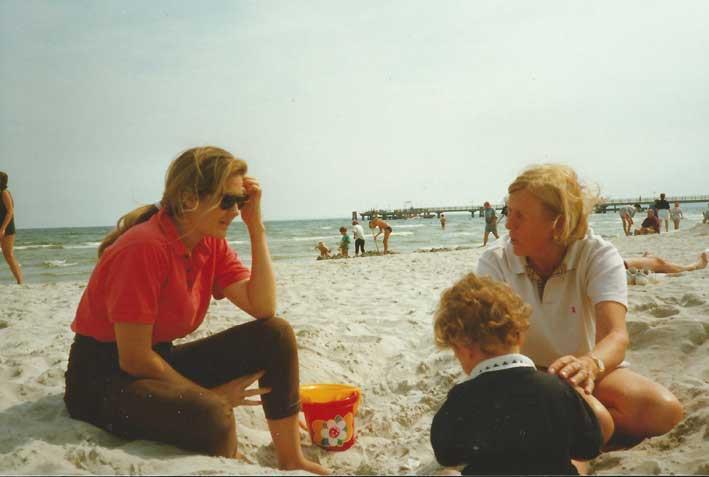
It was always apparent to me, while growing up, that my mother was different to those of my friends here in Malta.
First of all, my mother is German. This means that in our home we had a different language, food, history and traditions. We never spoke a word of Maltese at home. I spent a lot of time in Germany as a child, and even went to school there for some years as my father was a gynaecologist and we left Malta in the late 1970s during the doctor's strike.
My mother is also a medical doctor and absolutely took it for granted that I would both study and work. Her two sisters in Germany, who played an important role in my life, are lawyers. Their example and approach to life as three working and professional women definitely influenced my mind-set and character.
There are certain ways of viewing things and people, here in Malta, which I can only share with my mother. Although I am Maltese, I also see and understand Malta through foreign eyes. I can be both an insider and an outsider. Just to give one example, my perspective on Maltese religious traditions is strongly shaped by my mother, who is Lutheran not Roman Catholic.
These divergent viewpoints can seem hazy and undefined when you are young and just try to fit in with the others. Instead of fading into the distance over the years, they have become more important and clear to me as time goes by.