From the first moment of my visit to Professor Richard England's gorgeous house, I am immediately struck by the joie de vivre and youthfulness of this talented man. No longer in the first flower of youth, as it were, he nevertheless gives off the aura of a boundless energy that is reflected in his surroundings - his rooms are literally covered with examples of his works (paintings, sketches, books) which are testament to a man who truly has spent his life doing what he loves.
"I don't make a distinction between work and free time. Art is my life. As Mother Teresa said: 'It is not so much what you do, but how much love you put in the doing'. Also, I am a great believer that if you rest, you rust", he laughs.
As we sit in his living room, bright light shining through the large window which overlooks a lovely back garden, Professor England declares that he has always had a passion for art. He draws 'madly' he tells me, as I gaze in wonder at the myriad intricate pen-and-ink sketches strewn over his large dining-room table. Even in this age of technology, he says, he still firmly believes that the bridge between mind and paper is still best crossed by the hand.
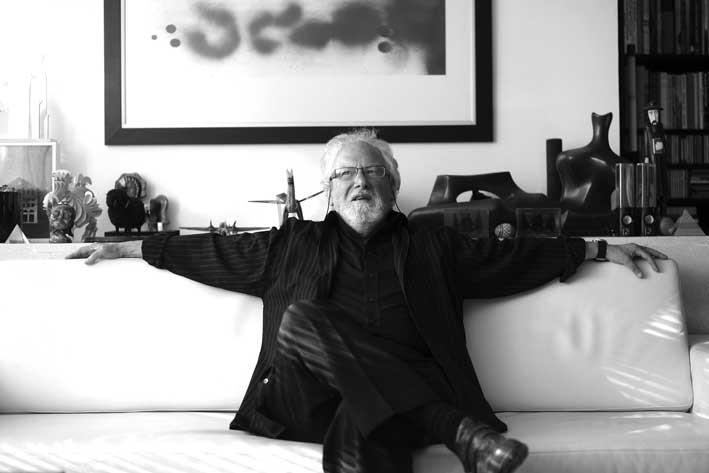
In the same breath, this prolific writer (he has penned 26 books) casually mentions that he has recently finished writing a tome containing 200 poems centred on the myth of Orpheus.
In the foreword to this book, Daniel Libeskind - a world-renowned Polish-American architect who won the competition to be master plan architect for the reconstruction of the World Trade Center site in Lower Manhattan and is also a good personal friend of his - says: "Not only is Richard England a master architect, a gifted draughtsman and an accomplished writer - he is one of the 'originals': a unique human being: an architect who has transformed practice through poetic form and inspiration."
Although he does keep himself busy with 101 things to do, Professor England's current pet project is a building in Gozo which will serve as a spiritual space for all faiths - and even for those who lack one.
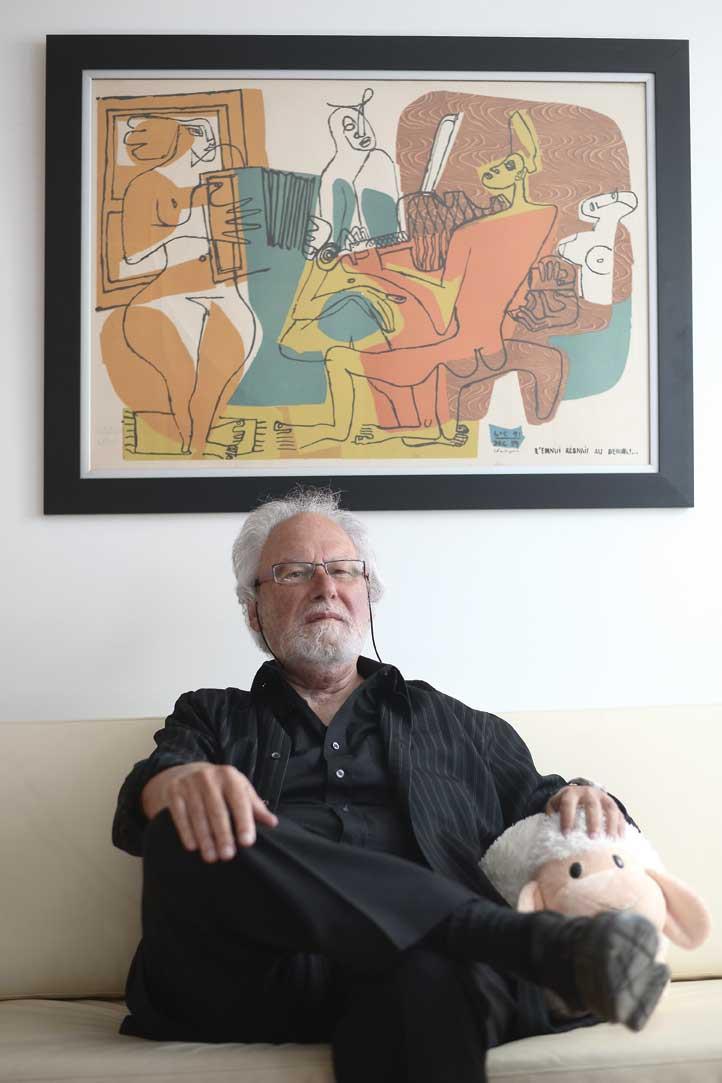
A practicing Catholic, he says he has been very fortunate to have designed 42 sacred spaces in his illustrious career - 24 or 25 of which actually came to fruition, including of course the Church of St Joseph in Manikata, which he designed at the tender age of 23 and, much more recently, the stunning Dar il-Ħanin Samaritan, a conference centre and meditation centre for the Society of Christian doctrine in Santa Venera.
"I have always been very interested in trying to express the spiritual," he says, "Nowadays, with all the horrors and atrocities unfolding around us in the world, it is not a question of whether man is still spiritual but whether man is still human. The shrine in Gozo has been designed as a place of spirituality, of silence. Not empty - but a pregnant silence. The soul needs more space than the body, so there is an extra dimension to spaces such as these."
Professor England says that he is sure the Ġgantija temples were actually a sacred shrine and that the island itself was a sacred one. »
« "This was a time when architects were high priests, magicians and myth-makers who surely had a wisdom which somehow we have lost. Over many centuries, architecture in Malta was once a path to enlightenment. It has now regretfully become a road to speculation, which probably means that whilst we still have lots to learn, we perhaps have more to remember," he laments.
He admits to what he calls, a torrid affair with Malta's sister island. "When I was a student, I spent a lot of time there with a friend. It has a beautiful atmosphere but, unfortunately, it is deteriorating. I remember Gozo when it was absolutely idyllic," he reminisces. "We used to cycle to one particular bar to have a drink. I would wander around in the silence and am sure I met all sorts of ghostly spectres. Now the ghosts have gone and you walk around alone."
The idea of the interfaith shrine is to try and put Gozo on the map and create a place which is a mediation space for any religion or no religion. The design incorporates a square, a circle and a triangle. The square gives the indication that anyone is welcome from any direction; the circle gives a sense of unity and the triangle reaches to the heavens.
Professor England says that the project has had a lot of support from the Bishop of Gozo and the Gozo Minister. The designs are now completed and he is in the process of moving on to the next stage: producing working drawings. His wish is that it is all done and dusted by 2018.
Apart from architecture and painting, another of the professor's passions is opera - tenors in particular. He informs me that he has over 10,000 recordings of the world's most famous tenors - including those on cylinder and vinyl of course - as well as being the proud owner of the only copy in existence of what may well be the world's rarest operatic record by Italian tenor Giovanni Zenatello, who performed in Malta during the 1900/1 season.»
« The discussion of opera brings us to two of our very own tenor superstars - Paul Asciak, who had sadly left us a few days earlier, and was a great personal friend of Professor England, and his protégé Joseph Calleja.
"I remember Paul calling me to go over to see what he had discovered," he says, "It was, of course, Joseph Calleja. His voice was God-given. His technique was something Paul instilled in him. Today he is among the top two or three tenors in the world. He has such a beautiful sound."
Talking about Asciak reminds Professor England of his own mentors: the Italian architect-designer Gio Ponti, with whom he spent two years working in his studio in Milan, and the British architect Basil Spence, who lived in Malta in the early 1970s and the artist Victor Pasmore, both of whom were very close personal friends.
He also harks back to the 1960s which he calls an amazing period that has never come back. "It was a decade where the future looked so good, so hopeful. It even impacted on Malta a little later - with the emergence of people such as Emvin Cremona, Charles Camilleri, Fr Peter Serracino Inglott, Francis Ebejer and Antoine Camilleri and the influx of people such as Pasmore and Desmond Morris," he recollects. "That was the most amazing period. Then it died and it never came again. Now, unfortunately, the future looks bleak. Something has fizzled away. We live in an age when we know the price of everything and the value of nothing. Everything is measured in money."
However, all is not lost. After a pause, he smiles and says that there is yet hope - at least in the sphere of architecture - through a breed of local architects that give him hope for the future; wunderkind Chris Briffa being one of them.
As I make my reluctant farewells (I would have gladly spent another hour or two continuing this most pleasant conversation), Professor England leaves me with his personal maxims:
"I have always believed that an architect must be not only the designer of the future but also the defender of the past. Architecture is what a building does to you, not what you do to a building. Its frozen music should enchant and lift up your soul. Architecture is about giving poetry to the pragmatic."
Certainly food for thought from this intelligent, gifted and worldly-wise man.