PN Deputy Leader Mario de Marco has said in Parliament that the PN will not take part in the MEPA demerger debate until the public consultation period ends.
Parliament is discussing the Environment Protection Bill, one of three Bills regarding the MEPA demerger.
Yesterday saw arguments between the Opposition and government over todays' sittings, with the PN wanting to wait until the consultation period concludes in order to discuss the bills in plenary, and government arguing that the Committee stage would occur after the Summer break. The Committee stage is where the finer points of bills are discussed, clause by clause.
Environment Minister Leo Brincat said that the Environment and Resources Authority will change the dichotomy between the environment and development and will play an important regulatory role.
The Minister mentioned the need for balance between the environment and development. He argued that the environment is now a very important topic for the population, especially for youths. "People take the environment seriously everywhere".
"In England, they found that the environment is one of the top 6 important topics in peoples' minds, regardless of the fact that it is not high on the political agenda. The people said that this is because everyone has a right to the environment".
He quoted from the PL manifesto, and said that we believe Malta should be at the forefront of environmental standards." A good environment leads to better health and a healthier lifestyle. We will work with determination to regain what has been lost".
"The quality of air will be a priority as we believe that clean air is a right for every citizen". He stressed the need to leave a the environment in a better state for future generations.
He described the environment as a priority for the environment and the government's aim is to turn it into a proactive authority to protect and improve the sector.
"We added a number of promises, one of which is that the Authority will be given a vote on the Planning Board".
He stressed that the NGOs will be able to pick their own representatives to serve on the Environment and Resources Authority as well as the Planning Authority.
"So what exactly will change"? he asked.
He explained that he has obligations to the MEPA workers, the Unions, the spirit of the Manifesto and the people. "We are determined and committed that after a few weeks of transition, the Authority would have its own strong identity. In the interest of the environment, the law defacto will be enacted and the Board of Directors etc would be set up".
He mentioned that there were people who tried to make the workers lose hope, telling them that in the sector of environment there was no future. "With our intensive behind the scenes work, it will help us succeed within this process".
He has met with the workers on a number of occasions, where he let the environment workers speak their minds and listened to them.
He mentioned that such ideas were taken on-board for the restructuring of the Environment Resources Authority.
He mentioned that an implementation plan was also worked on behind the scenes, which began months ago and will continue for months after the demerger occurs.
"Implementation of the action plan, for the authority to be established and for it to work well is underway".
He said that this work would not be possible without the cooperation of the workers, unions, managers, Ministry officials and for the help of the Change management team.
"For the first time Malta will have an autonomous environment Authority and the environment is being given the same level of attention as development".
The Authority will have the power to extend the importance of environmental importance to all departments.
"It will promote research in the environment sector within different institutions".
The Environment Board will have the majority of members being independent with a background in social policies, the environment, etc. He said that it will have greater transparency than MEPA has today.
The Environment and Resources Authority will also play an important role to reach the environmental targets given by the EU. "We should reach these goals because we believe on them, and not just because we will be fined".
"After the brain drain in MEPA, who left over the years, we must address this human resources deficit and make a quantum leap in this regard, addressing this problem. The Authority would be able to impose conditions wherever needed, monitor activities that can have an environmental impact and publish the state of the environment report, which will be a top priority".
The Act will allow for a National Environment Strategy, he explained. We don't want it to just be a wish-list, but rather we want a strategic governance document which will have legal strength.
"Our aim is to increase transparency and reduce bureaucracy without damaging the environment".
He explained that every decision affecting the environment would be able to be challenged in the Tribunal. He said that it would be an Authority going up against another Authority.
Not true that the environment will be relegated to consultees - Minister
The Act allows for the public to have access for environment information provided by the Authority. He said that on the Executive Council, which is a Planning Authority organ, will have the same number of members as those coming from the Planning Authority. "It is not true that the environment would be relegated to consultees".
Turning to monitoring and enforcement, he mentioned the importance for effective enforcement. "The Authority will have the power to investigate every aspect in relation to the environment".
He said that it will be a three-tiered approach. Self-regulation, then compliance, then enforcement.
He mentioned that if fines are not enforced, then they wouldn't be useful, backing up his call for strong enforcement. The Authority can take all necessary action against situations which harm the environment, he added.
The Minister explained that later on a fund will be created to help NGOs better conduct their work.
He said that this Bill is not a steamrolled process, stressing that government only wants to pass the 2nd reading by Summer. "The most important step is yet to come, to implement all we have promised".
He argued that the Committee stage will be where all the clauses are debated, and this will come after the four-week consultation period.
Minister Brincat said that the previous administration had the opportunity to implement this years ago, adding that the PL when in Opposition had suggested the MEPA demerger in 2010.

Greco reports and Transparency International under always described MEPA as a hub of corruption. "perception or not we must eliminate this problem for good".
A small argument broke out when the Minister said that there is agreement on principle for the demerger. PN MP Ryan Callus then said that they never said they agreed with it, but rather understand that government has a remit through its electoral manifesto.
Opposition Leader Simon Busuttil said that the Opposition never imagined what the reason to split MEPA could be, and said that it is clear to everyone now, that government want all the power in Castille's hands. He added that the Opposition knows what the Opposition's position is.
The Minister said that in October 2014, the Opposition said that while they fear what can happen to the environment, they were changing their opinion to the possible split.
PN MP Marthese Portelli found the article and read it, explaining that the Opposition was worried of the negative effect the split could have on the environment.
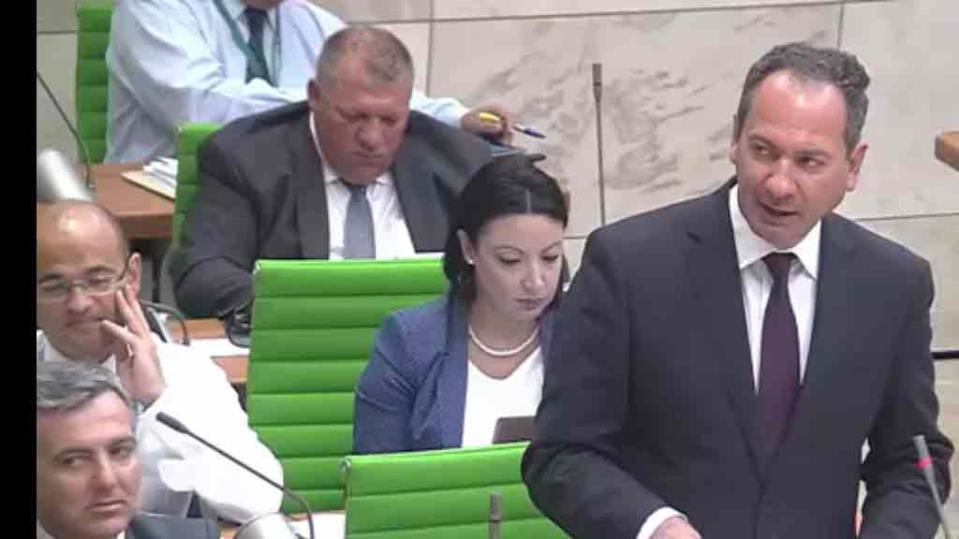
Opposition will not participate in the debate before the consultation process ends - Mario de Marco
“We the Opposition are not ready to be part of this travesty. We do not want to be an accomplice in this sham of a debate. We want to come here, informed with the voice of the people, and our vote should be motivated by the want of the people who we represent,” PN Deputy Leader Mario de Marco said.
The opposition will not participate in this debate, before the consultation process ends, Mario de Marco said. “We are making our final appeal for government to stop holding the debate before the consultation ends”.
MP Mario de Marco stressed that government was trying to rush through this bill, instead of holding this debate after the consultation concluded.
Dr de Marco said that out of 39 deputies, only 2 were inside the Plenary session. PL MP Debrah Schembri said that Ministers as well as deputies are in their offices in the building, able to watch on TV.
Dr de Marco then quipped that 4 were now present in the sitting.
Back on point, he asked what kind of consultation government wants to hold, closing the debate without Parliamentarians listening to what society wants.
“Is this really a government that listens?”
“How can we be so arrogant to call this a government that listens where instead of listening to civil society, government wants to close the debate before the consultation period ends. Government is not taking consultation seriously and is not taking this debate seriously. With all due respect, this debate is an insult to civil society and to all Parliamentary deputies”.
“Government took over 13 months to create this Bill, one that was published on the Parliament website on Friday, later on the government website three days after. All the independent media as well as civil society are saying government is rushing to close the debate on the issue.”
“One would expect that the Minister would be familiar with the Aarhus requirements, and not simply pay lip-service to the environment. He should take it on-board to the decision making process. How can we debate such an important topic, a 2nd reading that is such an important forum for debate, on the future of our environment, and government comes along saying that he doesn’t want to listen to civil society as he is required to by law”.
“The reality is that in this country, we are not living in normal circumstances. We are a small country, where our countryside is limited, a country with the densest population in Europe. Every development has an environmental impact. We are seeing a government, where an area earmarked for a nature park, government chose to create a development project, arguing that it is the only area where a university can be built. We are seeing a government who tries to delegate where it wants development”.
Din L-Art Helwa today said that government’s environment credentials have hit a new time low, Dr de Marco added. “This is why Civil Society, as well as the NGOs who were receptive to the idea of an Environment Authority are now criticising this idea”.
“As the AD said, it does not want to see the fragmentation of MEPA as we want a strong Environmental voice and not just pay lip service to the Environment”.
Right to appeal in front of tribunal
PL Whip Godfrey Farrugia mentioned the Millennium development goals, where the environment, ocean protection and climate change were in the forefront.
He said that the Environment and Resource Authority will have more power, specifically mentioning the creation of policies.
He said that clear processes and transparent processed will be a result of this. “Every process will be open to public scrutiny”.
“The Environment Authority, through autonomy, will have the right to appeal permissions granted by the Planning Authority grants permission in front of an independent tribunal which is not allowed today as it is incorporated within the same authority that grants developments”.
“The environment sector is dominated by international obligations, ones which might not have been given the importance they deserve”. The new Authority will have more power, he said, adding that ENGOs will be involved in the process of environment decision making”.
He said that although the debate is ongoing, the consultation is still taking place. He mentioned that the Environment Parliamentary Committee looks at the policies and local plans, where every citizen can participate. He argued that this committee met 20 times in 2 years, and in the past legislature met less in 5 years.
He argued that the majority of works occurs in Committee stage not during the 2nd reading. He believes that once they do reach that stage, there would be the golden chance through the consultations, for the changes asked for to be made. “We will meticulously go through the law”.
He stressed that what is being discussed affects each and every one of us as well as future generations.