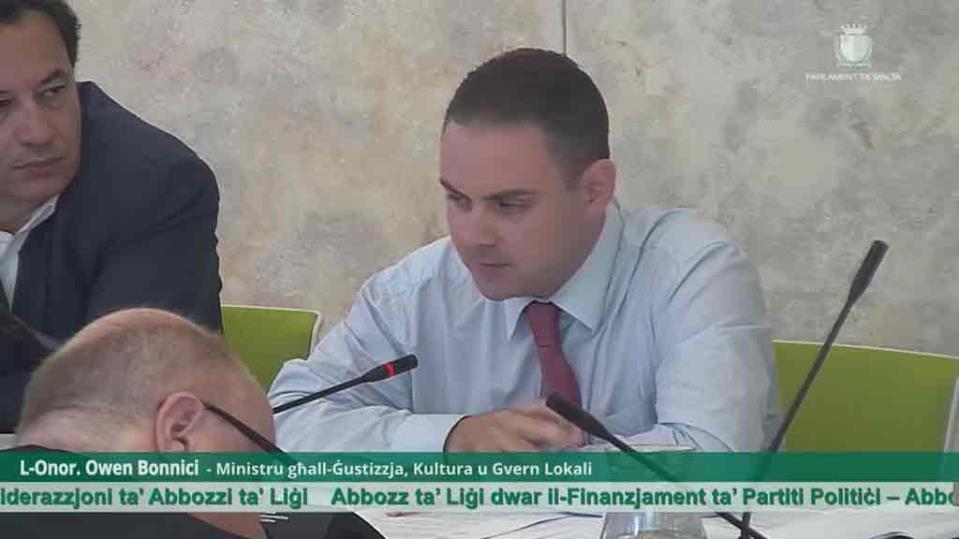
Justice Minister Owen Bonnici, explaining the Environment and Planning Tribunal Bill in Parliament, said that a government is only as strong as its citizens' ability to take action against it.
Minister Owen Bonnici said that the Bill has the aim to establish a tribunal that deals with the MEPA demerger.
"NGOs will be given new rights. When comparing the situation today with the situation following the new law, NGOs will be given possibilities that they currently do not have".
This tribunal is a step in this direction, he said. It will introduce a more ordered system for appeals. "The Bill creates an administrative tribunal which will be ideal to handle the technical questions in environment and planning".
He mentioned that some people believe that every decision should be handled by the courts, "the second school of thought, which I agree with, is that where there is technical information involved, specialised tribunals should decide these issues".
"The advantages of a tribunal are that it is more specialised, can have technical experts, gives quicker decisions and costs less". He mentioned that just because the cost is less, it doesn't mean it does a worse job, adding that Parliament all agrees that specialised tribunals are ideal.
"A tribunal is successful as long as its members have security of tenure. If one has a tribunal deciding on a government decision, those members cannot be set on a basis of hire and fire. If the tribunal includes people who government can fire, then it won't be able to do it's job. In these circumstances, the Tribunal members will have security of tenure and cannot be fired at the whim of the Minister. When the tribunal members are chosen, they will have a 5 year-security of tenure, so for 5 years these members cannot be removed for deciding against an authority. This was not enough however. In order to assure their independence, after 5 years in the post they will not again be given the same post on the tribunal. This means that after year 4, they would not have to worry about being re-appointed. If there is proven misbehaviour however, they can be removed".
This system does have disadvantages, he said, where if there are good tribunal members, they could be lost.
"The Bill also provides for an Independent tribunal secretary. Tribunal members wages come from a consolidated fund, the government's current account. This means that a Minister will not be able to delay wages to the tribunal members as the Minister does not pay the wages of the members".
He explained that tribunal cases will be heard in public. "This means that anyone who would like to go and listen to the tribunal, they can".
A tribunal member, when appointed, will take an oath in front of the Attorney General.
"The tribunal must also move along the lines of natural justice, he explained and respect their principles to listen to both sides and members must not decide on anything where they would have an interest. It must decide on points of fact and rights. If one has a decision by the Planning Authority, and a person appeals and is not satisfied with the result, one would have the right to appeal in front of the Courts. The Judge responsible for these appeals currently would be Mr Justice Anthony Ellul".
He explained that fees in front of the tribunal will be cheap.
The Tribunal has the right to see all the files of the concerning Authority, and if the tribunals find it difficult to understand a particular file, he explained, they would have the right to appoint an expert.
"In order to appeal a tribunal decision in Court, they must do so within 20 days".
"The right to appeal is not only being given to those who, for example, weren't given a planning permission, but also everyone who felt aggrieved by the decision. As long as one files the appeal according to the law, then you wouldn't need to prove your interest". He stressed that he is very pleased with this part of the law.
According to the law, these people would be able to appeal as long as they submit reasoned grounds based on environmental and, or planning considerations to justify their appeal. Government departments and Authorities will also be able to appeal decisions from the Planning or the Environment Authority through the tribunal.
"The Tribunal will have the right to suspend a planning permission pending appeal, however safeguards have been put into place to prevent abuse. Within 30 days a decision must be given regarding the suspension of permission by the Tribunal. If the tribunal agrees and enforces a freeze on permission, then everything must be decided within 3 months".
He expressed his wish for agreement with the Opposition on the bill, stating that the people want to see Parliament agree rather than bicker all the time.
"The people want Parliament to be unanimous on positive bills, and while the Opposition would have certain reservations and criticise where they feel the need to criticise, it is bad to have an Opposition that criticises things that are positive".
This Bill will increase the rights for NGO's he added.
"Certainty is important, that at every stage, one would know where they are. The fact that at every corner, one would know where they are and what they need to do. Practitioners lives will be made easier".
"There is an unbalance towards the environment in this tribunal, giving society the ability to appeal decisions within this tribunal". He said the protection of the environment is in everyone's interest. "We could have left the right to appeal only to those with a direct interest, yet we didn't do this, and gave new rights to those who are not directly involved".
"This is one of the greenest Bills that has come in front of Parliament this legislature".
PN will not participate in this debate since the public consultation has not yet concluded
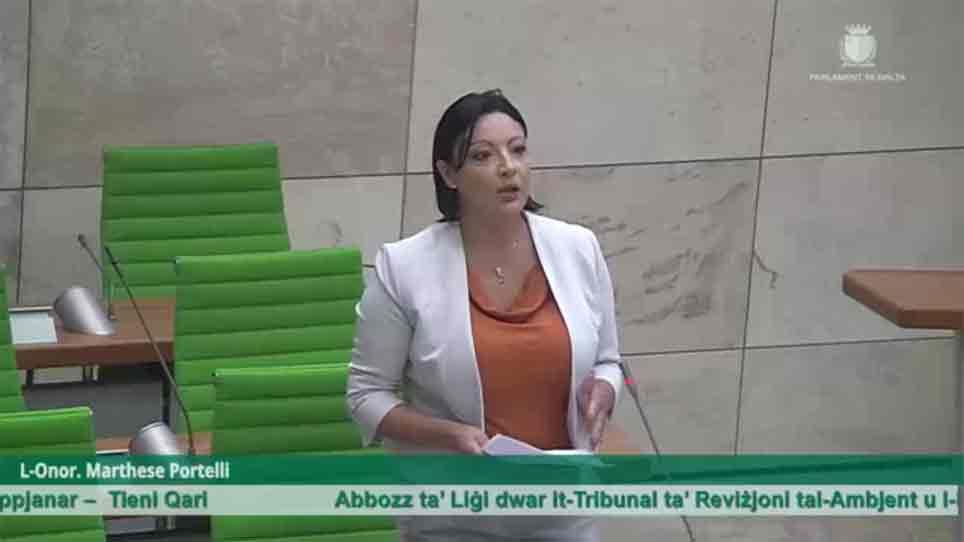
PN MP Marthese Portelli said that today, the third Bill regarding the MEPA demerger is being presented.
“This bill is one of three, along with the Bill regarding the Planning Authority and the Bill regarding the Environment Authority. Government was asked by NGOs as well as developers to have time to discuss the proposed bills through a public consultation, and all said that this discussion in Parliament should be held following the said consultation”.
On July 8, Din L-Art Helwa said that “the insistence by government to open the debate tomorrow without waiting for the consultation process to take place, turns the whole process into a complete sham”.
“FAA said that the last minute invitation to consult is simply a last minute lip service pretence to public consultation”
“Front Harsien ODZ had called on government to refrain from any further discussion in Parliament as ‘it does not make sense to have a Parliamentary debate in Parliament before NGOs submit their proposals’. It is inconceivable for us to debate these bills while the public consultation is ongoing. How can we, the elected peoples’ representatives, hold this discussion without knowing what the people want”.
“The Opposition and government are here as we were entrusted by the Maltese people and all of us must represent those people who elected us. The Opposition will not participate in this debate at this stage as we want to hear what the NGOs have to say and what the developers have to say, as we want to hear what the people have to say”.
She mentioned that the PN have worked with government on the Climate Change Bill, adding that there were some points they wanted change however resulted in agreement on the Bill. “This very week we saw a discussion regarding the new law that would establish the Energy and Water regulator, where we put forward out concerns, saw government answers, and will continue discussing this bill clause by clause this evening. As an Opposition, where there is a bill we feel is positive, we have voted in favour and given our contributions”.
“However, where there are three bills which have seen civil society constantly call for the debate to occur after public consultation, it is our obligation to again ask government to postpone the discussion until after the consultation. If government decides to keep going, the truth remains - that the Opposition will be here to represent society”.
Social Solidarity Minister Michael Farrugia argued that the Bills will be discussed in detail, clause by clause, during the Committee stage which will take place after the consultation stage ends. “Let us at least agree on cardinal principles, were if we don’t agree on one of the bills, then lets say so". He explained that if the Opposition votes against the tribunal bill this would mean that they do not want a tribunal.
Parliamentary Secretary Michael Falzon explained that this tribunal will be able to decide on planning control applications. "Previously this wasn’t able to be done. It will have the jurisdiction to decide on such applications. It is truly a step in the right direction."
"Turning to the Environment impact assessments and IPPC permits, NGOs will have the right to appeal in front of the tribuna, the Parliamentary Secretary added".