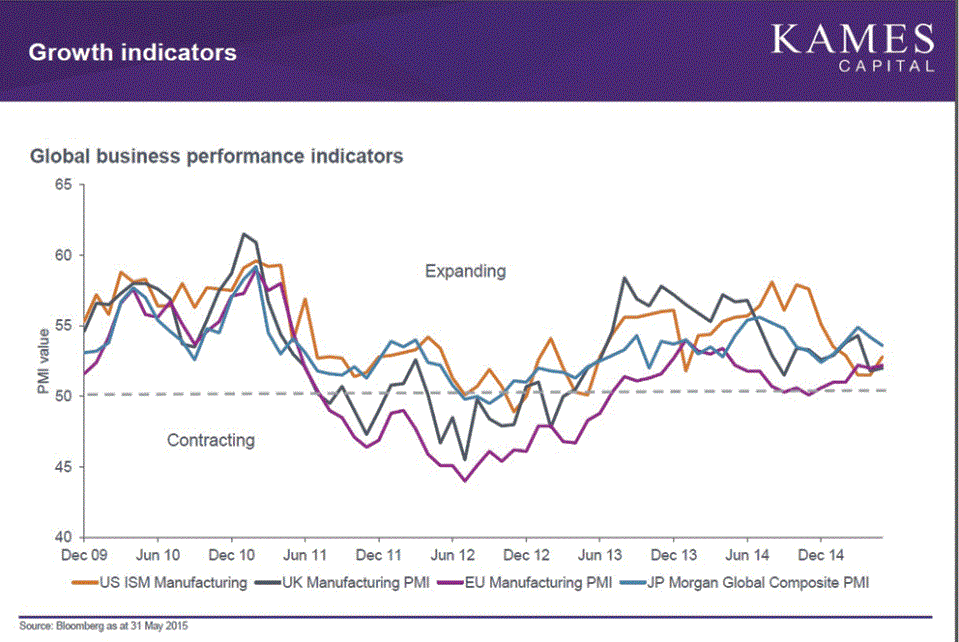
With both the United States and United Kingdom economies set firmly in a recovery phase and the Eurozone now also beginning to see some traction in GDP growth, Kames Capital takes a positive view on the global economy.
"Expansion in the US and the UK is progressing well. Countries in the Eurozone, including Ireland, Spain and Portugal, are all reporting positive GDP growth. Italy appears to have moved out of its trough - no longer reporting negative GDP growth - and Greece, despite its troubles, is too small to make a difference to the direction of the overall European economy," Stephen Baines, Investment manager in the Global High Yield Bond Fund team at Kames Capital, said.
The above table shows the projected direction of interest rates over the next decade. "The market is expecting the US and the UK to enter an interest rate-hiking cycle over the next couple of years. Nothing drastic is expected to happen in the next few years, with the hike in interest rates being a sign that the economy is recovering," Mr Baines said.
The long-term rate at which interest rates will peak, projected at between 2% and 3%, is going to be much lower than we saw in previous cycles, says Mr Baines: "Though it is levelling off and, given that we are in an interest rate hiking cycle, we believe that government bonds in general are over priced, with their yields not generous enough to reflect the risk that levels of GDP growth and inflation return to levels that have been seen throughout the 20th century.
"Also, we don't think that government bonds are sufficiently priced for the levels of inflation and GDP growth that we see today. On balance, returns from government bonds are probably going to be around 0 over the next six months, so your yield could well be wiped out by capital depreciation on the other side."
Kames Capital is arguing that investors should have low exposure to government bonds in terms of their duration positioning, focusing more on shorter-term maturities. Investment-grade corporate bonds are preferred, although their returns are correlated with government bonds.
"Credit spreads, in general, are still at levels that we think are attractive enough to compensate for default risk and, indeed, within financials - banks and insurance companies - we think that credit spreads are still quite generous. So they don't properly take into account the deleveraging and derisking that we have seen in those institutions since the credit crisis," Mr Baines said.
Improvements in major economies over the next few years will mean low levels of default in high yield bonds. "This means investors will be able to earn a coupon or a yield-like return. So with yields - certainly on our fund - of around 4.5%, we think that is a reasonable guide as to what returns could be going forward."
Emerging markets are probably the least certain part of the global fixed income markets, with Kames forecasting possible returns from -2% to +5%. Mr Baines pointed out that these types of bonds have previously been negatively impacted every time the US has increased interest rates. "Given, we believe, that the US is entering a rate-hiking cycle, we will be cautious on emerging markets," he said.
The current commodity downcycle may challenge fiscal positions in many emerging market countries. Valuations, too, of emerging market bonds are at tighter-than-average levels vs history. "So we don't think that is likely to be the most attractive place to invest," he added.
Credit spreads vs US Treasury bonds were at relatively tight levels. "So, not only are the fundamentals deteriorating slightly, but you will be buying into emerging markets with tighter-than-average valuations. Note that the forecast range is quite wide in emerging markets, compared to some asset classes which is a function of the higher level of volatility that we can expect in the wider range of outcomes."
Although nominal bond yields are at 4% ‒ 4.5%, Mr Baines points out that we currently live in an inflation environment of almost zero for consumer price inflation. "So you receive all of your yield - or almost all - in real terms. It does not get eaten away by inflation. That is your main risk when investing in government bonds because you do not expect the UK, US or Maltese government to ever go bust.
"It is just the value of the currency that you receive at the time of maturity. So part of your bond yield is to compensate you for inflation risk."
Another factor is the supply and demand for funds. As demographics have changed over the past 20-30 years, the baby boom generation born after World War II, who needed funds to buy housing, cars or to invest in companies that provided the goods they demanded for their lifestyles, are today reaching retirement with huge pots of savings. They want to invest these in bonds that provide a low-risk haven. "At the moment there is a high supply of funds and a low demand to borrow funds," Mr Baines observed.
Still the global economic outlook remains positive, although more negative for government bonds as central banks are gradually going to come under pressure to raise interest rates to stave off the threat of inflation developing as the labour market supply diminishes.
"That environment of a continual expansion over the next few years should provide a very good backdrop for lending to high yield corporations seeking to borrow because we think that will lead to a low default backdrop. So a low level of defaults from high yield borrowers should mean that investors in high yield bonds are able to capture a large proportion of the credit risk premium."