It is a besieged Europe, besieged by the hundreds of thousands, if not millions trying their best to break down the barriers of Fortress Europe in search of a better life for them and for their children, away from wars and destruction.
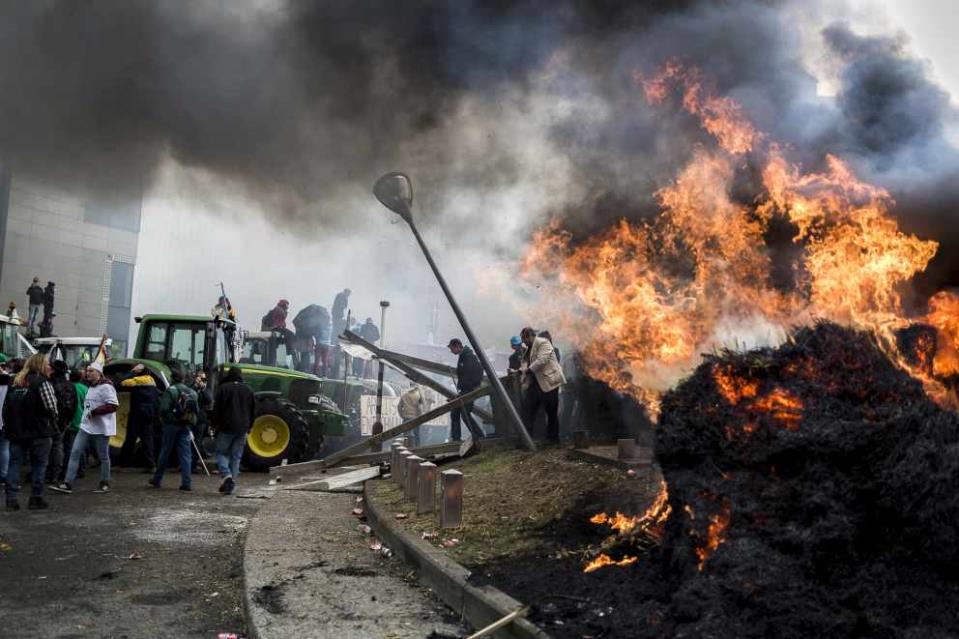
And Europe’s capital, Brussels, was under siege on Monday – for a different reason. Thousands of angry farmers drove their tractors to the European quarter to protest about the milk quotas. There were staged confrontations with the police who surrounded the European quarter from the night before with barbed wire barricades.
To this doubly besieged capital of Europe, the Directorate General brought journalists from all over Europe, courtesy of the European Journalism Centre, to hear about the new initiative by the Commission regarding long term unemployed. Only, it was not to happen.
The Commission was meant to discuss and hopefully approve this new initiative at its collegial meeting today but that has been bumped off the agenda by an urgent discussion on the migrant crisis. The initiative maybe will be discussed next week, maybe.
Marianne Thyssen, EU Commissioner for Employment, Social Affairs, Skills and Labour Mobility, who braved the farmers’ siege to meet journalists, thus had to break the news to the journalists.
She had more bad news to announce. This new initiative, if the proposal is adopted by the Commission, does not come with increased funding, it will more or less be a tightening up of loose ends and laying down on paper what some member states are already doing as best practice.
Nevertheless, the EJC seminar proved to be worthwhile for it showcased the good practices that are being employed and once again focused attention on the long term unemployed who make up the hard core of Europe’s jobless.

It is estimated that there are at least 12 million long term unemployed in Europe who have been out of work for at least one whole year and maybe this figure is seriously underestimated. One has to multiply this figure with a multiplier signifying families or dependents to understand the social implications. The longer they stay out of work, the more they will find it difficult to get back. The ever-present risk is for them to drop out of the job market altogether.
The first step is thus to find out how many of them there are, and this can only be obtained by getting them to register. This may seem a trite step, but surprisingly, not all member states have registers of the unemployed.
Only registration will enable the profiling of each long term unemployed person and thus a serious attempt to get to grips with each person’s problems which may exponentially increase with long-term unemployment to poverty and social exclusion, compounded maybe with bad health and/or disability, lead to indebtedness and consequent lack of self-confidence.
The seminar’s participants then heard about some best practices from countries around Europe.