Each EU Member State has been asked to draw up a report how it is tackling the long-term unemployed situation in view of a forthcoming Commission recommendation which may be issued next week.
The paper, drawn up by Mario Vassallo and Rose Marie Azzopardi last April, can be found on the Commission's website under the title ESPN Thematic Report on integrated support for the long-term unemployed (Downloads/MT_ESPN_Thematic report on LTU (2015).pdf)
This report presents an analysis of long-term unemployment, which in the case of Malta is seen to be declining, like the overall unemployment rate.
The report complains that tackling the LTU involves two agencies or departments under two different ministries but although there has been talk of setting up a one-stop shop to tackle the issue, nothing has happened so far.
The report sets outs to explain three main issues: the benefits and services to which the long-term unemployed are entitled; the concept of a one-stop shop to deliver and coordinate these services; and whether the approach takes the individual into consideration or whether services are delivered to everyone in the same manner, with no distinctions for personal circumstances.
This report addresses three issues in respect of LTU in Malta:
- benefits and services available to the long-term unemployed;
- coordination between services towards a one-stop shop approach;
- the existence or otherwise of an individualised approach to address LTU.
The services available to Malta's long term unemployed seek to provide them with both a relatively good financial support and incentive and training services to return to employment.
There are three types of unemployment benefits: UB (unemployment benefit); UA (unemployment assistance); and SUB (special unemployment benefits).
The first type, UB, is based on social security contributions and can be provided for a maximum of six months, while the other two are means-tested and are available for longer periods, that is until the individual finds employment or his/her financial and home circumstances change.
A person can also apply for unemployment assistance (commonly known as 'relief') if the amount of UB is low due to the low number of contributions paid. After the elapse of these six months, persons may continue to qualify for unemployment assistance, which does not have any time limits.
UA is means tested and is given to registered heads of households whose capital assets do not exceed €14,000 (if single) and €23,300 (if married), but does not cover individuals who are under 23 years of age. The long-term unemployed may qualify for this category.
A person may also qualify for Special unemployment benefits, which can be more than unemployment assistance, after the lapse of six months. The SUB system is rather complicated and different rates apply depending on the circumstances of the household, assets, contributions paid, dependents, etc. SUB can also be provided to individuals who for some reason (for example an accident) are physically unable to register.
Services are provided by two entities: the Employment and Training Corporation and the Department of Social Security. The first is responsible for registration, training and personalised support; the second is responsible for financial support. The ETC regularly forwards information to the DSS on the unemployed so that entitlement is in turn paid by the DSS.
A number of specific measures exist in Malta to help the long-term unemployed move out of the benefit trap. To encourage persons to find employment, which at times may not offer a much higher incentive than the social assistance they are receiving, assistance is tapered off over a three year period rather than it being suddenly terminated when a person returns to employment.
On the other hand, employers are rewarded with financial incentives for three whole years when they employ long-term unemployed persons.
Although there is a very good level of communication between the ETC and the DSS, a one-stop shop would improve services. However, whilst there are plans for a one-stop shop in the case of many e-services being offered by the government, there do not appear to be any plans to better coordinate activities and services offered by these two.
Existing communication is mainly the forwarding of a weekly list of persons registered with the ETC to the DSS so that the latter can update its own list of people who qualify for that particular week.
The ETC's individualised approach is in the form of a personal action plan (referred to as PAP by officers within the ETC). This covers a number of areas which build up the skills and educational aspirations of the person seeking employment. The PAP provides information regarding how to apply for jobs, where to look for them, how to write a C.V., and other practical processes which the individual may not be familiar with.
It also explores the areas where the individual may benefit from training or skills acquisition, which is then also provided by ETC itself. It is our suggestion that an ad hoc contract between the unemployed persons and ETC, replacing the current personal action plan, would also add clarification and transparency with regards to rights and duties.
1 Benefits and services supporting the long-term unemployed
1.1 Data on the long-term unemployed
The number of long-term unemployed in Malta for 2013 and 2014 is summarised in Table 1 below. Data shows that 216 of them found a job during 2014.
Insert table 1
An independent study of Malta's long term unemployment rate projects a further decline in the years ahead.
1.2 Cash benefits and services offered
Unemployment benefits are provided to people who become unemployed and register for work with ETC. There are three types of unemployment benefits: UB (unemployment benefit); SUB (special unemployment benefits) and UA (unemployment assistance).
The first type, UB, is based on social security contributions and can be provided for a maximum of six months, provided the individual has contributed for at least 52 weeks during his/her working life and has contributed for 20 weeks during the last two years, before applying for the benefit.
The SUB is non-contributory and is paid to the head of the household instead of the UB after a means test. This is also payable for a maximum of six months.
UA is payable under means test if the insured person has exhausted the right to unemployment benefit and does not have any time limits (it does not cover individuals who are under 23 years of age as the Youth Guarantee scheme provides for them).
UA (also commonly known as 'relief) is payable when the household's capital assets do not exceed €14,000 (single) and €23,300 (married). Capital assets do not include the house of residence, a summer residence and a car (if married and the spouse has a driving licence then two cars are excluded).
UA is therefore particularly relevant for the long-term unemployed. The rate of UA varies in accordance with the means test and with household composition. A single person receives up to €100.84 per week. (In comparison, the minimum wage in Malta during 2015, for those aged 18 and over, was €166.26). Each additional family member receives an additional €8.15 per week.
Therefore, a man on unemployment assistance, who is married and has two children, can receive €125.29 weekly. The difference between working for 40 hours a week at the minimum wage, or staying at home on assistance, is often not enough to encourage people to seek employment.
The only condition a person needs to fulfil to receive these benefits is to register at one of the approved centres and sign on at regular weekly intervals. (All benefits above are unemployment benefits and NOT 'social assistance'.)
Social assistance can also be provided to individuals who for some reason (for example an accident) are physically unable to register. Such individuals need to present a medical certificate, and then appear before a medical board which confirms their incapacity to register each week. They are then removed from unemployment related benefits and qualify for social assistance.
Social benefits are aimed to encourage unemployed persons to seek employment and not rely on benefits for their living but re-join the labour market. In reality the Employment and Training Centre and the Department of Social Security, even if working as separate entities, do cooperate. There is always scope for more coordination between the two.
The ETC deals with services for the long-term unemployed, such as informing them about the jobs available, drawing up personal plans and providing courses to reskill or upgrade the existing skills of jobseekers.
The role of the DSS is to issue financial assistance, if they have confirmation from the ETC that the jobseeker is actually registered on a weekly basis. If for any reason the person is struck off the register, (for example for not accepting to attend courses) the DSS would not find them on their list the following week and therefore stop payment.
1.3 Enabling and Activating Services
Malta's employment policy emphasises that persons who are able to work should be in work rather than relying on benefits. Malta imposes sanctions on the unemployed to accept any employment or training offers provided to them by the ETC, as set out in the Employment and Training Services Act, 1990; if they do not comply, they are removed from the unemployment register.
In Malta the problem was that the amount of benefits was not making work pay, because most of the long-term unemployed do not have skills and when they found jobs, they were low-paid ones. The wage they would be paid for such jobs would be less than the benefits they could receive and so they were not encouraged to return to work.
This problem is being addressed through an In-work Benefit Scheme which was announced by the Government in its Budget for 2015. Through this scheme, benefits are given to families with both parents working, and with children under 23 years of age. Families with a joint income of between €10,000 and €20,400, and with one of the partners not earning more than €3,000, benefit from this scheme. The maximum rate paid is €1,000 a year per child for families with a joint income of between €11,900 and €17,099. Families with a joint income up to €11,899 benefit from rates between €200 and €950 per child, and those with income between €17,100 and €20,400 receive between €190 and €970 per child. Single parents who have an income between €6,600 and €15,000 will also benefit from the scheme.
In the meantime, the ETC provides the following services to the long-term unemployed:
- Individual action planning
- Career guidance
- Matching with job vacancies and referral to job interviews
- Training
- Participation in work experience schemes and the Community Work Scheme.
To encourage the employment of persons with disability, the Government is seeking to enforce a law whereby 2% of employees in every company with more than 20 employees should be persons with disability. Those companies which do not employ the legal minimum of persons with disability will be asked to make an annual contribution of €2,400 for each disabled person that company should be employing.
Unemployed persons who have been on social or unemployment assistance for more than 2 of the past 3 years, will retain 65% of their benefits once employed in the first year, 45% in the second year and 25% in the third year. This scheme is also meant to encourage employers to offer more jobs to the unemployed and employers are refunded 25% of the salary for 3 years. This measure is managed directly by the Department for Social Security.
During 2013 the Community Work Scheme, particularly aimed at the long-term unemployed, was launched and included 1,100 jobseekers. This scheme offered registrants the possibility to do community work, for example with NGOs and local councils, and to learn new skills on the job. The work is low paid but it provides the long-term unemployed with the chance to feel that they were working, contributing to the community and possibly also learning some new skills. The objective of the scheme is for these persons to continue to work in the community or to find alternative jobs.
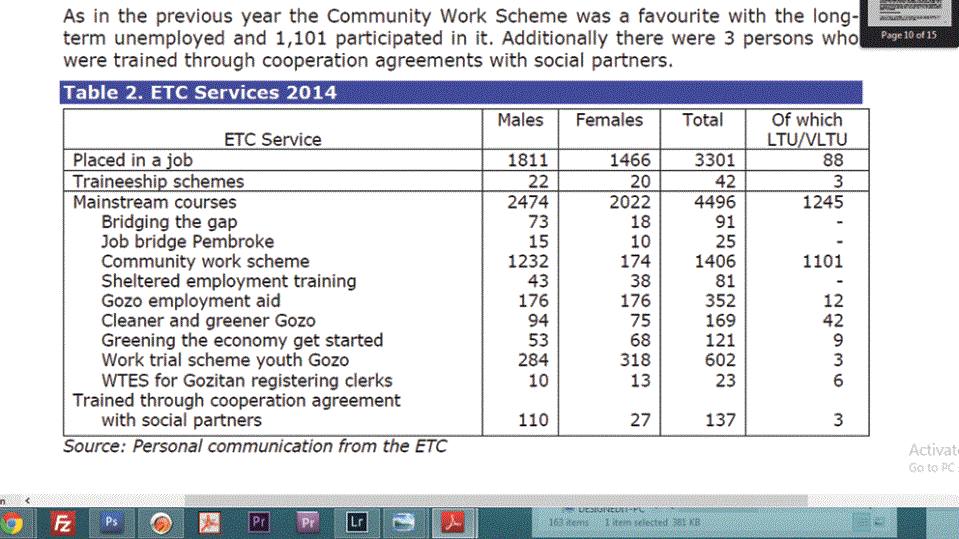
During 2014, there were a total of 1,248 long-term unemployed or very long term unemployed who made use of the services of the ETC.
Of these, 3 were enrolled in traineeship schemes, 88 were placed in jobs and the remainder utilized several schemes.
Most of the schemes were specifically aimed at the long-term unemployed in Gozo, (the smaller sister island where job opportunities tend to be more problematic, where unemployment has tended to remain static and where economic growth is lower than on the main island).
These targeted schemes included: Gozo employment aid; cleaner and greener Gozo; greening the economy get started Gozo; work trial scheme youths Gozo; WTES for Gozitan registering clerks. In total there were 72 Gozitan longterm unemployed who took part in these schemes.
As in the previous year the Community Work Scheme was a favourite with the longterm unemployed and 1,101 participated in it. Additionally there were 3 persons who were trained through cooperation agreements with social partners.
Table 2.
According to the National Reform Programme for 2014, one of the priorities is to address employment challenges and skill mismatches. In recent years focus has turned to female participation in the labour market, since Malta has the lowest level of female employment rate of all 28 Member States of the EU.
Therefore, the government 'announced the reduction in income tax for long-term unemployed women who are over 40 years of age and are going to start employment earning a tax-exempt wage'.
As has already been explained above, this is coupled with the possibility for the long-term unemployed who are joining the labour market not to lose their welfare entitlement, but to have it tapered off over a period of years (NRP 2014:7).
The possibility to recoup part of the salary encourages employers to engage the long-term unemployed. To achieve the revised employment rate target of 70%, the NRP provides a list of initiatives. These are not 'services' in the traditional social services jargon, but are nonetheless services which aim to encourage more labour market participation There is a particular focus on work-life balance in family life, aimed particularly at females, specifically those who have been out of the labour market for a significant number of years.
These include:
- Free childcare centres
- Opening schools earlier than normal school hours
- After-school care services
- Income tax reduction for those parents who send their children to paid childcare centres
- Tax-exemption for females entering the labour market
- Reduction of tax rates from 32% to 29% (for those whose income is up to €60,000 per year)
- More promotion of labour activation programmes. (Source: NRP 2014:24)
2 Coordination between services towards a one-stop shop approach
At present there are two distinct entities, under two separate Ministries, which cater for the unemployed. The ETC, responsible for their registration for unemployment, for the provision of career guidance, for training and for active labour market measures.
The Department of Social Security, within the Ministry of Family and Social Solidarity, is responsible for the payment of benefits to those long-term unemployed who are eligible, and to manage the tapering of benefits.
Information also flows officially from one to the other so that each one is kept updated on the number of registrants seeking employment: the DSS receives weekly updates from the ETC to ensure that the persons entitled to receive benefits actually receive them.
Whilst the DSS is a governmental department within a ministry, the ETC is a stand-alone entity, with a higher degree of independence. Decades ago, both services were under the same ministry which would have made the one-stop shop more of a workable arrangement at that point in time.
Individuals are not obliged to register for unemployment, however, they are encouraged to do so since the ETC provides them with support services and daily updates on the jobs being offered by the labour market.
There are also private employment agencies and the website of the Ministry for Family and Social Solidarity also provides some information on the procedures to be followed for one to find a job, (Ministry for the Family and Social Solidarity, 2015a), as well as limited information on vacant posts (Ministry for the Family and Social Solidarity, 2015b).
For the time being, there are no plans for a one-stop shop. The existing system may not be ideal but officials in both institutions say that the system works well. It is to be remembered that Malta's size and the nature of the workforce, where everybody knows everybody else, facilitates easy communication and personal contact.
3 Individualised approaches
At the start of registration, the jobseeker is informed about the various services the ETC offers. Within a few weeks of first-time registration, he/she is assigned an employment advisor who profiles him/her and together with him/her draws up an individual action plan which the jobseeker has to abide by.
Moreover, the jobseeker is referred to a short job-seeking skills training course. The jobseeker is regularly contacted by his/her employment advisor throughout his/her unemployment spell. For the long-term unemployed the individual action plan is likely to be reviewed and adapted in light of changing times, opportunities and also training undergone by the participant.
Such reviews, which occur every year, are done so as to reflect any changes in circumstances of the individual or the economic environment. The Personal Action Plan provides jobseekers with details on how to search for a job, providing ideas on where to look for a job, for example the ETC website, daily newspapers, EURES website, licensed employment agencies and JOB banks.
The PAP is developed personally by the employment advisor during direct contact with the job-seeker, during which the overall situation and potential of the jobseeker are discussed and appraised. The PAP provides information about skills (including work skills and personal qualities), qualifications and past work history.
The PAP booklet also helps with writing a curriculum vitae, covering letters, filling in applications and preparing for an interview. The PAP can be an effective tool, however, some of the people registering for unemployment who were interviewed saw it as just another form to fill in and found no real value in it, particularly since they felt they had few things they could add to it.
Others, who were young and registering for the first time, felt it was a way of showcasing all they stood for.