Many would argue in favour of the importance of studying in a foreign country, even if briefly, in order to be exposed to new perspectives and to gain knowledge different to that explored here in Malta. This is an infallible point, one which is important to all individuals from all countries and cultures. In addition to this, it is integral to bring sources of knowledge to our shores. If international scholars and researchers come to Malta to discuss their work with local students and peers, then the information which they will elicit will form part of local experience. Knowledge and ideas must constantly travel to Malta and beyond.
One of the approaches which Dr. Giuseppe Schembri Bonaci has been trying to develop within the field of modern Maltese art at the University of Malta is that of integrating the study of the local scene with the international one. This was successfully and wonderfully achieved on December 15, during the conference 'Peripheral Alternatives to Rodin in Modern European Sculpture'. The objective of the conference, which was organised by the Department of History of Art at the University of Malta, was to invite foreign speakers to debate the legacy of French sculptor Auguste Rodin as challenged and expanded by sculptors from all over Europe, with a focus on the Maltese Josef Kalleya.
This conference was organised in order to initiate a discussion on the role sculpture played in the formulation of a new artistic language and to also analyse the various idiomatic alternatives to Rodin co-existing during the first decades of the 20th century and beyond. Rodin is widely considered as the forbearer of modern sculpture whose pervasive influence proclaimed him as the authority of sculptural art.
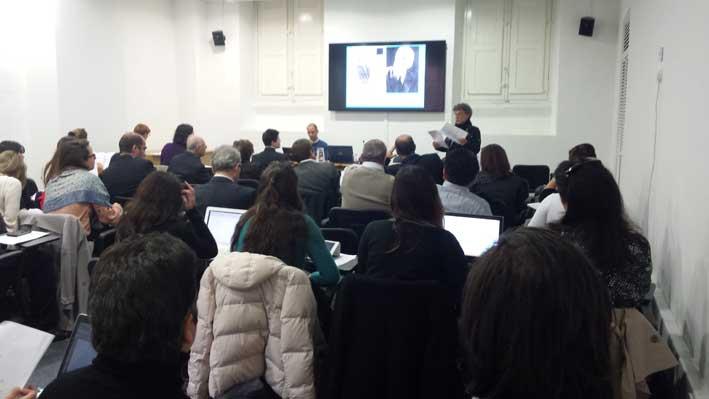
Dr Giuseppe Schembri Bonaci delivering his welcome address
However, Rodin's own developments were challenged by his successors and marginalised contemporaries who further pursued the aesthetic revolution catalysed by the French master sculptor. The conference's objectives included the task to see how this new language related to various daring exponents of sculpture such as the Italian Medardo Rosso, the more recent Swiss sculptor Hans Josephsohn, the Maltese contemporaries Antonio Sciortino and Kalleya, Henry Moore, Alberto Giacometti, Lucio Fontana, Constantin Brancusi, Georg Baselitz, and several others.
Kalleya's name was new to all the foreign participants, yet all reacted to his art. Many questions arose on his working process; on the way he cut into clay using a knife to create visceral incisions, and also on his method of creating photomontages which involved the adherence of a photograph of a bozzetto onto a photograph or postcard of the site where the artist intended to realise his projects. It is hard to find parallels between Kalleya's artistic practice and that of other sculptors of the 20th century. Kalleya's work is not properly appreciated or understood locally, as myself and others have mentioned a number of times, but the extent of his inventiveness and creativity is something I only became more aware of when listening to the conference papers and the subsequent panel discussions.
The conference began with the contribution of Prof. Joseph Paul Cassar who gave an overview of Kalleya's art and his process in order to introduce the artist to the public. Prof. Cassar lives and works in the United States, where he discusses Maltese modern art with international audiences.
Dr. Sophie Biass-Fabiani, curator of the Musée Rodin in Paris, was the second speaker and she discussed the works of sculptors working in the 1960s and 70s. 2017 will mark the 100th anniversary of Rodin's death and to commemorate it the Musée Rodin will be hosting an exhibition on Rodin's legacy. Dr. Biass-Fabiani's paper gave an overview of the thought behind and the artists which will be included in this exhibition, an event which will allow further insight into the work of Rodin as well as that of his ancestors.
To conclude the first panel, Dr. Julia Kelly from Loughborough University, UK, debated the question of chance as explored by 20th century sculptors. Her paper was very important for the study of Kalleya's art because he likewise played with the process which leads to the ultimate outcome of a work. Other Maltese artists such as Gabriel Caruana and Antoine Camilleri also explored such an approach.
The second panel was opened by Ulrich Meinherz, the curator of Kesselhaus Josephsohn in St. Gallen, Switzerland. Meinherz spoke of the work of Hans Josephsohn, a Swiss sculptor who intentionally attempted to bypass characteristics of the European avant-garde in his work. His art was a continuation of the centuries-long dialogue on classical sculpture yet expressed by means of a 20th century language.
Dr. Jon Wood's paper followed with a discussion on the mutation of the human form in modern sculpture. Dr. Wood, who is curator of research at the Henry Moore Foundation in Leeds, contrasted the transformation of nature into fantastical or meta-human form, contrasting such approaches to Rodin's fascination and treatment of the human body.
Barbara Vujanović , curator of Atelijer Meštrović in Zagreb, addressed the artistic relationship of Rodin and the Croatian Ivan Meštrović, who was greatly influenced by the French master but went on to develop his own artistic manner. A similar formation may be observed in Antonio Sciortino's work, a contemporary of Rodin whose early 20th century sculptures display great admiration of the French sculptor.
The final contribution was by Dr. Schembri Bonaci who has studied Kalleya's works in great depth. This paper attempted to introduce new concepts into the study of Josef Kalleya, who, as noted by Dr. Schembri Bonaci, was a contradictory artist working within a complex oxymoronic context. Despite living in Malta for the majority of his life, Kalleya managed to pioneer an aesthetic which fits within the parameters of the global avant-garde.
It was intriguing to see that all the conference participants continued to debate the artists and approaches which were central to the entire conference even once the event was concluded. Those who attended were also able to see some sculptures and photomontages created by Kalleya which are exhibited at the University of Malta Valletta Campus. The exhibition is currently closed but will reopen to the public on Monday 4 January 2016.