The Griffon Vulture rescued by BirdLife Malta from the Malta Freeport last Friday is now safe in Sicily, the environmental organization said today.
“Nicknamed ‘Maximus’, this Griffon Vulture (Gyps fulvus), rescued after being stranded on a Freeport crane, is by far the largest bird to have come to BirdLife Malta for care in the NGO’s lifetime. It arrived last Friday to Malta after it is thought it hitched a ride on a cargo ship while crossing the Strait of Gibraltar. After four days in BirdLife Malta’s care, Maximus was yesterday (Wednesday 8th June) transferred to a wildlife centre in Sicily to gain health and independence before being released at the Nebrodi Park, a site where a re-introduction programme for the species has been in place since 1998.

Nicholas Barbara and ALE at Freeport securing Maximus before being transferred down the crane. Photo by Edward Bonavia.
From the colour of its feathers, head and eyes, Maximus could be anything from 1 to 2 years old, and therefore a juvenile bird by Griffon Vulture standards. At this age Griffon Vultures cannot be sexed. Maximus was severely underweight and his condition required immediate treatment. The bird was yesterday morning accompanied by BirdLife Malta staff to Sicily, following which it was picked up by staff of the Istituto Zooprofilattico Sperimentale della Sicilia, with its final destination being the Parco Faunistico Venatorio Parco D'Orleans in Palermo, where the bird is currently undergoing further treatment to nourish it back to health.

Nicholas Barbara and ALE at Freeport securing Maximus before being transferred down the crane. Photo by Edward Bonavia.
As soon as it gains enough health and independence, Maximus will be prepared to join its similars at the Parco Dei Nebrodi, where the current population amounts to circa 100 individuals originally introduced from Spain. The bird will be fitted with a uniquely numbered ring which can be read from a distance, allowing its identification and monitoring, following which it will be transferred to an enclosure within the Nebrodi Park close to where the resident population is.
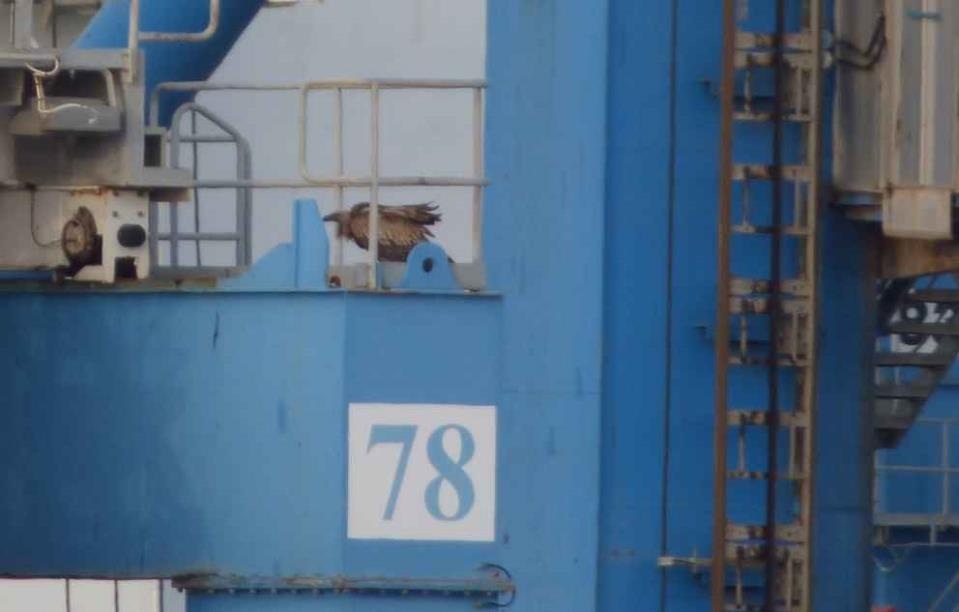
Vulture on a crane at the Freeport. Photo by Edward Jenkins.
Given its discovery at the Freeport, and its rare occurrence in Malta, it is thought the vulture hitched a ride on a cargo ship on its way to Malta. The most likely suspect is a cargo ship that made a trip from Ecuador to Malta passing through the Strait of Gibraltar in the vicinity of which the bird is thought to have landed on the cargo ship. The ship entered Freeport on Friday early morning to offload containers, at which point the bird must have been disturbed and relocated itself on top of a crane, being too weak to fly any further distance. Maximus could therefore be of Spanish origin.
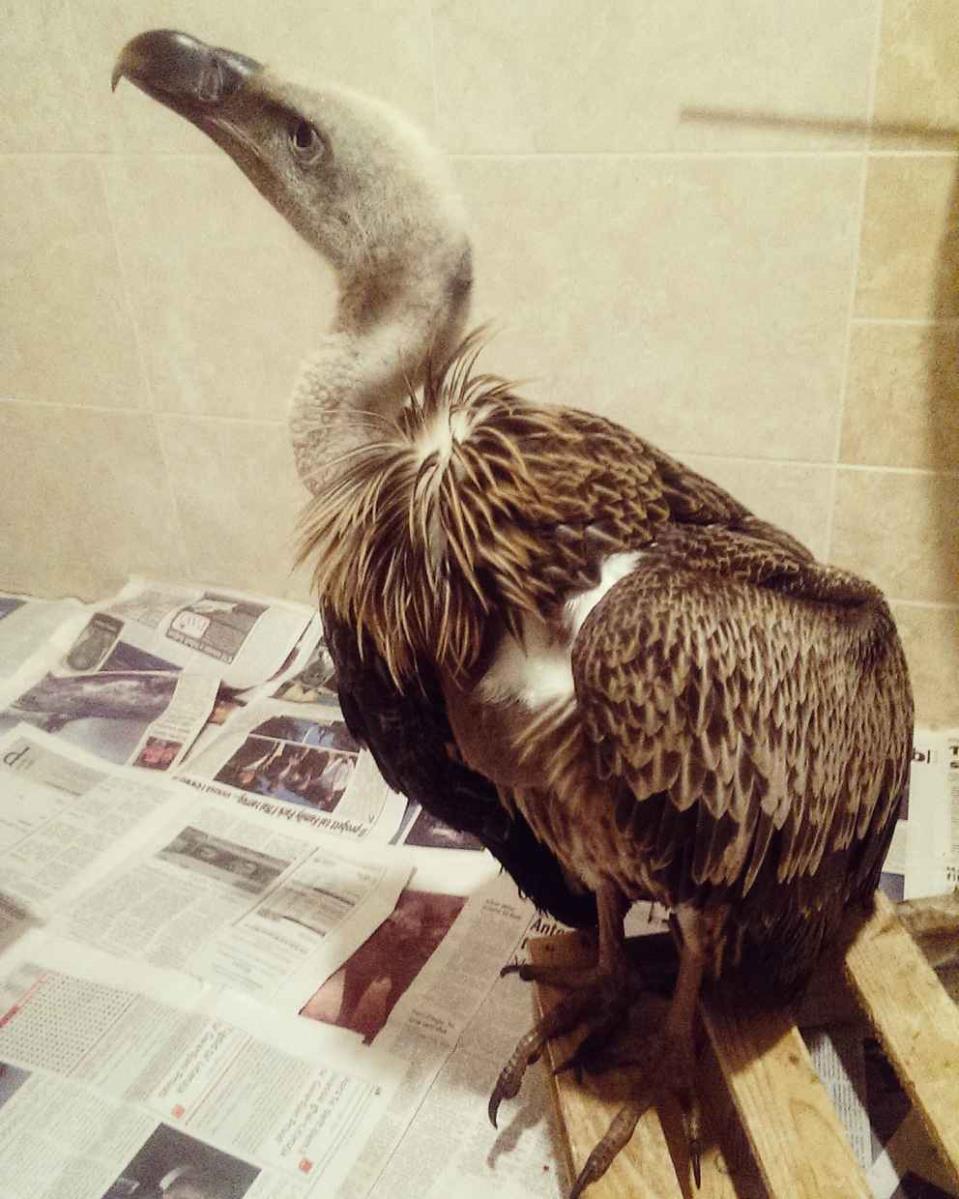
Griffon Vulture Maximus at BirdLife Malta premises. Photo by Nicholas Barbara.
BirdLife Malta’s Conservation Manager Nicholas Barbara stated: “Despite looking impossible, I am glad we managed to convince all concerned that taking the vulture to custody was the best and only solution at this circumstance. I never handled a Griffon Vulture before or climbed a crane, however we had no time to wait and it had to be done. I am grateful to the ALE staff and the Freeport personnel who assisted me at the moment. Equipped with nothing more than a bed sheet, I covered the bird as it was asleep and we then strapped it securely to ensure the bird would not harm itself or us, before taking it down to ground level”.
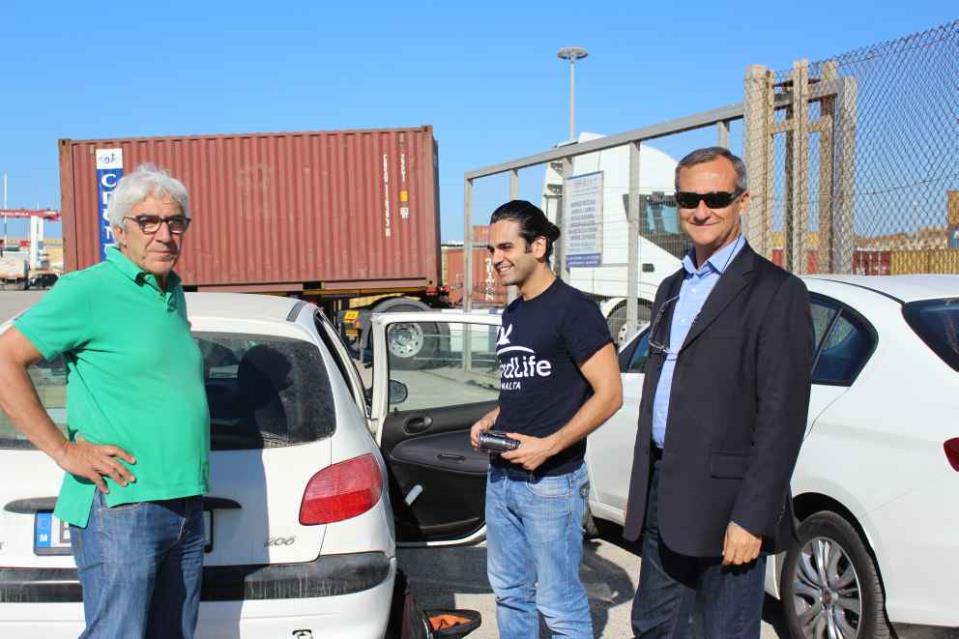
BirdLife Malta Conservation Officer Nick Piludu with Italian authorities.
BirdLife Malta’s Conservation Coordinator Nick Piludu said: “The government authorities’ trust in BirdLife Malta giving care to this bird is commended. When we received news that the bird was to be given to our care, we immediately contacted our partners in Sicily, Greece and Hungary to get the best advice on how to bring it back to health. A few pounds of meat fed regularly to the bird sustained it until yesterday’s morning transfer to Sicily. We are hopeful Maximus is now in safe hands and look forward to seeing it being released at the Parco dei Nebrodi.”
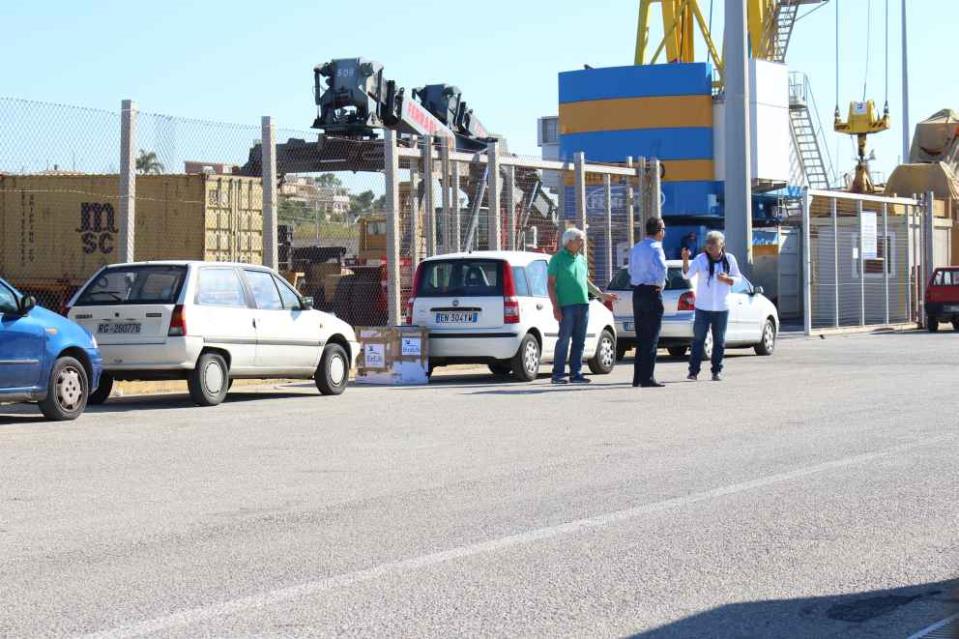
Vulture in a box before boarding ferry to Sicily.
BirdLife Malta thanked the Administrative Law Enforcement (ALE), Freeport staff and the Civil Protection Department for assisting in the challenging rescue of the Griffon Vulture. It would also like to thank the Wild Birds’ Regulation Unit (WBRU), the Government Veterinary Division and the Environment and Resources Authority (ERA) for trusting this unique case to the organisation, as well as for authorising and assisting in the logistics enabling the transfer of the bird yesterday morning.
It also thanked the Istituto Zooprofilattico Sperimentale della Sicilia for accepting to adopt Maximus, who will now sustain the Griffon Vulture re-introduction programme of the Parco Dei Nebrodi in Sicily.
Griffon Vulture biology
Live for up to 30 years in the wild
Mate with one single partner all their life
Lay just one egg per year
As with other vulture species, it feeds on the carcasses of dead animals which it is able to spot from distances away
Griffon Vulture in Malta
The Griffon Vulture (Avultun Prim) is considered as being a very rare species to spot on Malta. Its habitat normally consists of vast open areas and cliffs or mountains where it breeds, something which we don’t have in Malta.
Birds are normally resident and do not migrate, though occasionally this does happen. The closest population to Malta is a colony of circa 100 individuals at the Parco dei Nebrodi in the north of Sicily.
Two known records are known in recent history from Malta – one Griffon killed in 1847 at an undisclosed location, and another one killed on the 6th October 1991 off Filfla at sea. The latter had sparked a protest by the then Malta Ornithological Society (MOS) over a lack of action by police to prosecute a suspect. Other sightings have been mentioned but these are not confirmed. Maximus could therefore be the first record for Malta of a Griffon Vulture that lived to be rescued, and re-introduced to Sicily.
Griffon Vulture in Sicily
Griffon Vultures in Sicily went extinct in 1969. A re-introduction programme was set up in 1998, with around 30 individuals introduced from Spain over a 7 year period. The first Sicilian vulture following the re-introduction programme hatched in 2005.
Further assistance to the Griffon Vulture population is done via the use of feeding stations as well as a further introduction of individuals from Spain.