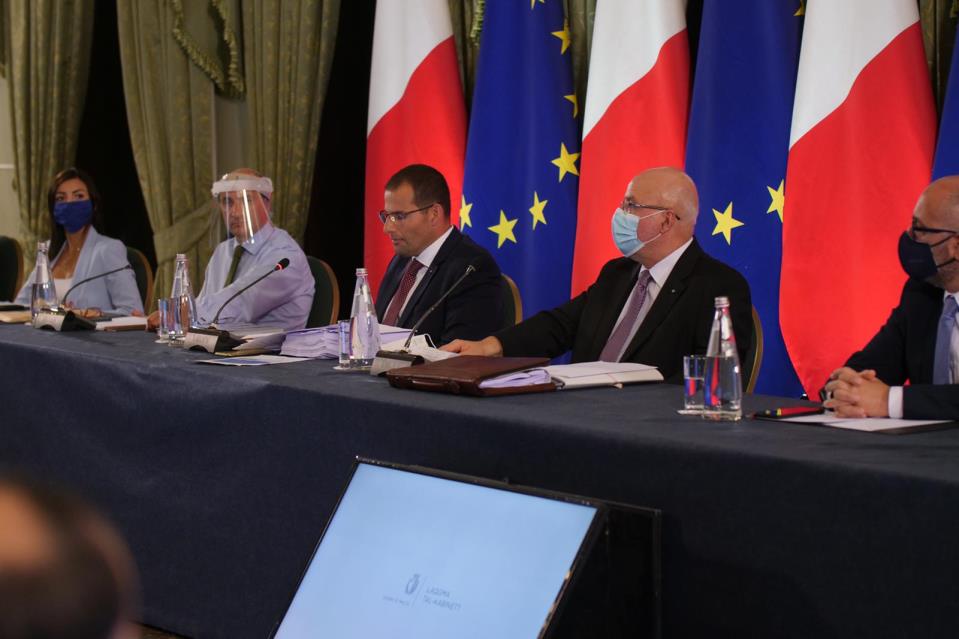
Prime Minister Robert Abela presented a new economic vision for the country during a special Cabinet meeting on Tuesday.
Speaking at the Chamber of Commerce, Abela said that today the government has enough experience in order to propose a new economic model based on one over-arching principle: the attainment of a better quality of life.
It is Abela’s first Cabinet meeting outside of Castille since he took over as Prime Minister at the beginning of this year, and the first time that the Chamber of Commerce itself has hosted a Cabinet meeting.
The Prime Minister explained that this can be achieved through five points: good governance, economic growth which reached everyone, reformed education, modern infrastructure, and becoming carbon neutral by 2050 with intermediary targets every 10 years.
Delving into the points, Abela said that good governance is central to a healthy economy. “Corruption is not acceptable at any level; businesses need a level playing field in order to thrive”, he said.
He said that the reforms drawn up and enacted in response to recommendations made by the Venice Commission were met positively, noting that the reforms themselves were specifically drawn up with the context of Malta’s judicial system in mind and which remove some of his own powers.
Now we will see the fruit of it, Abela said.
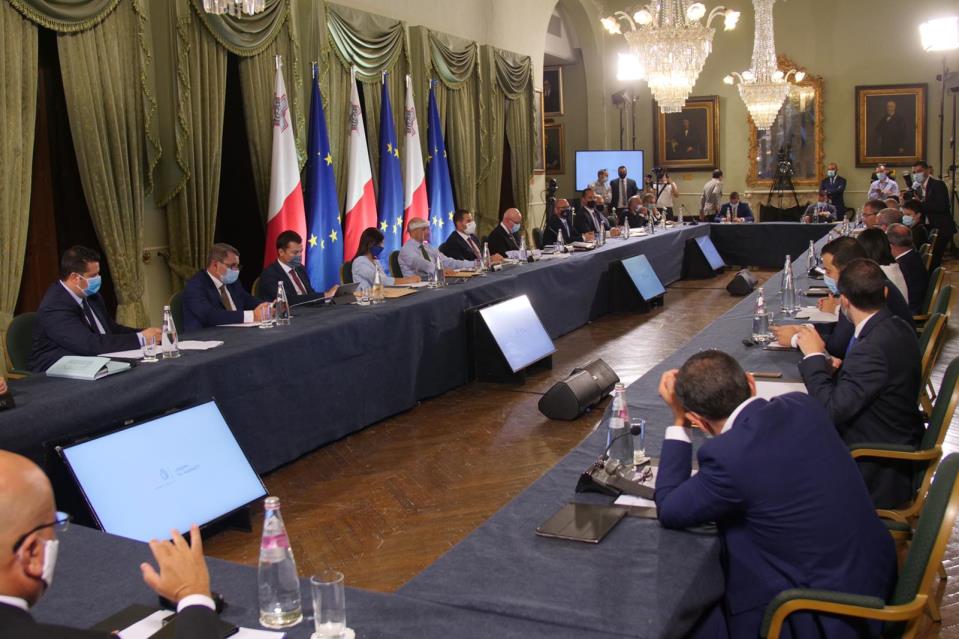
Photos Alenka Falzon
Moving on to the second point, Abela said that all economic growth must lead to a better quality of life; sustainable growth leading to quality jobs, more time to spend with one’s family, and a more merciful society for those who have fallen behind.
“There is no point in economic growth if society isn’t living a better life as a result”, Abela said.
He noted issues such as excessive noise, air pollution, and accessibility – be it for the disabled or because environmentally speaking certain areas are now no longer accessible.
The pandemic is a call for profound reflection and is giving a chance to create a better life, he said
Abela also reflected on the type of tourist that Malta should attract. He said that Malta has to orient its campaign to attract a better quality of tourist. Mass tourism, he said, has to be balanced out with high quality tourists who come to Malta and appreciate the culture and history of the country while treating it as an oasis of relaxation.
Delving into education, Abela said that the current education system is not preparing children enough to be ready to excel in subjects such as mathematics, science, and digital science – subjects which are central to the country’s vision for the next 10 to 20 years.
He said that there has to be added emphasis in the coming years on subjects such as life sciences, robotics, coding, software development, artificial intelligence, and industry 4.0 amongst others.
Turning to infrastructure, Abela noted that to have a better quality of life and attract quality investors and tourists, then Malta needs to offer the infrastructure of a modern country.
“We cannot be a country which has the most sophisticated industries, but then gets stuck in traffic every morning”, he said.
He observed that it is time for serious decisions to be taken when it comes to alternative means of transport and innovative mass transport systems.
Malta’s digital infrastructure also needs to improve, he said, with all services being made available through one website in such a manner that the checks and balances remain but that the bureaucracy is not excessive.
Abela also announced that a second fibre optic cable will be laid between Malta and Gozo in order to attract more industry to the sister island, adding that more details in this regard will follow in the coming weeks.
Finally, he spoke about becoming carbon neutral by the year 2050, something which he described as an ambitious but achievable target. “What we have done up till now is not enough”, he said before noting that the environment is the most crucial part of this plan.
He said that the government needs the best minds to come together in order to achieve this.
Finally, Abela said that he wanted to see more women involved in the leadership and decision making positions in the country. He said that he wanted to see more competent women come forward and give their own perspectives, especially in technological subjects.