When the British took over Malta (1800-1964) as a protectorate in 1800, it served well the needs of the Royal Navy, becoming its main base in the Mediterranean basin. The dockyard was based around the harbour area (Cottonera and Valletta area) with a small yard on Manoel Island.
As a naval power, Britain improved and developed the berthing and other facilities of the dockyard. The most important facility was the Drydock, completed in 1847, which was the first dock for the Navy outside of Britain. Over the years, the Malta dockyard was enlarged to cater for different services between 1861 and 1909 with a further five dry docks being added.
Apart from providing the livelihood of thousands of workers, working at the dockyard carried with it prestige and pride as the best skills in all areas of work (both technical and managerial expertise and know-how) were obtained from this firm. The service given by the workers was also top notch and the yard competed with the best docks in Europe.
But the Drydocks was dependent mainly on British military spending power. This created labour unrest and strife as fear of pay cuts and job loss were the order of the day whenever the British government had to cut on expenditure. This predicament was also becoming stronger as Britain was also losing on its former colonies that were seeking independence and hence less spending.
In the 1950s, the Drydocks employed about 10% of the Maltese labour force. The Maltese government considered diversification of the Maltese economy and commercialisation was also becoming a top priority in the first development plan for Malta in 1959. Moreover, Egypt in 1956 nationalised the Suez Canal adding more woes and uncertainty to the workers at the Drydocks.
In a move to reorganise the management structure on commercial lines, qualified management and modern techniques in personnel management, organisation and methods of work study, office mechanisation, production engineering, production control, education, training and welfare schemes were introduced.
Since Bailey took over, work started on a high note in diverse areas such as ship-repair, major steelwork, contracts for the construction of new industrial estates for Malta with factory premises such as Phoenix at Mosta being built.

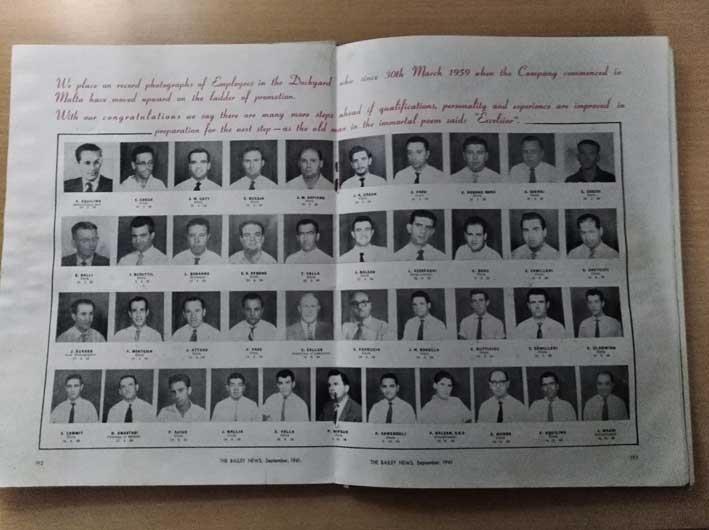
The Bailey News was a publication circulated by Bailey (Malta) Ltd. It was an illustrated 16-page publication with a coloured cover. It was produced in English and Maltese.
It gave news to the workers of the new commercial yard to build up good relations between the management and its operatives.
Apart from ship-repairing, the company introduced and undertook engineering work. Some contracts included:
- Complete overhaul of oil drilling equipment and gear, particularly for Libyan oilfields;
- Manufacture and erection of fuel storage tanks for Shell and Esso;
- Manufacture and erection of gasholders and large water tanks;
- Manufacture and erection of travelling and overhead cranes;
- Repair of all kind of electric motors and electronic equipment complete factory electrical installations;
- Large steel building manufactured and erected;
- Turnkey factory and building projects;
- Boat-building at Manoel Island Shipyard; and
- Manufacture of a 20-ton lottery drum for the Malta Government.
Bailey also created and supported the following limited liability companies:
- Malta Bacon Co Ltd
- Mid-Med Towage Co. Ltd
- Associated Freezers Ltd
- National Fisheries Ltd
- Villa Rosa Beach Club
- Mediterranean Aquatic Sports Centre
- Jablo Plastics (Malta) Ltd
- Frozen Foods (Malta) Ltd
- B.I.M. Ltd
- General contracting and Engineering Joint Stock Company Ltd
Despite the above success stories, Bailey was ousted from the Dockyard on 14 February 1963 when a Council of Administration took over control of the Dockyard after government passed an emergency bill to this effect.
The pot had been boiling since 1961 for Bailey when a long saga commenced with criticism of the company's operation in the House of Commons.
As a result an inquiry was set up in 1962 to investigate and report the company's operations. This was conducted by J. R. Muirie, a partner in the accounting firm of Peat, Marwick & Mitchell.
The findings were quite damning for Bailey as conclusions showed that the firm was not conducting its business properly. Bailey was with 12 per cent of its share capital by £7,250,000 of unsecured loans. Also funds were transferred from the loan capital to the UK as a hedge against the risk of nationalisation.
Following this report, in 1963, Duncan Sandys announced in the House of Commons that both the British and Maltese governments had "rather reluctantly intervened".
Bailey had presented three writs against the government and accused Muirie of being unaware of the abnormal political situation prevailing in Malta.
Still, early in 1963, government suspended payments to Bailey and the Admiralty its contracts for naval works.
On 30 April 1963, the Council appointed Swan Hunter and Wigham Richardson as managing agents and the Dockyard traded under the new name of Malta Drydocks. Thus ended another chapter in the Malta Drydocks' history.