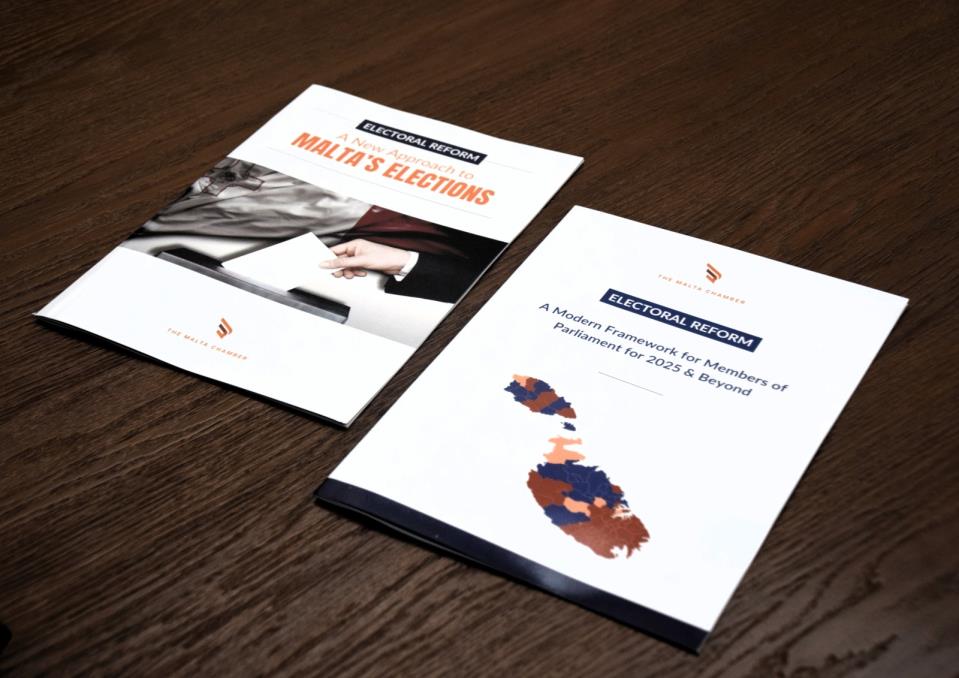
The Chamber of Commerce wants Malta's electoral system to be reformed, with its Head of Policy Kevin Mizzi telling The Malta Independent on Sunday that the idea was not to make radical changes but to suggest what can be improved in the current system.
Mizzi said that at the core of the chamber's reform proposal is maintaining the country's current electoral system - the Single Transferrable Vote. This principle is something which Mizzi said was also on the discussion table, but the Chamber ultimately decided against recommending a complete change and instead chose to focus on how the current system can be improved.
"We considered a number of systems such as the closed system, where your vote goes to a party and they then choose their own candidates rather than the voter choosing a particular person," Mizzi said.
"However we decided that we wanted to keep a realistic element to what we are pushing for because we felt that there was a lot of good that could be lost if we suggested something more radical - and sometimes you need to take the first step before getting to the fifth," he added.
"We saw that realistically there was a better chance for take-up if we follow this route rather than the radical route," he said.
The chamber's spokesperson Rachel Attard also pointed out that drastic changes in Mediterranean cultures don't always work, with Mizzi pointing out that there is an argument that a "democratic deficit" can be created by radically changing the electoral system that everybody is now used to.
Full-time MPs with a full-time pay
A key aspect of the chamber's proposed reform is for Members of Parliament to become full-timers. It's a matter which has been debated for a number of years: currently, Malta's MPs are considered as part-timers receiving only an honoraria of half of the top scale of the public sector pay grades - which as of 2025 stands at €25,562.50.
"We think that the system should be full-time and mandatory," Mizzi said when asked whether the chamber had considered other ideas, such as a hybrid system.
"Let's say it how it is: today you don't go to work in the morning, be in Parliament at 4pm and out at 7:30pm and then you can go home, and you use your Thursday and Friday for your constituents. The system isn't like that anymore," he said.
He noted that many of the laws coming through are derived from the European Union and need a detailed level of scrutiny with an element of consultation with entities such as the Chamber itself so that Malta's realities can be reflected in them.
"The element of preparation is hefty," Mizzi said. Right now, he said, MPs are working during the day in order to sustain what they feel to be a respectable income but then must somehow keep up with the preparation for their Parliamentary work.
There are other reasons: Mizzi said that having a full-time MP would serve to reduce the potential of corruption also reduce instances where backbench MPs who do not make it to Cabinet are given another role somewhere in the government in order to get a better salary.
The chamber's idea of full-time MPs goes hand in hand with reducing the size of the Parliament from its current 79 MPs to 45 MPs, as this would help fund the reform.
Attard noted other points: a full-time Parliament would reduce the risk of conflict of interests developing. "Something we want to avoid is having an MP defending a client in the law courts in the morning and then discussing the same case in parliament in the evening," she said.
She also commented that the chamber has observed that some MPs - even members of Cabinet - are simply not well-prepared. "We've seen MPs in the media, at conferences or even here with us who are completely detached from reality," she said.
An important factor of this proposal is how much political office holders would be paid if Parliament were to be switched to full-time - and whether it would be enough to entice people to stop their day jobs entirely to enter the political world.
Mizzi explained that the salaries on offer today are "very low" and the Chamber, through expert David Spiteri Gingell who wrote the proposals, consulted with a recruitment expert to draw comparisons with the market salaries in order to find some form of alignment.
What the chamber settled upon was pegging an MP's base salary to that of a government director general - which is Scale 3 in the public sector pay ladder.
When the strategy was written - which was before the government signed a new collective agreement increasing the salary scales - this was worth €42,582 per year. Under the new collective agreement it would stand at €44,723 per year.
Also included however for each MP is a communication allowance, part-time secretarial support, and a full-time researcher to work with the MP in order for them to be better informed about the subject at hand.
There are then top-ups for office holders, Mizzi said, with these being pegged as a percentage of the median average of what a CEO in the private sector earns - this works out to around €126,500 per year. Under the chamber's proposal, the Prime Minister would get 90% of that, a Minister and the Opposition Leader would get 75% and a Parliamentary Secretary would get 65%.
"Even though we are increasing salaries, we expect more transparency and accountability, and that these things like not issuing the declaration of assets do not keep happening," Attard pointed out.
The electoral district debate
Turning to the electoral process itself, the chamber isn't only proposing to reduce the number of MPs, but also the number of electoral districts. Malta currently has 13 electoral districts, but the Chamber's proposal would see this reduced down to five.
Malta's district system is a topic of debate, particularly as the borders of each district are redrawn time and time again, with localities split between two districts on more than one occasion in order to maintain a balance in voting populations.
Naxxar, for instance, is already split between two electoral districts, and new proposals being put forward today could see localities such as Birkirkara, Fgura and Swieqi split between two districts.
Mizzi explained that the chamber's system of having five districts would see around 60,800 voters in each of them, and each district elects nine MPs.
Particular is Gozo's position in this equation: right now it has a voting population which is higher than any other district on the main island, and that cannot be reduced because the Constitution stipulates that the island cannot be split on the electoral map.
To this end, Mizzi said, the chamber decided that one of the five electoral districts that it is proposing should include all of Gozo together with the localities of Mellieha and Mgarr - "two localities which are relevant to the distinct and particular aspect of Gozo," Mizzi said.
Asked about whether there is a constitutional concern in doing this, Mizzi said that Article 61 of the Constitution speaks of not dividing Gozo and its voting population - but makes no mention of not being allowed to add localities with all of Gozo into one district.
"Our proposal is in line with the Constitution," he said.
"Why is there added value for Gozo in this? When there was controversy over the arterial road from Mellieha to Cirkewwa, who was the most vociferous on it? It was the Gozitans - and rightly so, because connectivity is linking one place with another; if one side has no say then the connectivity aspect is somewhat belittled," he added.
Technical Ministers: 'This isn't something anti-democratic'
Another of the chamber's proposals is to remove the system of co-options but also introduce conditions for the appointment of unelected technical ministers, parliamentary secretaries, or even shadow ministers under certain criteria.
There is a caveat though: such a technical person would have to replace an MP - the one who had performed worst in that party's electoral showing. There is a capping to: a party can only have one technocrat for every six MPs it elects.
Asked how reflective this is of the democratic system when one is replacing someone who is elected with someone who is unelected, Mizzi observed that it is to replace a co-option system which "many times is not being used for its original intentions, but to elect someone that the leader at the time would want in Parliament."
"It might be motivated by the desire for more competence, and let's face it as businesses we can see that we need more competence," Mizzi continued.
He said that the chamber had already said back in 2022 that candidates should be trained and prepared for the life of a politician before coming up for election, but in the absence of state financing to help political parties, this system of technical ministers and shadow ministers could be a solution.
"It's not something to use by force, but it is a legal pathway to have that competence. It has its weight of course, and it's a very big responsibility on the shoulders of the Prime Minister and Opposition leader because there is a cost - so best prepare not to use the system," Mizzi said.
"The ideal scenario of course is for these technical people to be elected straightaway but we know that in practice that's not how it works, so we are giving a legal pathway to bypass the abusive practice of the co-option," Mizzi said.
"We also recognised that in the last decade there have been emerging competencies which are very difficult to find in Parliament," Attard said. She mentioned artificial intelligence as one such example.
"This isn't something anti-democratic or a sign to remove the merits of MPs - in no way do we want to do that - but we are saying that there are certain competencies which people are needed for," Attard added.
A national threshold guaranteeing representation in Parliament
The chamber is also proposing a threshold through which a political party is automatically elected in Parliament. Under this proposal, if a party where to attain 5% of the national vote then it would be automatically entitled to one of the 45 seats in Parliament - even if none of its candidates are elected through the quota.
The remaining 44 seats would then be divided between the parties elected - Mizzi said that the chamber did not want to see provisos which would see more MPs added for different scenarios such as, for instance, the gender mechanism, which the chamber said it disagrees with.
All of this, however, hinges on the two political parties having the desire to reform the electoral system - and the fact is that some of these reforms will weaken the hold that the two major parties have on Maltese politics.
"Today in Europe there are around 30 coalition parties in government, so it can work. Is there a risk? Yes there is a risk. What we can definitely say thought is that in a two-party system there were already issues when there were small majorities," Mizzi said, as he cited two occasions where the Maltese government was brought down by infighting - the 1998 Alfred Sant administration by Dom Mintoff and the 2012 Lawrence Gonzi administration by Franco Debono.
The principle of electoral reform is that it has to remain inclusive and not restrictive," he said.
Mizzi added that this is coming at a time when more people are not voting, invalidating their vote, or voting for independents or third parties despite knowing that the risk of voting for such is ended up unrepresented in Parliament because getting the 16.7% quota needed in a single district is "impossible."
He said that the Chamber toyed with the idea of a threshold set at 3% or at 5%, ultimately settling for the latter even to avoid certain risks avoided with the far-right.
"This would be a fair system within the context of voting patterns and people's inclinations today," he said, as he noted that people today do not vote for a third party in part because they know that they have no chance of being elected.
"This is also a challenge to the big parties, because it means that they need to work more for better candidates so the electorate goes back to them," Attard observed.
The way forward from here
Asked what the way forward is now for this reform, Mizzi said that in order for a proposal like this to be taken on board one needs support, the opportunity to explain, and to also bang ideas together so that - if need be - the proposal can improve.
The only premise that Mizzi said the Chamber is placing is that the balance between the two proposals - which are the electoral reform itself and the changes to remuneration for MPs - is maintained.
"We are giving added contribution to the public discussion. Let's see where it goes, but I think we need to engage and find support for the proposal," Mizzi said.
"What we don't want is one thing: that this is another document placed in the shelf and everybody forgets about it because it serves them to forget about it. We didn't do this work for nothing but because this would bring accountability, transparency and good governance," Attard meanwhile concluded.