The other day, I had a healthy discussion with a friend of mine regarding the government's proposed changes to planning regulations. Both of us started from the premise that development is key to growth and change in our social, political, and economic system. We agreed that it is only economic development that can truly reduce poverty and provide higher income to Malta's people. Both of us accepted that this involves utilising scarce resources from the environment. Finally, we were at one that the environment is as important as development, and therefore progress can only be achieved if development is sustainable.
Lofty ideals, you might say. What we agreed seems to make sense. Any survey of the population will likely confirm that the absolute majority of the population agrees with these tenets and conclusions. So would the government, the Opposition, and the social partners. Unfortunately, the consensus breaks down almost irretrievably once the discussion delves into the question of implementation of the principles of sustainable development.
This is because the sustainability problem is a value orientation problem, as recognised by the World Commission on Environment and Development. Are the values we hold just those of economic growth and profit? Or are they those of well-being and societal development? Are these values mutually exclusive or can they be combined together in a balanced way?
One orientation is to forge ahead with economic goals that imply environmental and social dumping: economic processes marked by low salaries, low job security, plundering and degradation of the environment, and unfair competition favouring certain sectors. Another orientation could be that, whilst the pursuit of profits remains central to the economy, such profits are generated within the fabric of social and environmental sustainability.
Malta's current orientation still places too much emphasis on the accumulation and growth of the economic value of wealth. This is music to the ears of those who already have loads of it and want more. Those who fall behind or who are better off, but are not obsessed by GDP growth, obviously eschew a merely quantitative dimension for the assessment of wealth.
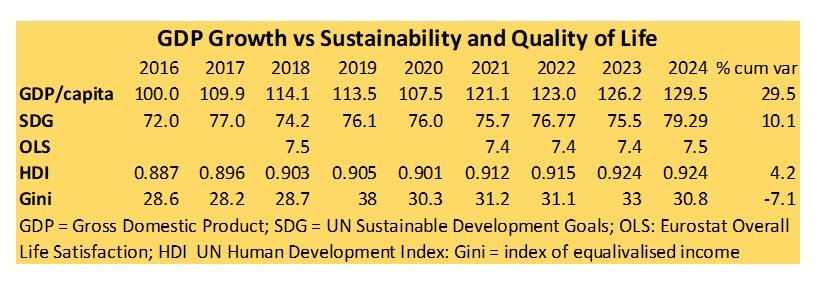
It is easy to see why GDP growth does not necessarily translate equate to sustainability, equality, or quality of life. The table shows that GDP per capita increased by just under 30% over the last eight years, but three indices linked to the latter three measures show modest improvement or even a decline (income equality).
A radical cultural turnaround is needed to make sustainability and quality of life as important as economic growth. This will involve a transition from supreme individualism, which is dominated by the antagonistic competition between the homo homini lupus and the strength of ideas of the homo homini natura amicus.
The idea is not new. It featured strongly in the lessons on the economy by Antonio Genovesi, the forgotten father of economic science, considered a master by Adam Smith. It is to the Italian that we owe thoughts about the goal of "public happiness" and of a "civil economy." Returning to those concepts would repair the damage caused by financial greed and egotistical growth, which are generating growing and unacceptable inequalities.
If we wish to move forward, we need to reflect on how we can implement an economic and social theory that holds firmly onto liberal values but connects them through a sense of shared social responsibility. In such a scenario, the government, entrepreneurs, and capitalists would pay careful attention to all stakeholders, all the social players who are affected by their enterprises: workers, communities, localities, suppliers, and consumers. This definitely includes the circumstances, objects, or conditions by which citizens are surrounded, the physical and psychological environment in which they have to live.
One recent comment by Johann Buttigieg, the PA's CEO, shows how little he knows about sustainable development. He blithely dismissed minor irregularities as not worthy of the Authority's attention, when even minor developmental activities can harm the environment. These minor infringements, when grouped together, can be a major source of environmental degradation. It is as if one might consider a household's waste negligible although, combined with the garbage of thousands of other households, it becomes huge problem.
Environmental degradation covers a variety of issues, including pollution, biodiversity loss and animal extinction, desertification, global warming, and a lot more. It is indeed a reduction of the capacity of the environment to meet social and ecological objectives and needs, as the United Nations International Strategy for Disaster Reduction calls it. Accordingly, urbanisation, population growth, economic growth, an increase in energy use, and an increase in transportation all have the potential to degrade the environment.
The Planning Authority should ensure that planning and development takes fully into account the scarce resources of the country, for the greater good of society and the environment. Many times, it seems that it is more interested in the good of a select few than in the greater good of the community. I would dare say that it often goes rogue when it allows a few powerful people to utilise public resources for their private gain. Unfortunately, the Environment and Resources Authority ̶ the body entrusted with the mechanisms, checks, and balances to ensure that resources are used in a way that is sustainable, responsible, and beneficial to people, society, and the environment ̶ is failing in a big way.
The objections to the proposed changes to planning regulations are not, as is being claimed, an attempt to stop development, but a plea for a reasonable level of sustainable development. Sustainable development, though it may place a constraint on current consumption, will ensure that future generations will have a resource base that is no less than the resource base of the current generation.