Galina Troizky's Mystique Blues, currently on view at Muża, the national-community museum, is an exhibition that lingers in the mind long after the first encounter. Rather than treating the abandoned Mystique cultural hub at Madliena as a mere historical curiosity, Troizky uses it as a conceptual aperture through which to question Malta's increasingly fraught relationship with its built environment. Her work is not nostalgic, nor a lament in the traditional sense; instead, it becomes an excavation of the psychic residue left behind when cultural ambition collapses into neglect.
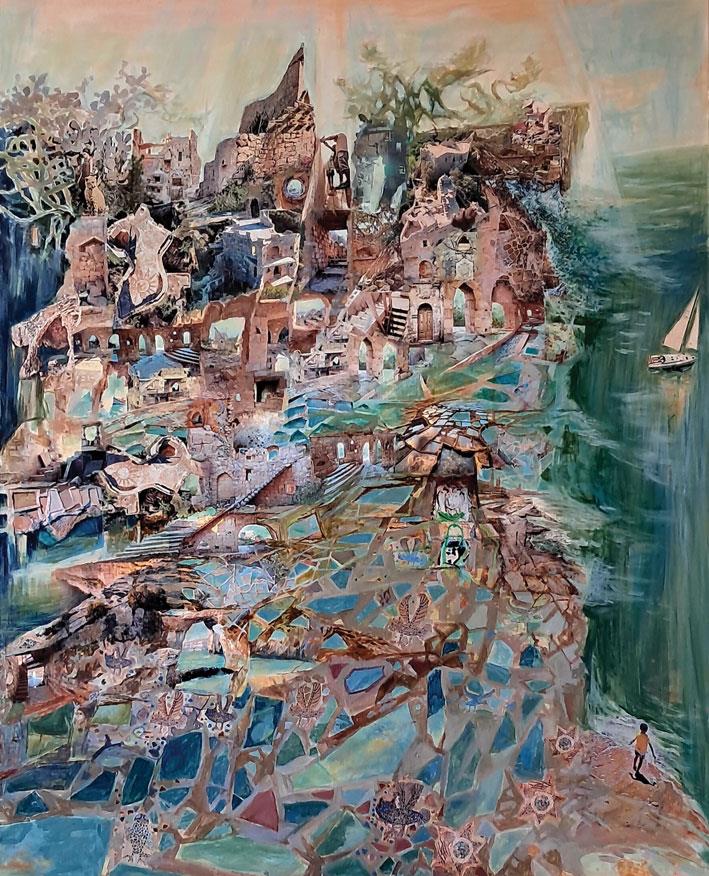
This approach echoes French cultural historian Pierre Nora's notion of lieux de mémoire places that become powerful precisely because living memory has been supplanted by loss (Nora, 1989). Mystique, once a daring experiment in Maltese cultural life and now a vanished site, becomes one such symbolic location. Troizky does not rebuild it, she reimagines it through fragmentation, through the splintered vision of a landscape and a community that no longer has trust its own continuity.
What immediately stands out is Troizky's refusal to depict Mystique literally. There are no architectural elevations or documentary reconstructions. Instead, she constructs the site through fractured surfaces, staccato rhythms, and a palette dominated by bruised blues, greys, and violets. This is not description but atmosphere, the chromatic equivalent of a musical resonance still echoing in its absence. The viewer enters not a place, but a mood, an afterimage suspended between memory and invention.
Her mixed-media method, in which photography, collage, and paint collide, is central to her style and message, both consistently developed in earlier editions of her works, namely Archaeology of the Future (National Museum of fine Arts, 2010), Time, Space... and Palmyra (Malta Society of Arts, 2022) and Lost Paradise (Il-Hagar Museum, Victoria, in 2024). In the exhibit Building Boom, for example, Troizky layers urban facades, interior rooms, fragments of text, and glimpses of lived life into a vertical labyrinth. The work reads like a geological core sample of a city: strata of culture, labour, habitation, and destruction compressed into one trembling surface. Here, style becomes metaphor. The dense accumulation of images expresses how memory itself burdens the present, how the past is never erased but folded unevenly into the now.
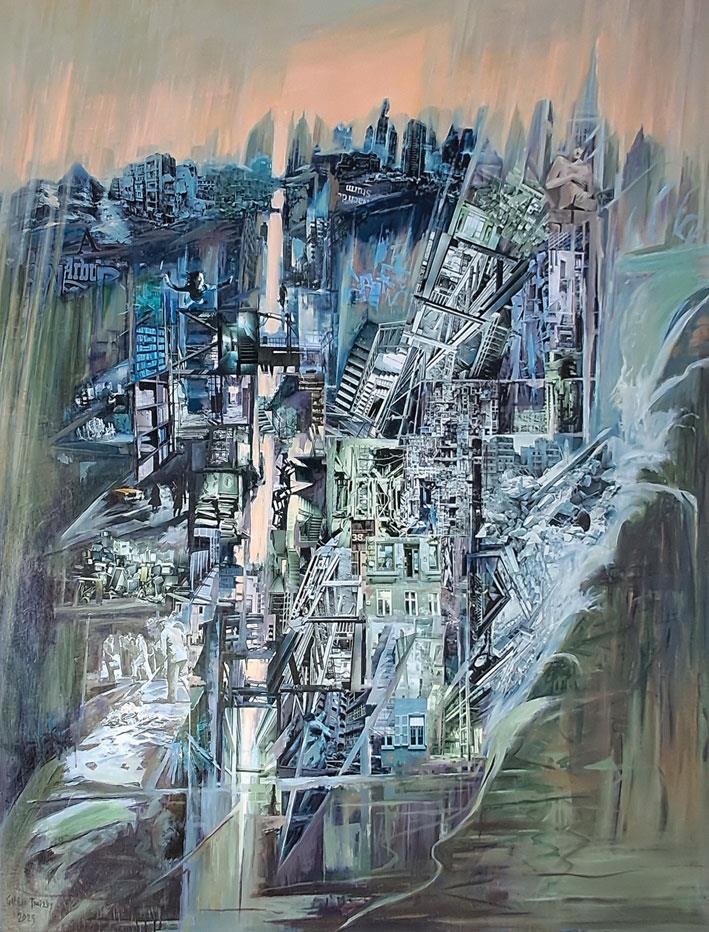
Similarly, Wave uses structural collapse not as drama but as a slow, almost geological unfolding. Architectural elements seem to drift or liquefy; staircases dissolve into water, beams tilt, and bodies appear submerged within the debris. The sea, long a symbol of Maltese identity, becomes in this work a force of attrition rather than of continuity. The painting visualises a wave not of water but of demolition, echoing the transformations overtaking the islands' coastlines. The stylistic interplay of turbulence and precision, Troizky's signature, gives the work an unsettling emotional charge.
One of the strongest aspects of the entire exhibition is Troizky's ability to transform ruin into metaphor. The decayed shell of Mystique becomes a hinge between two Maltas: the imaginative nation that once embraced artistic risk, and the hyper-commercial present where speculative development has eclipsed cultural curiosity. The sense of loss is palpable, yet Troizky avoids moralising. Instead, she reveals the quiet truth that ruins are not only symbols of disappearance but catalysts for reflection.
This perspective places her work within a larger international discourse on heritage loss. Around the world, from the erasure of historic neighbourhoods in Beijing to the catastrophic destruction of Palmyra, artists and scholars have grappled with how cultural identity is compromised when the built environment is erased. Troizky aligns with this conversation, not through direct representation but through a psychological archaeology of space, where fragments provide the only reliable witnesses of what once was.
The musical sensibility in her works is undeniable. Mystique's history as a jazz venue is not depicted literally, but its improvisatory spirit permeates the canvases. Brushstrokes break into syncopated patterns, collaged elements repeat and mutate like riffs; shadows pulse with the tension of unresolved chords. As Rosalind Krauss argues, contemporary art often occupies an "expanded field" between disciplines (Krauss, 1979). Troizky's work drifts between painting, architecture, cartography, music, and memory studies, never settling, always reconfiguring.
Yet perhaps the most striking quality of Mystique Blues is its insistence that what is lost can still shape us. Troizky's images are not elegies but warnings, visual alarms calling attention to the accelerating disappearance of Malta's cultural fabric. Her collaged approach mirrors the islands themselves: layered, fragile, and increasingly incoherent under the pressure of development.
If the exhibition mourns anything, it is not simply a building, but a mindset: the willingness to innovate, to create without permission, to prioritise imagination over profit. In resurrecting Mystique within the cultural imagination, Troizky does far more than memorialise a forgotten site. She transforms absence into agency. She asks who we are becoming, what we are allowing to vanish, and what if anything we are prepared to defend. In an age when Malta's landscape is being redrawn with unprecedented speed, Mystique Blues stands as both a mirror and a provocation. It invites viewers to consider heritage not as a static inheritance but as a living question, and art as the space where that question can still be asked.
The exhibition Mystique Blues will run at Muża until 10 February
Professor Louis Laganà PhD (Lough) is an academic, curator and practising artist