The history of the Jews in Malta is one of the lesser-known stories across Maltese history - but while never anywhere near being in majority in these islands, the story of the Jews and Malta is one which spans many centuries.
The Malta Independent on Sunday interviewed military historian Nathaniel Calleja Gera, who will be delivering a talk at an event held by the Tayar Foundation to mark International Holocaust Remembrance Day on Tuesday.
The early Jewish community in Malta
The earliest evidence of Jewish presence in Malta goes back to the late Roman period and one can find evidence such as markings and incisions of menorahs, the seven-armed candelabra which is synonymous with the Jewish faith, on certain tombs and catacombs, Calleja Gera explained.
"Pretty much from then onwards there has been some form of Jewish community in Malta, although it is not constant," he continued.
Most notably for these early times, there is evidence of a Jewish community in Medieval Malta residing in Vittoriosa and Mdina, and it is also known that Jewish merchants moved between Malta and Sicily during this period, he said.
The Jewish community is thought to have made up around 3% of Malta's small population at the time, but Calleja Gera notes that even in this period there is an image that points towards the Jews being ostracised.
"This is something which is very synonymous in countries with a Christian background, keeping in mind that according to the Bible, the Jews were responsible for Christ's crucifixion," Calleja Gera said. This was something that followed the community around wherever they went.
Calleja Gera continued that there is evidence that points towards the Jews being marked in terms of clothing even this far back in history. "There were orange or red circles sown onto their merchant clothes in order to identify them as Jews," he said.
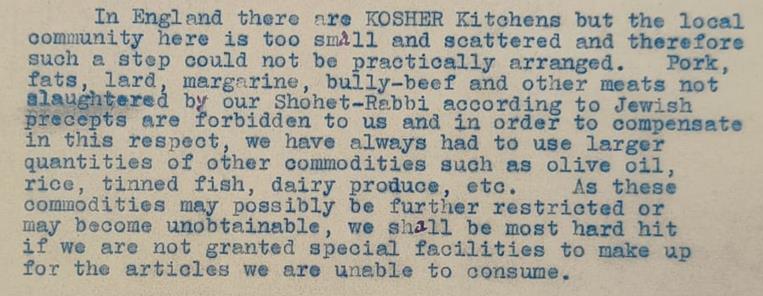
Excerpt from petition by the Jewish Community regarding limitations to their kosher diet (NAM-CSG-1-3168/1942)
The Jewish community at the time was thought to be a merchant community, Calleja Gera noted, and he said that while Malta was under the rule of the Aragonese Crown there was a "much more fluid environment" for the community.
That is, until the community was expelled in 1492 under the terms of the Alhambra Decree - a royal edict by the Catholic monarchs of Aragon and Castille which essentially ordered all Jews to either leave their kingdoms or convert to Christianity.
Asked whether it is possible that much of the community converted to Christianity, Calleja Gera said that there may have been some who converted but noted that it is unlikely that there were many.
"There might be cases where some would claim conversion, however I would not say that was quite common, keeping in mind that Judaism is not just a religion, but a culture. For Christians this is not something we might necessarily understand too well because we have a distinction between our religion and what we do on a daily basis. Being Jewish, especially further in the past, you have a daily structure to live up to and it's not easy to change, even for practical reasons."
By the time the Order of St John arrived in Malta in 1530, the Jewish community was practically non-existent as a result of the pressures put on the them during the Medieval period.
"The more Catholic Malta became under the Knights, the more the Jews did not find a home here," Calleja Gera said.
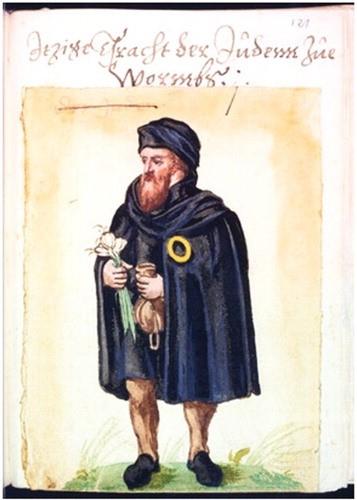
Medieval depiction of a Jew, identified by the coloured 'donut' sewn onto his cloak
Migration of Jews to Malta in the 1930s
It certainly appears that the situation improved as the centuries went by. Calleja Gera pointed out that in the late 1700s - just before the French takeover of Malta - a cemetery for Jewish slaves was opened in Malta; something which implies that there was a community present which was big enough to require a dedicated cemetery.
It's a changing world in 1800 when the British arrived: one which, through global colonialism and imperialism, is more connected than ever before.
This means, Calleja Gera said, that there was more movement of people and more trade. The period of Britain's rule over Malta created an environment which was stable enough for a Jewish community to safely establish itself in, he said, although this is not to say that they were not seen as being different.
The community was definitely established as an organised body: particularly around the Second World War years, the community stepped in to serve as guarantors for prospective migrants and also lodged various petitions during the war years to the British authorities.
The 1930s and the rise of Nazism in Germany together with the annexation of Austria by Hitler's regime made it clear that Europe was becoming more and more hostile to Jews.
Calleja Gera noted that Jews had already been migrating to Malta for economic reasons, but more began trying to make the journey to Malta owing to the course that mainland Europe was taking.
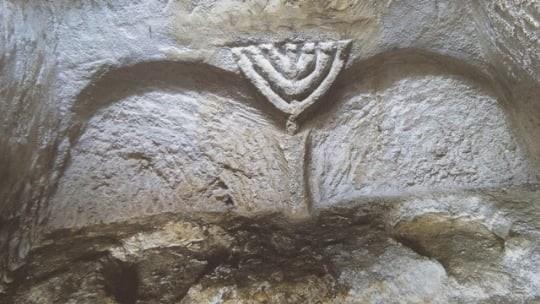
Menorah engraved on a on a Jewish grave in one of Rabat's catacombs
These cases were handled on a case-by-case basis by the British authorities and, after many background checks, they refused entry to these migrants on many occasions.
There is evidence that requests were not always explicitly made because the person wishing to migrate felt their safety threatened on the continent, Calleja Gera said.
He cited one example where prospective refugees applied to immigrate to Malta with the main reason being that they were doctors and they believed that Malta, at the time, needed doctors. The continental situation was mentioned as something of a sidenote.
"My interpretation is that they were putting the main reason for travel as work-related because they believed that this was more likely to get them access to Malta. Unfortunately, in this case they were refused anyway and they were told that there is no more need for non-British doctors on the island," Calleja Gera said.
The same situation happened with those with backgrounds in agriculture and as labourers.
"Whether this was done for legitimate reasons or whether it was in anticipation of having to intern migrants from an enemy country - it's not totally clear," he said.
"When we talk about the British government in Malta we have to remember it is made up of multiple individuals with multiple agendas and oftentimes opposing interests. For instance, the defence element might contradict the needs of the agricultural sector. But when we talk about the build-up to the Second World War, defence and security trumped everything else," he added.
Asked about whether these Jews integrated into Maltese society, Calleja Gera pointed that Malta in the 1930s was a politically diverse place, and that included certain fascist elements like the Union of Maltese Fascists which - while small and, in the grand scheme of things, irrelevant - held anti-Semitic views much like its Italian and British cousins.
"This idea that the Jews are scapegoats definitely existed, however since Malta was a British colony, it was not something really on the official agenda at the time," he said.
This was, however, a small but very organised and vociferous community, Calleja Gera said. "When they were faced with what they perceived as injustices - whether true or not - and practical issues they brought it up as an organised body. They had a committee and they helped each other not just locally but also offered aid to Jews transitioning through Malta to other places," he said.
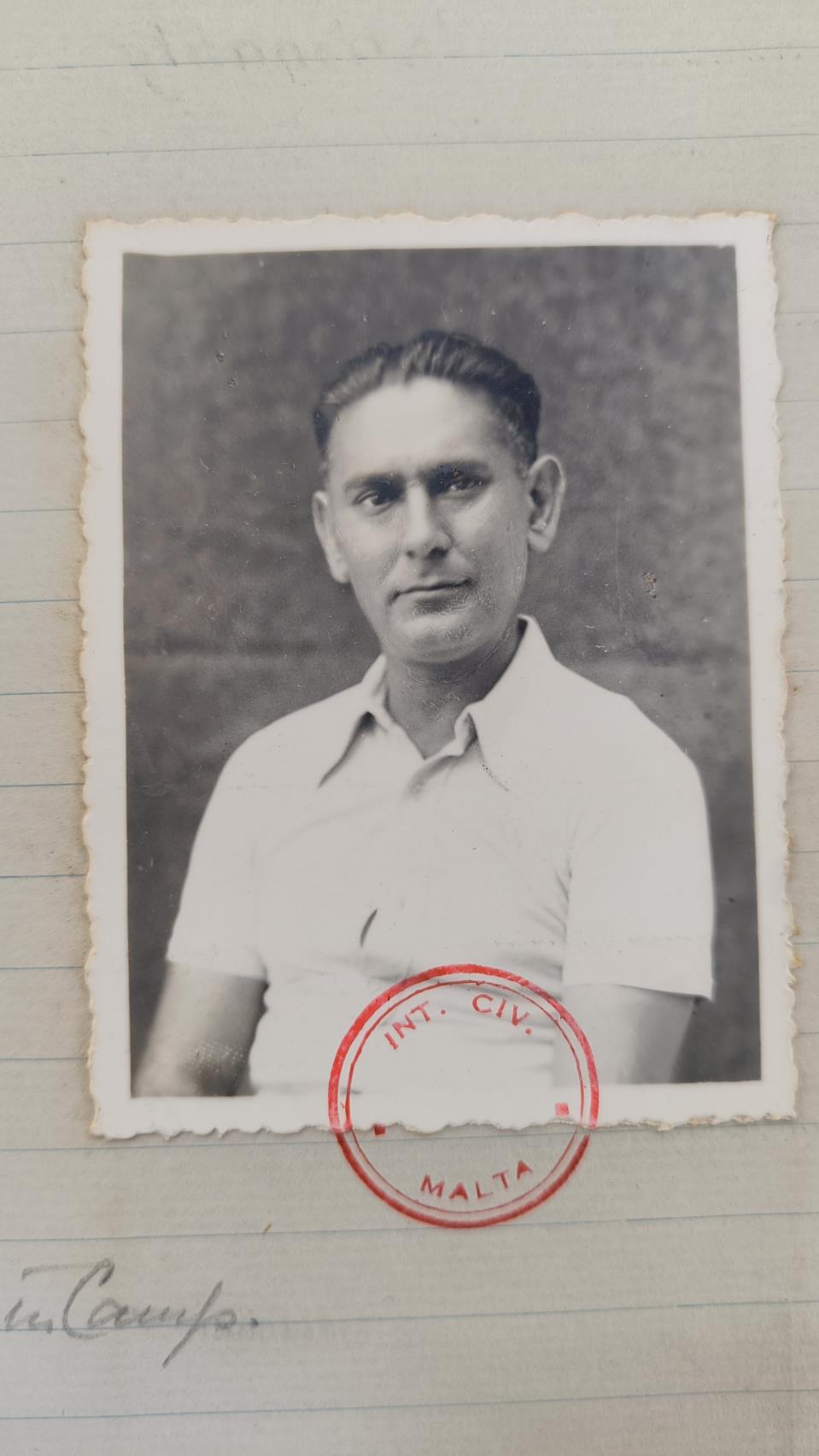
Issi Bielawski a 40-year-old German artist who was interned in September 1939 together with other foreign Jews
The Jews and the Second World War in Malta
When the Second World War did break out, Fort San Salvatore in Kalkara was used as an internment camp and foreign migrants, including Jews, who came to Malta were initially interred there - not because of their faith, but because they were by and large coming from enemy countries such as Germany, Austria, and Italy.
"Some of them had also served in the German and Austrian armies in World War One," Calleja Gera said.
Among those interred at the Fort were also Maltese who the British thought were a bit too close to Italy for their liking - including future Prime Minister Enrico Mizzi and a number of Nationalist Party politicians.
The outcomes for those held at Fort San Salvatore varied, Calleja Gera said: some were released after initial processing, others were kept there for various lengths of time, others were released and then reinterred, and others were deported - like the aforementioned Mizzi and his political colleagues were deported to Uganda.
Records of all those who passed through Fort San Salvatore exist at the National Archives of Malta, and Calleja Gera gave one such anecdote: the story of a certain Mr Issi Bielawski - a 40-year-old German artist who was interned in September 1939 together with other foreign Jews.
The Jewish Community in Malta was petitioning his release from internment even though he was considered an "undesirable character" by the British authorities. He was kept in internment while a colleague artist of his, Mr Rokotnitz, was released in mid-1940.
After release from internment, Jewish refugees had to keep signing a form of bail book and record their conversations. "These people were practically spied on by the Maltese. The Maltese had an interest in protecting themselves and these people were, first and foremost, foreigners from enemy territory, hence making them more suspicious," Calleja Gera said. In July 1941, both Bielawski and Rokotnitz were deported permanently.
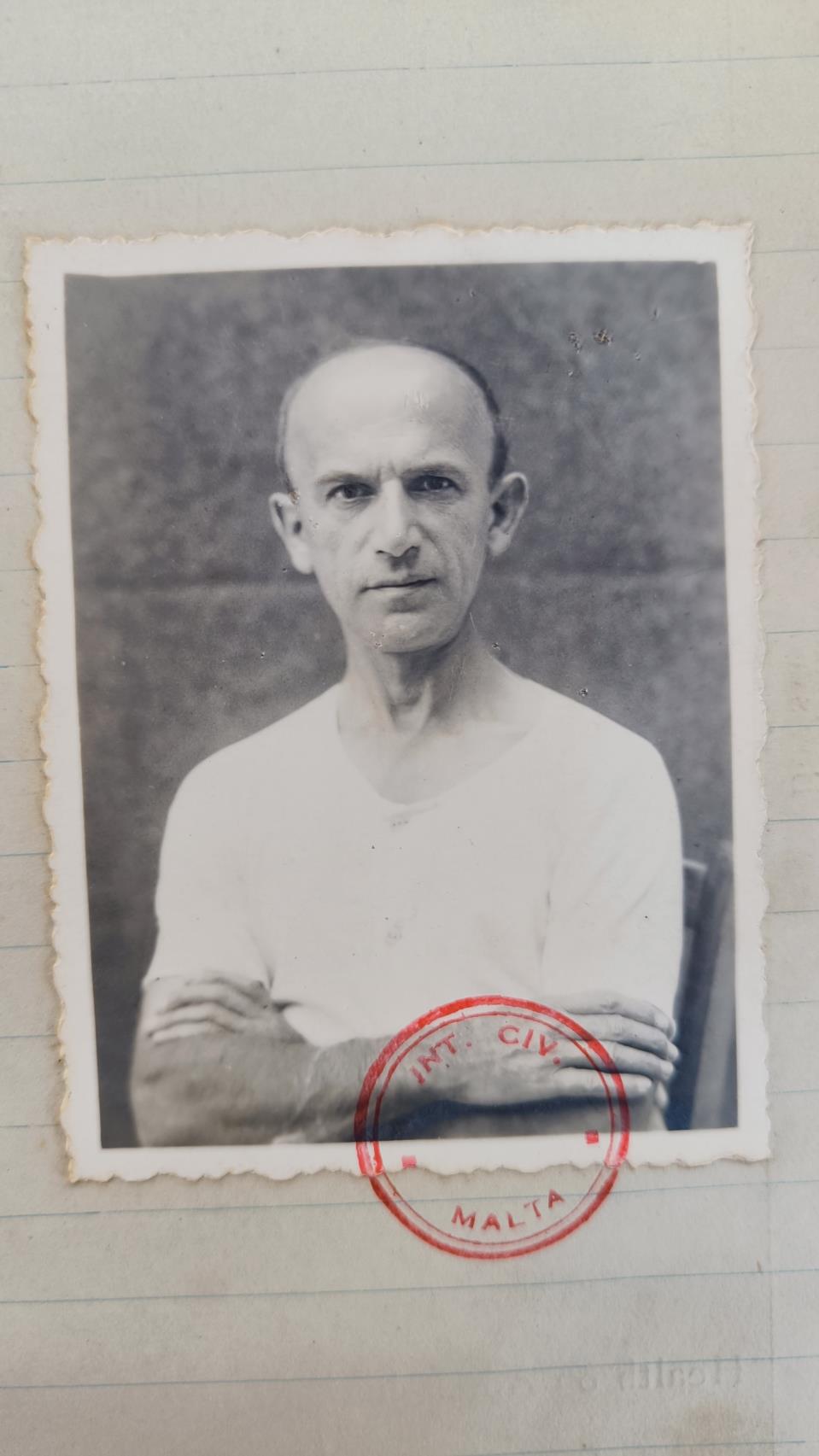
F. Rokotnitz, a colleague to Issa Bielawski
These cases varied, Calleja Gera said, and their outcomes heavily depending on who they were and what they managed to convince the British of: "If you were an established businessman in Malta like the Eder family was then you may be able to have a less difficult route. If you were already a troublemaker or a vagrant without a job then it was a much more difficult to stay here without being interned permanently."
The Jews who were not interned had their own problems to face, Calleja Gera noted.
While Maltese Catholics did not have any particular religious restrictions on what they were eating, the culinary requirements for the Jewish community made having to go through the lack of supplies even more difficult.
"In fact, the Jewish community in Malta petitioned the British government, saying that they do not have enough variation in terms of food to sustain themselves and so they asked to open a Kosher kitchen and sought the potential delivery of more material which they could consume without issue," Calleja Gera said. This petition came in July 1942, when Malta was at its breaking point.
"That raised problems with the British government for both practical and political reasons. Politically they did not want to set a precedent that small communities were being given preference over the state-run Victoria Kitchen, and on a practical basis, it was difficult to bring in supplies in general, let alone specific requests for the 80 individuals who made up the community at the time," he added.
Even to pray, local Jews had to travel into Valletta - which was the hotspot for bombing - because that was where the island's only synagogue was located.
There were similar challenges in Fort San Salvatore, where certain Jews made requests and petitions to the internment authorities to be allowed certain days of fasting, isolation and prayer to align with their religious needs, Calleja Gera noted.
"So it was not life going on as normal - the Jewish community had to keep pressing the government to assist them to keep practicing their faith and culture which are very much tied together," he said.
It is a misconception, Calleja Gera says, that the Jews in Malta were somehow treated better than the Maltese during the war: "They were not treated any better, rather they faced more challenges when it came to surviving the siege."
"We have to keep in mind that the Jewish community in Malta, although small, had a number of obstacles that we don't necessarily think of because we aren't used to them," he said.
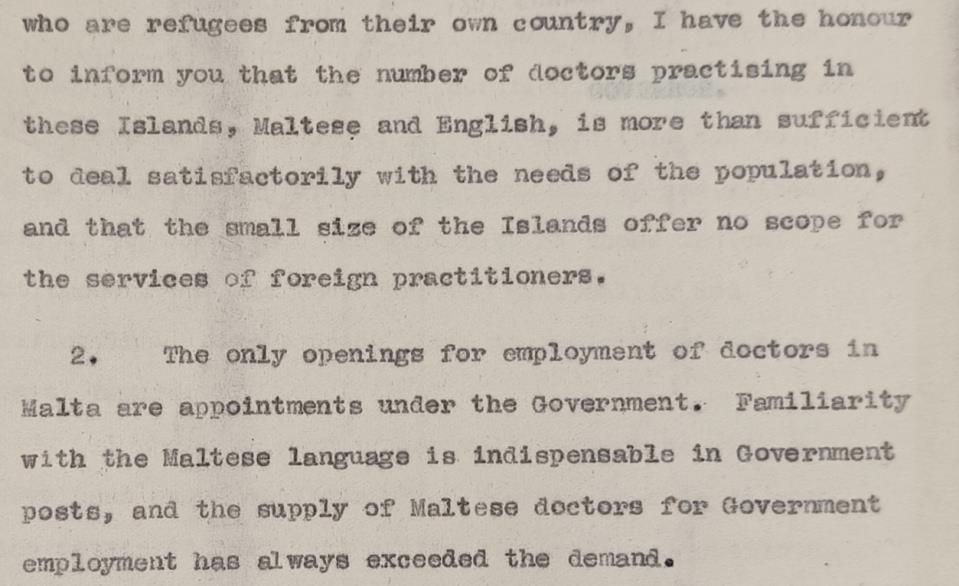
Excerpt from a British communication denying entry to German-Jewish doctors. National Archives of Malta: NAM-CSG-1-2395/1938
What don't we know?
The question of what we don't know yet is one of the most fascinating in any historical genre. There is much still to be uncovered about human history, particularly about minority communities, and Jewish history in Malta is no different.
Asked about what we still don't know about Jewish presence in Malta, Calleja Gera noted that the Medieval period in Malta is filled with uncertainties in general, not just on the Jewish community.
"When it comes to the Second World War, it would be interesting to look at personal written accounts. They do exist - diaries, journals, and so on. There are Jewish families in Malta or who had members in Malta who have records of what they were doing on the island, and these personal accounts are always a revelation," he said.
He continued that we tend to look at history from above - meaning, through the lens of the official accounts by the authorities - but history from below is essential, particularly in the case of numerically outnumbered communities such as the Jews.
"They had a lesser voice and the stories from such individuals can shed more light on the history from above," Calleja Gera said.
This can even come in the form of old photographs, saying that even these can allow historians to make connections. "You'd be surprised how many families have albums of people they know photographed with people they don't recognise, but can then be recognised by the historian or by others" he said.
"Connections can only come about if people come forward and allow historians to conduct research on their family history," he concluded.
Historian Nathaniel Calleja Gera will be addressing the Tayar Foundation's International Holocaust Remembrance Day event on Tuesday 27 January, speaking about the Government's policy on immigration before and during the Second World War.
The event is nearly fully booked, but will be broadcast on the Tayar Foundation's website.
Photos provided by historian Nathaniel Calleja Gera